


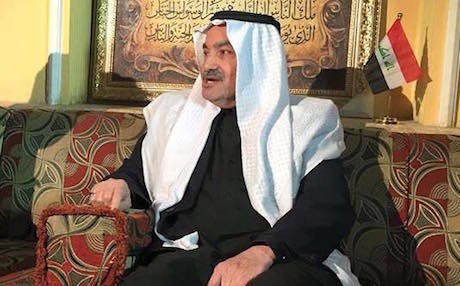
Sheikh Abdulrahman Munshid al-Assi, head of the Arab Political Council in Kirkuk and an influential Sunni figure in the province, says Kirkuk is and will remain an Iraqi city and will never become a part of the Kurdistan Region.
He has good relations with Kirkuk’s Kurdish governor, Najmaldin Karim, but cautioned him when the governor took part in the Kurdish flag celebrations last week. Al-Assi believes “genocide” is taking place at the moment against the Sunni Arabs and accuses Kurdish security forces of assassinating young Arabs. In this interview with Rudaw, he articulates his views about Iraq’s Kurds and Sunnis, the Peshmerga and the fight with ISIS.
Rudaw: Everyone is talking about Kirkuk’s future, but there is no common view in regard to this. What is the Arab view of the future of Kirkuk?
Sheikh Abdulrahman: The Arab view is the most just one. Kurds say it is a Kurdistani city, Turkmen say it is Turkman, but Arabs say it is an Iraqi city and not an Arab city. No Arab official has ever claimed that Kirkuk is an Arab city. And this is our view, which is more realistic than the other groups. We will not take part in the sectarian debate about the future of the city, but defend its Iraqi identity. It is inappropriate for the Kurds to say Kirkuk is Kurdistani, which will divide the communities apart in the city.
Rudaw: Kirkuk’s governor took part in the Kurdish flag celebrations. How did you view that?
 We will not take part in the sectarian debate about the future of the city, but defend its Iraqi identity.
Sheikh Abdulrahman: I have good relations with the governor and I think it was highly inappropriate for him to take part in the event. He is the governor of Kirkuk and should protect the interest of all the groups. He should have raised the Iraqi flag and not the Kurdish, because Kirkuk is part of Iraq and not Kurdistan, even though Kurdish leaders and people keep insisting otherwise. It will never be annexed to the Kurdistan Region and if they forcefully annex it, the stability of the whole of Iraq will deteriorate.
Rudaw: Kurdish youth say they have seen Arab youth raising the Islamic State (ISIS) flag. What is you comment about that?
Sheikh Abdulrahman: Nonsense. It is a new way of targeting the Arabs, accusing them of being ISIS collaborators. Unfortunately, Kurds see every Arab as a potential member of ISIS. It is a big mistake. I don’t think for a second that Arab students would fly the ISIS flag; they simply cannot -- maybe here and there in the streets, but not on the university campus.
Rudaw: How is your relation with the Kurdish leaders in Erbil?
Sheikh Abdulrahman: We have always had good relations with Kurds. We have had strong historical ties with the Barzanis. It is unfortunate that Barzani frequently talks about Kirkuk being a Kurdistani city without taking into consideration historical Arab-Kurdish relations. I think President Barzani should take into account that there are many powerful Arab tribes and clans here in Kirkuk and they deserve his and other Kurds’ respect and recognition. Kurds already have three provinces; is not that enough?
Kurds already have three provinces; is not that enough?
Rudaw: But there are also some Arabs and Turkmen who claim that Kirkuk is a Kurdistani city and should be annexed to Kurdistan?
Sheikh Abdulrahman: We call these people traitors since they do not represent the will of the Kirkuki people. It is not important what these traitors and mercenaries think and say.
Rudaw: The Turkmen insist on Kirkuk being a Turkmen city. Do you fear for an ethnic civil war in the city?
Sheikh Abdulrahman: We the Sunnis have it rough here in the city. Our youths are being terrorised in the streets. There are assassinations of Arab youths. You can visit a police station to verify it. It has increased recently.
Rudaw: Who assassinates the Arab youths?
Sheikh Abdulrahman: There is an on-going “genocide” against the Arabs in Kirkuk. We have been sidelined. The US administration in Iraq favored Kurds in Kirkuk and gave them all the powers. Now Kurds have the upper hand, while they were in the minority earlier. They brought more Kurdish families here and gave them money to settle here. Arabs and Turkmen have been totally ignored. Kurdish parties in Kirkuk are responsible for the political conditions in the city. Still, we are ready for negotiations. We hope the new generation of young Kurds, especially those who return from abroad and have lived in multicultural, tolerant, European societies can change the Kurdish stance on Kirkuk and defend the coexistence of different peoples here.
Rudaw: Do you mean the governor?
Sheikh Abdulrahman: No, he is not young enough to be counted as the new generation.
Rudaw: But even the Arabs and Turkmen have voted for the Kurdish governor.
Sheikh Abdulrahman: The traitors have. Those Arabs and Turkmen who have voted for other lists are counted as traitors. We have been besieged and abandoned. I urge the governor to change course and start a dialogue among all Kirkuk components. The governor should not try to incorporate Kirkuk to the Kurdistan Region, but instead try to develop an approach that is more rooted in Kirkuk. The governor was advocating for a federal Kirkuk Region, which could be realistic if all groups take part in it. We are principally against dividing Iraq into different regions and entities and want to see a unified Iraq. But the governor’s proposal can be of interest for us too, and we can discuss it.
We hope the new generation of young Kurds, especially those who return from abroad and have lived in multicultural, tolerant, European societies can change the Kurdish stance on Kirkuk and defend the coexistence of different peoples here.
Rudaw: We have spoken to Hasan Toran from the Turkman Front and he is happy with the Kurdish leader. Why do you have more objections than the Tukmen?
Sheikh Abdulrahman: I am familiar with Toran’s views, but they represent him, not us. The Arabs are a component of the society in Kirkuk. We have a history here. But we still can live together. We should not allow political leaders to do whatever they want. Kurdish leaders were favouring federalism in the past, but now they are talking about confederalsim. So, it is clear that they want to establish a Kurdish state. Nobody should do what they want with the future of the country or Kirkuk.
Rudaw: Have you -- or will you -- join the fight against the Islamic State?
Sheikh Abdulrahman: The US administration totally sidelined us when it entered Iraq in 2003 and did nor arm our forces. So, we have no troops to fight anyone.
Rudaw: You think things can be different in Kirkuk in a decade?
Sheikh Abdulrahman: I think, if the Kurdish leadership is willing, we can manage great tasks. We are not extremists, we want to coexist. We see Kurds, Christians and Turkmen as our brothers and sisters and as our partners. We have no objection to the 32 percent share of power that has been allocated to us. I really hope our Kurdish brothers come to the understanding that the best solution for Kirkuk is to live peacefully together, which is in the best interest of this province. We have no problems with anyone, but God save us from the Kurdistan Region. In 10 years, there might be genuine peace and prosperity in Kirkuk and Iraq.
Rudaw: Kirkuk’s oil is under Peshmerga control now and is being exported through the Kurdistan Region. How do you see that?
Sheikh Abdulrahman: It was done in the past Iraqi administrations when the oil ministry was honest.
Rudaw: You mean during Maliki?
Sheikh Abdulrahman: The Iraqi government is not the property of Maliki. The Iraqi state connected the Kurdish oil fields with Kirkuk to export it. Kurdistan should export 200,000 bpd through these pipelines. But then it turned out that it was a prearranged plan and there were other intentions. Now, we see Turkey intervenes in the process here and there, and that should not be accepted. But generally I think using the Kurdish pipeline is temporary till things calm down and then there are other ways to export it, for instance through Syria.
In 10 years, there might be genuine peace and prosperity in Kirkuk and Iraq.
Rudaw: How do you see Shiite militias in Kirkuk?
Sheikh Abdulrahman: The Shiite voluntary forces are temporary. We think arms should only be in the hands of the army and police forces. There should be no comprises on that. There are some militias around Kirkuk which pose no threat at the moment. We had an Iraqi army division here in Kirkuk. But who destroyed it?
Rudaw: You mean Peshmerga did that?
Sheikh Abdulrahman Yes, the Peshmerga. They destroyed the 12th division totally and disarmed the Iraqi officers and attacked them. If the Peshmerga meant well, they would have not looted the army division. If the Peshmerga meant to be honest and positive, they would not have destroyed and looted the Iraqi army division in the city. But I think there was a reason all that happened, as if even they (Peshmerga) were part of the plot against Iraq.
Comments
Rudaw moderates all comments submitted on our website. We welcome comments which are relevant to the article and encourage further discussion about the issues that matter to you. We also welcome constructive criticism about Rudaw.
To be approved for publication, however, your comments must meet our community guidelines.
We will not tolerate the following: profanity, threats, personal attacks, vulgarity, abuse (such as sexism, racism, homophobia or xenophobia), or commercial or personal promotion.
Comments that do not meet our guidelines will be rejected. Comments are not edited – they are either approved or rejected.
Post a comment