


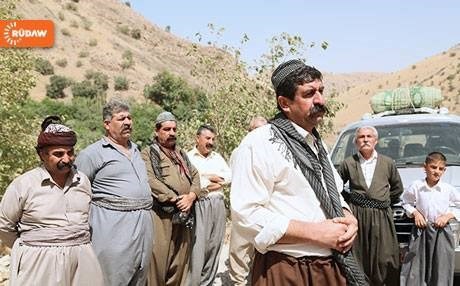
SULAIMANI, Kurdistan Region – A Peshmerga regiment of Kakei Kurds to defend the minority from the Islamic State (ISIS) around Kirkuk remains hampered by political disputes over who would command the unit, according to a Kakei official.
“We collectively selected someone to be the commander of the regiment, but it was rejected by a political party,” claimed Rajab Asi Kakei, head of Kirkuk’s Cultural Center of Yarsan.“
“The party wants to appoint a member of its own. The Minister of Peshmerga is now aware of the issue and he has suspended the process,” he said.
Following the establishment of armed forces from minority groups living in the so-called “disputed territories” in Iraq, 650 Kakeis were entered into training programs in order to build a Kakei armed unit composed of three regiments. But disagreement over a commander between the Kurdistan Democratic Party (KDP) and Patriotic Union of Kurdistan (PUK) has delayed the process.
Although all efforts are now aimed at building a Kakei regiment, it is still unclear whether the Minister of Peshmerga, who is from neither of the two political parties, can resolve the dilemma.
Kakeis are spread over a large swathe of land in Kirkuk, and Asi said: “There is no hill or mountain to separate our areas from those under ISIS control. Therefore, the continued presence of Peshmerga forces in our area is necessary. Kakeis can do this; they will know better than anyone how to defend their areas. The recent events have shown that people are more loyal to their respective areas.”
Kakeis have long lived in the villages of Ali Sarai, Zanqer, Albomuhammed, Albunajim, and several others. They see these villages, which lie in fertile agricultural lands, as the major source of income. Currently ISIS is in control of Albomuhammed and Albunajim.
Sources have told Rudaw that the PUK had not approved the selected commander because of his affiliation with KDP. As a result, the Minister of Peshmerga had decided to appoint Adil Kakei, a former commander in the Iraqi army, as the supervisor of the Kakei regiment for two months until a commander is appointed.
In Nineveh province, ISIS has captured Kakei villages and destroyed of their religious shrines.
Asi confirmed that four Kakei soldiers, serving in the Iraqi Army, are in ISIS captivity. He said they were the only Kakeis held by ISIS.
Kakeis remain concerned about their areas lying close to ISIS positions.
“There is a very short distance between us and ISIS. Yet, Peshmerga forces are stationed behind us, not ahead of us. At nighttime, women and children leave Ali Sarai while men stay to defend it. They have abandoned the plains so that ISIS can attack us,” according to one villager.
Wasta Rasul, a PUK commander in Kirkuk, rejected that the Peshmerga are incapable of protecting the area. “We have protected Kakeis in the last six months in the absence of a Kakei armed unit. There is no threat to them,” he said.
“Out of 130 families in the Albomuhammed village, only 12 are Kakeis and the vast majority of families in Albunajim village are Arabs,” he added.
The commander said he is unaware of any rivalry between the KDP and PUK over command of a Kakei regiment.
Ari Hersin, from the Kurdish parliament’s Peshmerga Committee, said that the issue would be discussed by lawmakers in the presence of the Peshmerga minister.
Hersin expressed concern over the creation of such a force at a time when the Kurdish leadership is engaged in efforts to unify Peshmerga forces.
“All religious and ethnic components of the Kurdistan Region should unite in protecting one another. We will discuss the unification of 70 and 80 forces with the Minister of Peshmerga,” Hersin commented.
Dler Mawati, from the parliament’s Peshmerga Committee, also expressed concerns over the establishment of a Kakei force
“We see the establishment of different militia groups in Iraq, but (in the Kurdistan Region) we have to talk about a national professional force, nothing other than that.”
Comments
Rudaw moderates all comments submitted on our website. We welcome comments which are relevant to the article and encourage further discussion about the issues that matter to you. We also welcome constructive criticism about Rudaw.
To be approved for publication, however, your comments must meet our community guidelines.
We will not tolerate the following: profanity, threats, personal attacks, vulgarity, abuse (such as sexism, racism, homophobia or xenophobia), or commercial or personal promotion.
Comments that do not meet our guidelines will be rejected. Comments are not edited – they are either approved or rejected.
Post a comment