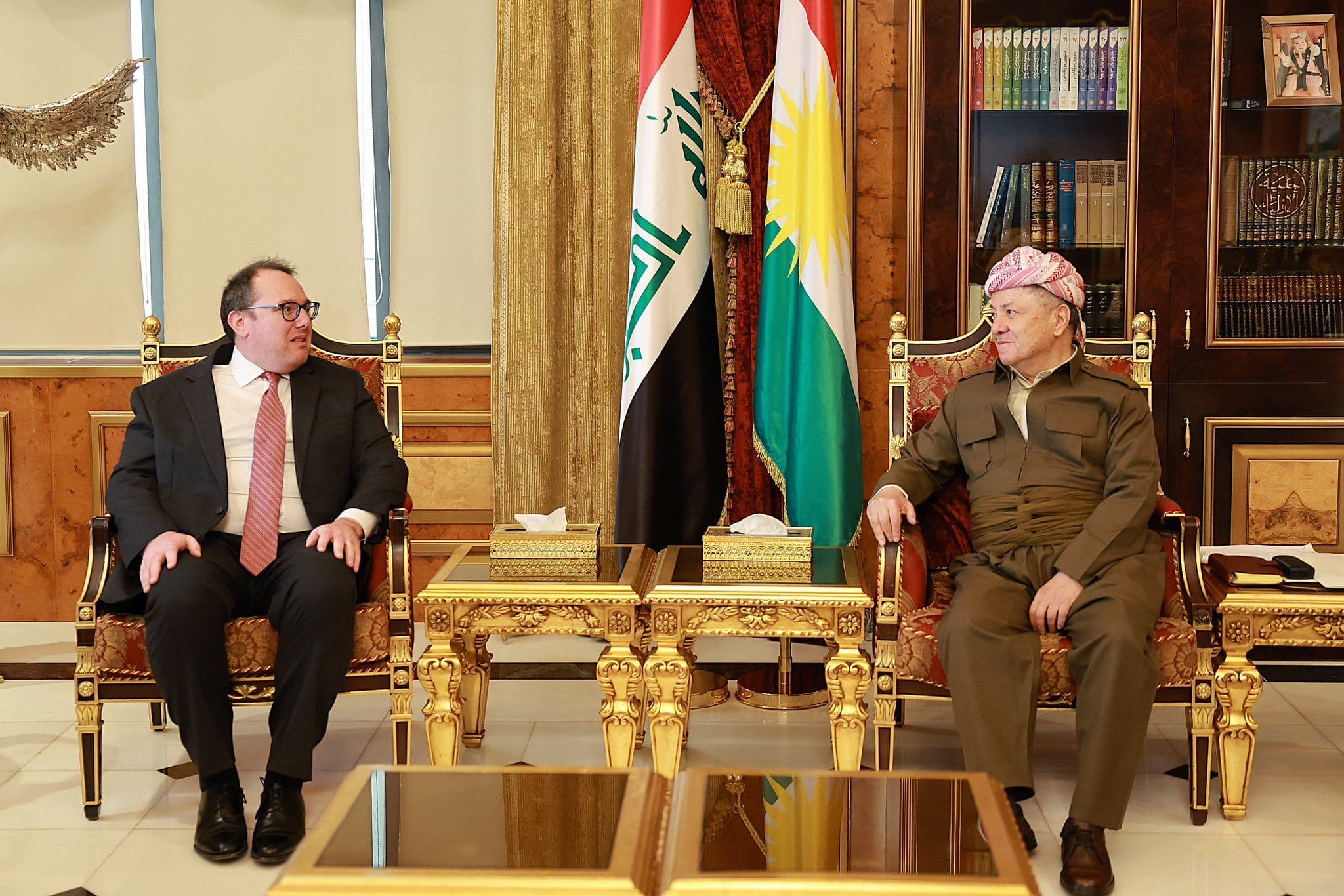
ERBIL, Kurdistan Region - President Masoud Barzani on Sunday received in Erbil the Charge d’Affaires of the US Embassy in Iraq, Joshua Harris, where the two officials highlighted Erbil’s role in supporting a milestone integration agreement between Damascus and the Kurdish-led Syrian Democratic Forces (SDF).
In a statement on Facebook, the Barzani Headquarters quoted the US diplomat as conveying “the thanks and appreciation of the President and Government of the United States to President Barzani for the support and assistance he provided toward reaching the recent agreement between the Syrian [interim] government and the Syrian Democratic Forces (SDF).”
Hours earlier, the preeminent Kurdish leader hosted SDF Commander-in-Chief Mazloum Abdi.
In a previous statement, the KDP leader’s office said the discussions focused on “the latest developments in Syria and the steps for implementing the agreement” between Damascus and the SDF.
The Kurdish-led forces announced on Friday that it had reached an agreement with Syria’s interim government in Damascus on the future of northeast Syria (Rojava), including the integration of its civilian and military institutions into the Syrian state.
The deal followed a large-scale offensive by the Syrian Arab Army and allied forces against SDF positions in mid-January, which prompted the Kurdish-led forces to gradually withdraw from several areas, including parts of Aleppo, Deir ez-Zor, Raqqa, and regions near Hasaka, the predominantly Kurdish province in eastern Rojava.
Many of these territories had previously been liberated by Kurdish-led fighters from the Islamic State (ISIS) following the group’s declaration of a so-called caliphate in Syria and Iraq in 2014.
The preeminent Kurdish leader also held talks on Saturday with Syrian interim President Ahmed al-Sharaa, during which similar issues were discussed.
On the Iraqi front, President Barzani and Harris “exchanged detailed and in-depth views on the political process in Iraq, emphasizing the importance of adhering to the constitution” and agreed “on the necessity for Iraqis themselves to decide the affairs of their country, based on partnership, balance, and consensus.”
The statement added that “both parties welcomed the recent dialogues and consultations held in Baghdad, aimed at developing political mechanisms and scenarios that consider the interests of the Iraqi people and strengthen the US-Iraq partnership across various fields.”
Iraq held early legislative elections on November 9, followed by general voting on November 11. The final results were announced in mid-November and ratified by the country’s highest judicial authority, the Federal Supreme Court, in mid-December.
Since 2003, an informal power-sharing system has allocated the parliament’s speakership to Sunni Arabs, the premiership to Shiite parties, and the presidency to the Kurds.
Under Iraq’s constitution, the president must be elected within 30 days of the first parliamentary session. Once sworn in, the president has up to 15 days to task the nominee of the largest parliamentary bloc with forming a government.
The Iraqi parliament earlier on Sunday postponed a scheduled session to elect a new president of the country.
Kurdistan Region Prime Minister Masrour Barzani remarked that the country's two biggest Kurdish parties - the KDP and the Patriotic Union of Kurdistan (PUK) - have yet to reach an agreement on a joint candidate for Iraq’s presidency.
For its part, Iraq’s ruling Shiite Coordination Framework said Saturday it remains committed to nominating former prime minister Nouri al-Maliki (2006-2014) as its candidate for the premiership.
The bloc reiterated its support days after US President Donald Trump warned on Tuesday that Maliki, a longtime ally of Tehran, was a "very bad choice,” adding that if he is elected the US will no longer help Iraq.