


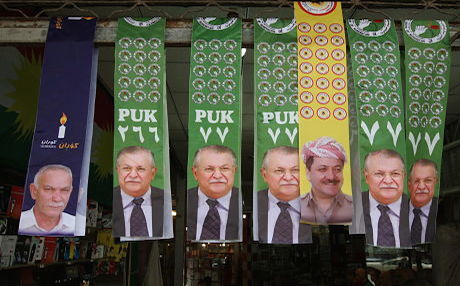
ERBIL, Kurdistan Region – Senior members of the Patriotic Union of Kurdistan (PUK) say they are reluctant to formally abolish the Strategic Agreement with the Kurdistan Democratic Party (KDP), despite the political upheaval since the September polls.
The PUK came close to collapsing, after its leader Jalal Talabani suffered a heart attack in December 2012 and the party lost to the rival Change Movement (Gorran) in the Kurdish polls last September.
The PUK’s coveted place in the incoming Kurdistan Regional Government (KRG), alongside the KDP, is now going to Gorran.
Nevertheless, “PUK leaders are reluctant about abolishing the agreement,” said a PUK leadership member.
Although the agreement has not been formally annulled, one of its major conditions has been ignored. The accord stipulates that the PUK and KDP must participate in elections as a single alliance, which was not done in the September polls.
Therefore, “the agreement does not hold the power it used to” said Fareed Asasard, a senior PUK official. “The political agreements do not have to be formally abolished. Agreements abolish by themselves,” he added.
“Now, PUK and KDP see that their agreement has faded. Now, there are major disagreements between both parties on the issues of Turkey, Syria, Iran, (Iraqi Prime Minister Nouri) Maliki, and PKK,” said Asasard.
The Strategic Agreement was signed in 2007 between PUK and KDP, stating that administrative and government posts are to be divided between both parties.
Senior PUK officials have frequently voiced concern about the provisions of the agreement. They have claimed it has harmed PUK’s interests to serve those of KDP’s.
The issue of withdrawing confidence from Maliki’s cabinet in 2012 further deepened the gap between signatories of the agreement. KDP leader Massoud Barzani insisted that Maliki must leave office, but Talabani refused to sign the bill calling for his removal from office.
In the April 30 Iraqi parliament elections – and local elections in Kurdistan -- the PUK made a comeback from its earlier poll loss.
Now, the party says it is back on its feet, this time stronger than ever. PUK leaders say they have “learnt to run the party without Talabani.
The majority of political observers had believed that the PUK would collapse in Talabani’s absence.
The PUK is now eyeing the post of Iraqi president, which is held by the absent Talabani.
Asasard believes the presidency will be given again to the PUK. “However, it won’t be the end of the world if PUK does not get that post, either,” he said.
Asasard said the party was considering five candidates: Barham Salih, Adil Murad, Najmaldin Karim, Adnan Mufti, and Fuad Masoum.” “Salih is the strongest candidate,” he added.
Saadi Ahmed Pira, a senior member of the PUK’s leadership, said that a party convention would take place after the Iraqi and Kurdish governments, as well as the provincial councils, had been formed.
The scheduled convention for January 31, 2014 failed to take place due to PUK’s internal conflicts. Salih and Kosrat Rasul, both deputies of the general secretary, had insisted the PUK must convene as scheduled. However, the wing led by Hiro Ibrahim Ahmed, who is also Talabani’s wife, had insisted the convention must take place after the April elections.
“Those who believed the convention should take place after the election won. PUK scored high in the elections,” Pira said.
However, no timeframe has been set for holding the convention, even though the elections are over.
“PUK will hold its first convention without Talabani. Major changes will take place in the convention” said Asasard.
“Although the time has not been set, I believe the convention will take place in the last three months of the current year. There is a widespread belief that PUK must not divert its attention to the convention, while the three governments are being formed,” Asasard said.
Comments
Rudaw moderates all comments submitted on our website. We welcome comments which are relevant to the article and encourage further discussion about the issues that matter to you. We also welcome constructive criticism about Rudaw.
To be approved for publication, however, your comments must meet our community guidelines.
We will not tolerate the following: profanity, threats, personal attacks, vulgarity, abuse (such as sexism, racism, homophobia or xenophobia), or commercial or personal promotion.
Comments that do not meet our guidelines will be rejected. Comments are not edited – they are either approved or rejected.
Post a comment