


By Vanessa Powel
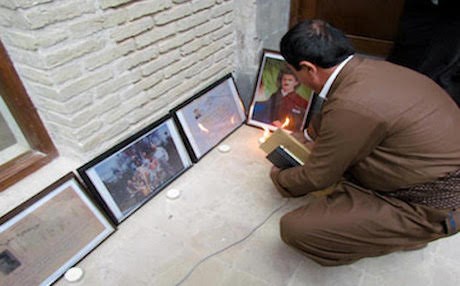
ERBIL, Kurdistan region – In a landmark ceremony held at the historic citadel in downtown Erbil on Wednesday, religious leaders from five different faiths met to commemorate the 71st anniversary of the deportation of Jews from Iraq.
Representatives of different faiths lit candles in front of historical photographs of Iraqi Jews.
Described as a “forgotten Holocaust”, it was 71 years ago that Jewish communities in Iraq were ransacked. Temples were pulled down, and Jews were stripped of their citizenship rights and all possessions according to a statement read out at the ceremony by Sherzad Mamsani, Director of Kurdistan’s Jewish Affairs.
“Iraq lost an important part of this diverse past 71 years ago and we must remember the tragic expulsion the Jewish people of Iraq suffered,” said Henry Haggard, U.S. Deputy Principal Officer who also spoke at the ceremony.

The policy known as “Farhud”, meaning violent dispossession in Arabic began in June 1941 when orders were given to deport Jews from Mesopotamia. A pro-German government had formed in Iraq at the time, opposed to British rule, giving rise to anti-Semitism and Nazi influence in the region.
In June 1948 the deportation, torture and murder of Jews in Iraq began, according to Mamsani.
An estimated 200,000 Jews were deported from the area during this time. By 1951 nearly all Jews had been relocated to the State of Israel.
It has only been in the last two years that the Kurdistan Regional Government has supported a policy of Jewish revival through the appointment of a Jewish representative to the Ministry of Endowment and Religion Affairs.

“The history of Iraq is also the history of the Jewish people. The Jewish people played a leading role in Iraqi society and helped make Iraq what it is today,” said Haggard.
“I am heartened that the Jewish community that played such a vibrant and important role in Iraq’s history 2600 years is returning to the Iraqi Kurdistan region,” he said.
Outside, on the steps of the citadel, a handful of Jewish men openly pose for photos wearing their kippah (Jewish cap) without any fear.
Kak Mansour, whose grandfather was Jewish but himself Muslim, proudly wears the kippah in tribute to his Jewish ancestral roots.

“My grandfather was Jewish”, he says.
Religious minorities have always coexisted alongside one another in Kurdistan.
One of the effects of the coming of ISIS is that it has forced different faith groups to work together more closely and cooperatively.
Representatives of Yezidis, Zoroastrians, Christianity and Islam were all present at the ceremony alongside representatives of the Kurdish Jewish community.

Comments
Rudaw moderates all comments submitted on our website. We welcome comments which are relevant to the article and encourage further discussion about the issues that matter to you. We also welcome constructive criticism about Rudaw.
To be approved for publication, however, your comments must meet our community guidelines.
We will not tolerate the following: profanity, threats, personal attacks, vulgarity, abuse (such as sexism, racism, homophobia or xenophobia), or commercial or personal promotion.
Comments that do not meet our guidelines will be rejected. Comments are not edited – they are either approved or rejected.
Post a comment