
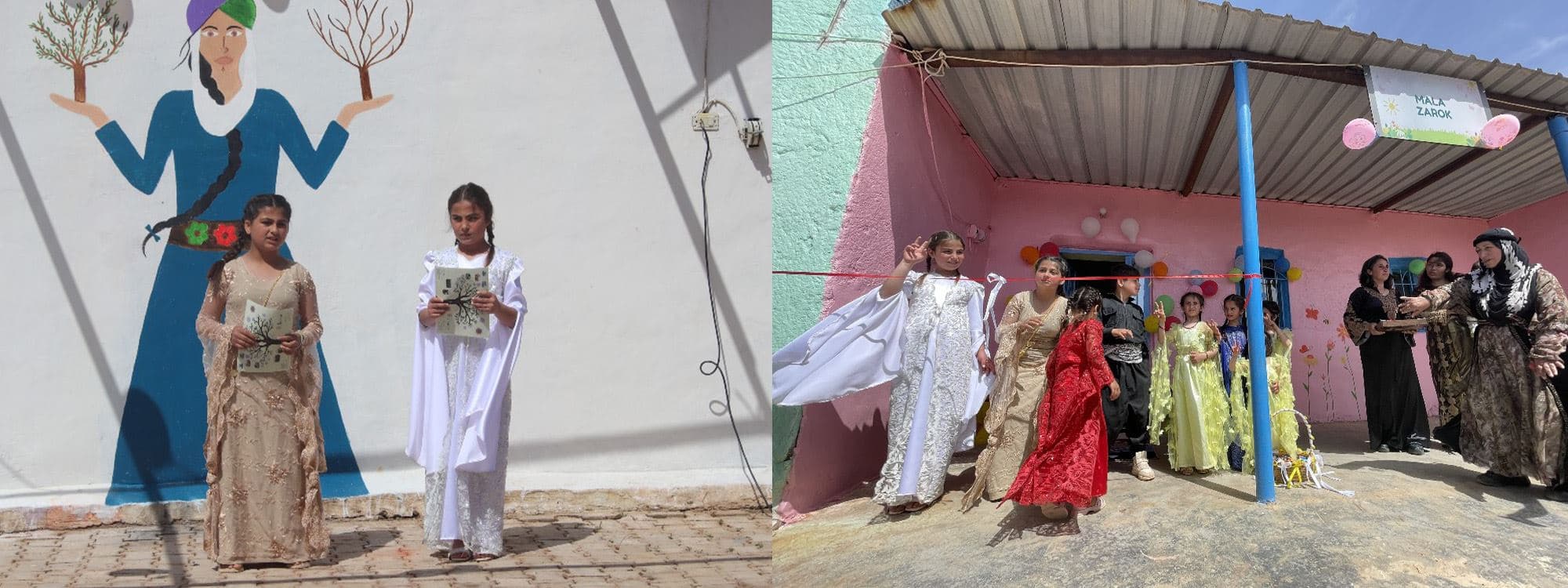

ERBIL, Kurdistan Region - A recently launched project in the Kurdish-held northeast Syria (Rojava) aims to educate a group of children and prepare them to become leaders of their generation.
Jinwar, which means women’s land in Kurdish, was introduced in 2016 and inaugurated two years later. It is a village for women and children. Located in Hasaka province’s Dirbesiye subdistrict, the project "is a place for women who want to live a free life with other women and children, women who do not want to get married, women who lost their husbands in war or who were facing violence in their families," according to its official website.
Jinwar announced Children’s House on April 4.
“We have 15 children. All are girls except for a nine-year-old boy. We fund the project with revenues of the village, including money gained from agriculture,” Yasmine Ahmed, the head of the initiative, told Rudaw English days later, adding that the Kurdish-led autonomous administration in Rojava also provides them with logistic support.
She noted that the project's aim is not only to provide children with opportunities to play and learn but also to equip them for the future.
When these children grow up with this kind of education, they will think differently and be equipped with both scientific and ideological skills, she added, noting that they will also be able to pass on their knowledge to others outside the village.
Jinwar has made headlines since its establishment due to the uniqueness of the initiative. The project is founded on the principle of self-sustainability and aims to provide women with a safe, violence-free environment. It serves as a sanctuary for those who have fled domestic violence or war. While men are welcome to visit, they are not permitted to reside in the village. Boys who accompany their mothers are allowed to live in the village until getting married.
Yasmine said they want the children to act like teachers to those living outside the village once their education is done.
“We are now their teachers, but one day they will be our teachers. We envision such a future, and we believe it will become a reality. The future of Jinwar’s children should be distinctly different, built on a unique system of organization and ideology,” she stressed.
“At Jinwar, we want our women and children to be unique. We do not want them to be like others who grow up with a capitalist ideology and live in a society with a lack of communal life, love, and justice,” she stated, adding that when these people are educated, they will be dispatched outside the village to “create a free and democratic society.”
Photos submitted by: Rojava Information Center (RIC)