


By Salam Hadi
The day I submitted to being a solider and put on the khaki uniform, the rebel youth in me started to die. It was 1988 and I had just been released from Abu Ghreib prison on an amnesty. The same amnesty also exempted me from military service. I was willing to spend several more years in prison as long as I could avoid the army.
But around the end of1989 the Baath party suddenly changed its mind and sent tens of thousands of people like me to army bases across the country on decree No. 737. No one had any clue that this was part of preparations for the invasion of Kuwait. Personally I didn’t care if Iraq wiped Kuwait off the map. I was only thinking about how I prided in the fact that I had been a political prisoner and how I never served in Iraq’s military. That’s why I was totally devastated and became a different man when that pride was shattered.
Not only me, Kurds were all in a state of defeat in 1989. The Anfal, the destruction of the villages and the routing of Peshmerga had killed in the Kurds the spirit of rebellion. People had turned into a flock of sheep. The Baath government no longer needed to raid someone’s home in the middle of the night in order to arrest him. The security services would simply send a message and you would go to them on your own feet.
My parents were terrified. They would tell me that if I didn’t answer the call and join the military the government would raze the house over their heads. They were telling me that I had just come out of prison and if I defied the government the next time they would disappear me for good. My mother was saying don’t make me go and beg at the doors of the security police again. “The entire two years you were in prison I didn’t enjoy a single meal,”
I was sent to a military base in Shingal (Sinjar) where I saw many of my former fellow inmates, former Peshmerga and villagers who had sheltered the Peshmerga all their lives. But no one dared to talk to anyone else. The days of talking politics in prison were gone. Anfal and Halabja had broken the back of the Kurds.
I had grown up in a low-income neighborhood in Sulaimani city. Our neighborhood was called Qarachawa (gypsies) and it was looked down upon by everyone else in the city. I don’t know why being a gypsy should be a shame.
As soon as it was dark Peshmerga fighters would infiltrate our neighborhood and people would bring them food and water and listen to their stories. My father was always glued to his radio, desperately looking for “the station” while constantly cursing under his lips. In that environment a young boy like me could not dream of becoming a doctor. Even in class, the teacher would be talking and I would draw pictures of Peshmerga. It was clear where I was headed. But I was too young and therefore I was counting the days until I was old enough to be accepted by the Peshmerga when I join them. That was my ultimate dream.
In the end, to fulfil my dream and burn all the bridges back to city life I decided to become a lone wolf and carried out an act against the regime at the age of 16. That’s how I ended up in Abu Ghreib prison.
My issue against military service was not that I was joining an army that had just razed all the villages of my country, dried the rivers and destroyed a thousand-year-old environment. My problem with the army had some philosophical reasoning too.
The training that you go through as a soldier and the atmosphere they put you through strips you of your individuality and melts you into the mould of the army. You will no longer be you and become nothing but a cog in a giant machine. Dressing like thousands of others, eating with thousands of others and training and looking like them deprives you of whoever you are and makes you part of a sheep herd.
One thing that the army kills first is your free spirit and self-confidence. I had to pay this heavy price for an army that wasn’t mine and for a country that wasn’t mine.
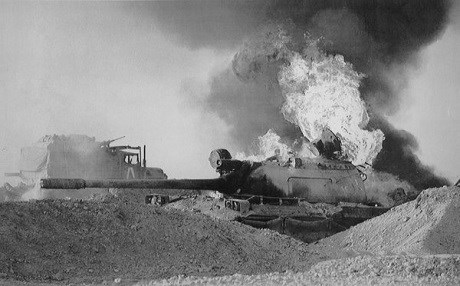
For me, the happiest day of my life as a soldier was the day our “dear commander-in-chief” made the mistake of sending his army into Kuwait. I was one of those soldiers and I entered Kuwait on a tank from Safwan. I knew very well that the giant had just stepped into a trap and that he won’t come out of it easily. I couldn’t wait to see the army I was part of completely destroyed.
I had been transferred in May to the tank battalion of the fifth division in Zubair southwest of Basra. From that day until the army marched into Kuwait in August the number of soldiers and reinforcements was increasing in the area day after day.
I had immense anxiety and was seriously worried about losing my mind. I saw no light at the end of the tunnel. There was no way out of the army other than perhaps suicide. But suddenly there was the invasion of Kuwait which sprouted new hope in my heart. Unbelievable!
We had been training on protection against chemical weapons. No one knew what was going until the day hundreds of thousands of us marched into Kuwait.
I knew very well that the fate of the Iraqi army would be what we saw soon afterwards. That’s why, when two months after the occupation of Kuwait, we could take home leave, I came home and began waiting for the annihilation and end of that army.
Comments
Rudaw moderates all comments submitted on our website. We welcome comments which are relevant to the article and encourage further discussion about the issues that matter to you. We also welcome constructive criticism about Rudaw.
To be approved for publication, however, your comments must meet our community guidelines.
We will not tolerate the following: profanity, threats, personal attacks, vulgarity, abuse (such as sexism, racism, homophobia or xenophobia), or commercial or personal promotion.
Comments that do not meet our guidelines will be rejected. Comments are not edited – they are either approved or rejected.
Post a comment