


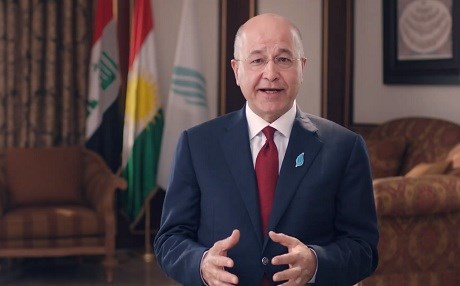
ERBIL, Kurdistan Region – In a new campaign video released on Sunday, Barham Salih, head of the Coalition for Democracy and Justice (CDJ), has pledged to end the salary saving system and to pay back the withheld salaries of the Kurdistan Region’s public sector workers in under four years.
“[The] future of our country is unclear and is under threat. But criticism and [expressing] desperation is not enough. The important thing is the solution,” Salih said in a new Facebook video. He said the CDJ has an “all-inclusive and realistic” agenda.
Salih, a former prime minister of the Kurdistan Region, accused officials of the Kurdistan Regional Government (KRG) of pursuing the “wrong policy” and of causing the financial crisis.
He promised to end “the oppression of the salary saving system and compensate your confiscated salaries within four years.”
The KRG has implemented a series of austerity measures to fill the financial gap left when Nouri al-Maliki, then prime minister of Iraq, stopped sending the salaries of the region’s civil servants in 2014. This was quickly followed by the war with ISIS, which required the KRG to bolster the budget for the Peshmerga at the expense of other departments.
Salih also promised to match the salaries of the Peshmerga with those of the Iraqi armed forces.
Salih held office as a member of the Patriotic Union of Kurdistan (PUK) before he split to form the CDJ. This had led some PUK officials to criticized Salih for claiming the “achievements” of the PUK as his own, including job creation, long-term personal debt relief, and the sponsorship of higher education students pursuing their studies abroad.
On Sunday, Salih announced his roadmap for creating jobs in collaboration with international agencies and the UNDP.
If his party gains enough seats it can preserve Kurdish rights, he insisted.
“We can have a leading role in formation of Iraqi new government on the bases of preserving [Kurdistan] Region’s constitutional rights,” he said.
“[The] future of our country is unclear and is under threat. But criticism and [expressing] desperation is not enough. The important thing is the solution,” Salih said in a new Facebook video. He said the CDJ has an “all-inclusive and realistic” agenda.
Salih, a former prime minister of the Kurdistan Region, accused officials of the Kurdistan Regional Government (KRG) of pursuing the “wrong policy” and of causing the financial crisis.
He promised to end “the oppression of the salary saving system and compensate your confiscated salaries within four years.”
The KRG has implemented a series of austerity measures to fill the financial gap left when Nouri al-Maliki, then prime minister of Iraq, stopped sending the salaries of the region’s civil servants in 2014. This was quickly followed by the war with ISIS, which required the KRG to bolster the budget for the Peshmerga at the expense of other departments.
Salih also promised to match the salaries of the Peshmerga with those of the Iraqi armed forces.
Salih held office as a member of the Patriotic Union of Kurdistan (PUK) before he split to form the CDJ. This had led some PUK officials to criticized Salih for claiming the “achievements” of the PUK as his own, including job creation, long-term personal debt relief, and the sponsorship of higher education students pursuing their studies abroad.
On Sunday, Salih announced his roadmap for creating jobs in collaboration with international agencies and the UNDP.
If his party gains enough seats it can preserve Kurdish rights, he insisted.
“We can have a leading role in formation of Iraqi new government on the bases of preserving [Kurdistan] Region’s constitutional rights,” he said.
Comments
Rudaw moderates all comments submitted on our website. We welcome comments which are relevant to the article and encourage further discussion about the issues that matter to you. We also welcome constructive criticism about Rudaw.
To be approved for publication, however, your comments must meet our community guidelines.
We will not tolerate the following: profanity, threats, personal attacks, vulgarity, abuse (such as sexism, racism, homophobia or xenophobia), or commercial or personal promotion.
Comments that do not meet our guidelines will be rejected. Comments are not edited – they are either approved or rejected.
Post a comment