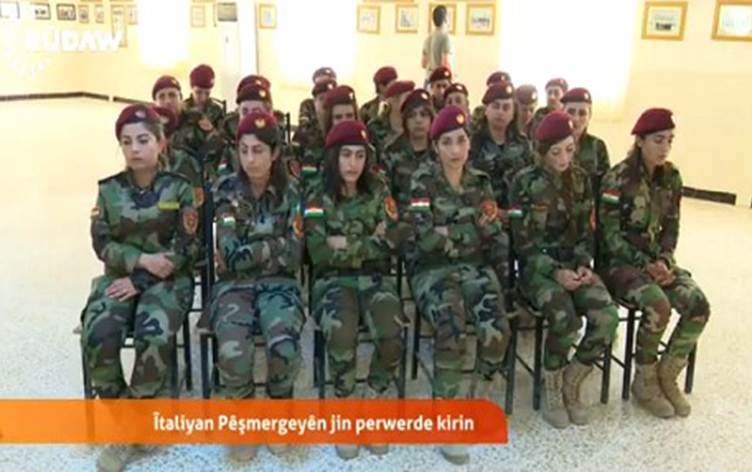



ERBIL, Kurdistan Region- At least 26 female Peshmerga from Syrian Kurdistan (Rojava) have received a month of training on combat tactics and advanced weapons by Italian military personnel.
Jihan Yasmin, a native of Qamishli, has been a Peshmerga for four years and taken part in many battles against the self-claimed Islamic State (ISIS).
In addition to the use of new weapons she learned first aid skills to help comrades in battle.
“We have learnt a lot from this training, such as providing first aid for the injured and how to use advanced weapons,” she told Rudaw. “It was such a useful training.”
Thousands of male and female Peshmerga from Syrian Kurdistan have undergone training in the Kurdistan Region in the last four years—since the start of the Syrian civil war—to participate in future defense of the country’s Kurdish areas.
The training of the female Peshmerga of Rojava was overseen by the Zeravani Special Forces, whose commander General Aziz Waisi, said was crucial for border protection and other military tasks guarding outposts, combat planning, and defusing booby traps.
Italian military advisors and trainers have worked with the Kurdish forces since the start of the war against ISIS in the summer of 2014 and they have so far trained more than 5,000 Peshmerga.
One Italian trainer told Rudaw that the Peshmerga were picking up the new skills and knowledge of advanced weapons quickly, adding “Our training had a major role in strengthening the Peshmerga fighters.”
High-ranking Italian defense officials have visited the Kurdistan Region in the last two years to oversee their contribution to the anti-ISIS contribution, among them Defense Minister Roberta Pinotti who arrived in Erbil last month to meet Kurdish military officials and training camps.
Jihan Yasmin, a native of Qamishli, has been a Peshmerga for four years and taken part in many battles against the self-claimed Islamic State (ISIS).
In addition to the use of new weapons she learned first aid skills to help comrades in battle.
“We have learnt a lot from this training, such as providing first aid for the injured and how to use advanced weapons,” she told Rudaw. “It was such a useful training.”
Thousands of male and female Peshmerga from Syrian Kurdistan have undergone training in the Kurdistan Region in the last four years—since the start of the Syrian civil war—to participate in future defense of the country’s Kurdish areas.
The training of the female Peshmerga of Rojava was overseen by the Zeravani Special Forces, whose commander General Aziz Waisi, said was crucial for border protection and other military tasks guarding outposts, combat planning, and defusing booby traps.
Italian military advisors and trainers have worked with the Kurdish forces since the start of the war against ISIS in the summer of 2014 and they have so far trained more than 5,000 Peshmerga.
One Italian trainer told Rudaw that the Peshmerga were picking up the new skills and knowledge of advanced weapons quickly, adding “Our training had a major role in strengthening the Peshmerga fighters.”
High-ranking Italian defense officials have visited the Kurdistan Region in the last two years to oversee their contribution to the anti-ISIS contribution, among them Defense Minister Roberta Pinotti who arrived in Erbil last month to meet Kurdish military officials and training camps.
Comments
Rudaw moderates all comments submitted on our website. We welcome comments which are relevant to the article and encourage further discussion about the issues that matter to you. We also welcome constructive criticism about Rudaw.
To be approved for publication, however, your comments must meet our community guidelines.
We will not tolerate the following: profanity, threats, personal attacks, vulgarity, abuse (such as sexism, racism, homophobia or xenophobia), or commercial or personal promotion.
Comments that do not meet our guidelines will be rejected. Comments are not edited – they are either approved or rejected.
Post a comment