



Error occured during this request! Please try again later.
AINKAWA, Kurdistan Region — When a two-meter tall stone relief from Nimrud fetched nearly $31 million at an auction in New York, descendants of the Assyrian Empire took the news with sorrowful pride.
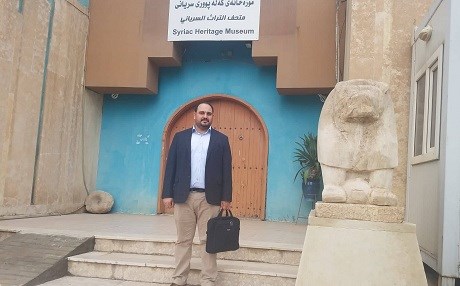
"For every Assyrian Chaldean Syriac people, we felt very sad because this is our heritage and history that is now selling in the world's auction. It gave us a lot of pain," said Kledo Ramzi, manager of the Syriac Heritage Museum in the Kurdistan Region's capital.
Ramzi, 35, is a native of Ainkawa, a Christian neighborhood in Erbil.
On October 31, an anonymous buyer at Christie's auction house paid $30,968,750 for a gypsum relief from the reign of Ashurnasirpal II (c. 883-859 BC). It originated from the Northwest Palace at Nimrud.
Christie’s called it “the finest example of Assyrian art to have come onto the market in decades."
The ancient city of Nimrud is located 33 kilometers south of Mosul, in Nineveh province. In 2014, ISIS swept through much of northern and western Iraq.
"Nimrud is a unique place for all of our people. I visited Nimrud twice after occupation and conquering of ISIL [ISIS]. There are some very simple statues remaining inside of Iraq in the Nimrud area, but unfortunately all the others are destroyed or hidden by ISIL," Ramzi added.
Around 400,000 Christians fled into the Kurdistan Region fearing persecution from ISIS. About half have left Iraq, with some 100,000 still in the Kurdistan Region and others returning to their areas. Iraq has not held a census since 1987, when 1.5 million Christians were counted.
"We feel we built this civilization not only for this land or for this country, but for the whole world and now it's destroyed by some people who didn't accept civilization," Ramzi explained.
Baghdad argued unsuccessfully before the auction that the 3,000-year-old frieze was protected by the Iraqi Antiquities Law.
The Assyrian king's palace was unearthed by British archaeologist Sir Austen Henry Layard. An American missionary, Henri Byron Haskell, acquired the panel from Layard in 1859, according to Christie's. Nimrud was part of the Ottoman Empire prior to Iraq becoming a British mandate in 1920.
Cultural destruction in the Middle East did not start with ISIS, leaving many to argue relics are best preserved outside of the country.
"This is what we call a 'kanz turathi' (cultural chest) in Arabic. This is a very expensive chest for the Iraqi government not only for the Assyrian and Chaldean people," Ramzi said.
Ramzi worries his peoples' history is falling into the black market.
"Preservation should be a priority of the Iraqi government because it's not only our heritage it is a national heritage. At the same time we know all these statues in the big and Western museums are preserved but for us we should think of it from a national perspective not from a pretty perspective," Ramzi implored.
"Here in the KRG we had a good budget from 2010 to 2013," he explained. "We need a team of volunteers including those in the diaspora to promote this heritage."
The Syriac Heritage Museum is the only for Assyrians in Iraq. Ramzi said it is up to Iraq's directorate of Syriac studies to decide what cultural support they want to provide in Nineveh.
"For now, we need to preserve what remains of the history of civilization. It's very painful for us as indigenous peoples of Iraq," said Ramzi, who has a background in advertising.
"We have a vision to connect it smoothly with the world and to use new marketing and technology to promote this heritage," he said.
"First of all to our new generation. Secondly, how to live with our Kurdish and Arab neighbors. This is very important for us. Finally for the international community — whether they accept it or not we are a minority but the indigenous people of this land," concluded Ramzi.
What happened to the $31 million and the relic?
Bidding for the "superbly preserved frieze," according to Christie’s, started at about $7 million. The winning bid was $28 million by an anonymous bidder by telephone, leaving many to wonder when or if it will resurface.
Christie's fee pushed the total price to $30,968,750, the second-most expensive Assyrian piece ever publicly sold.
Virginia Theological Seminary was the seller. Haskell gave the Episcopalian seminary three reliefs from Nimrud in 1860.
The seminary in the United States will use the proceeds from the sale to "underwrite Bicentennial initiatives such as the Vocations Scholarship Fund, making residential seminary education more accessible to candidates who reflect the changing face of the Episcopal Church," read a statement.
They will also allocate funds for the conservation of the remaining two reliefs that they will display at a scholarly symposium in the spring of 2019.
"It was a difficult decision," said Rev. Ian Markham in the statement. "These are world-class treasures that have been part of Virginia Seminary's history for over 150 years. But in the end, the Trustees felt that the cost of maintaining the entire collection would pull resources from our primary mission to educate lay or ordained leaders for the Episcopal Church."
The seminary will retain a laser reproduction of the auctioned carving for teaching purposes.
"For every Assyrian Chaldean Syriac people, we felt very sad because this is our heritage and history that is now selling in the world's auction. It gave us a lot of pain," said Kledo Ramzi, manager of the Syriac Heritage Museum in the Kurdistan Region's capital.
Ramzi, 35, is a native of Ainkawa, a Christian neighborhood in Erbil.
On October 31, an anonymous buyer at Christie's auction house paid $30,968,750 for a gypsum relief from the reign of Ashurnasirpal II (c. 883-859 BC). It originated from the Northwest Palace at Nimrud.
"It was hard news. Except this statue made a record — not only was it double, but five times because it came from $7 million to $31 million. So it was abnormal for us because we know the depth of our history and root in this area," Ramzi said.
Christie’s called it “the finest example of Assyrian art to have come onto the market in decades."
The ancient city of Nimrud is located 33 kilometers south of Mosul, in Nineveh province. In 2014, ISIS swept through much of northern and western Iraq.
"Nimrud is a unique place for all of our people. I visited Nimrud twice after occupation and conquering of ISIL [ISIS]. There are some very simple statues remaining inside of Iraq in the Nimrud area, but unfortunately all the others are destroyed or hidden by ISIL," Ramzi added.
Around 400,000 Christians fled into the Kurdistan Region fearing persecution from ISIS. About half have left Iraq, with some 100,000 still in the Kurdistan Region and others returning to their areas. Iraq has not held a census since 1987, when 1.5 million Christians were counted.
"We feel we built this civilization not only for this land or for this country, but for the whole world and now it's destroyed by some people who didn't accept civilization," Ramzi explained.
Baghdad argued unsuccessfully before the auction that the 3,000-year-old frieze was protected by the Iraqi Antiquities Law.
The Assyrian king's palace was unearthed by British archaeologist Sir Austen Henry Layard. An American missionary, Henri Byron Haskell, acquired the panel from Layard in 1859, according to Christie's. Nimrud was part of the Ottoman Empire prior to Iraq becoming a British mandate in 1920.
⭕ After $31 Million Sale of 3,000-Year-Old Assyrian Relief, Experts and Artists Denounce Christie’s. Critics call the recent sale, which shattered previous world records for Assyrian art sales, a callous example of the art market profiting from....
— Archaeology in Iraq (@AinIraq) November 3, 2018
ℹ️ https://t.co/NtdYX50svG pic.twitter.com/pATVRQKQHo
Cultural destruction in the Middle East did not start with ISIS, leaving many to argue relics are best preserved outside of the country.
"This is what we call a 'kanz turathi' (cultural chest) in Arabic. This is a very expensive chest for the Iraqi government not only for the Assyrian and Chaldean people," Ramzi said.
Ramzi worries his peoples' history is falling into the black market.
"Preservation should be a priority of the Iraqi government because it's not only our heritage it is a national heritage. At the same time we know all these statues in the big and Western museums are preserved but for us we should think of it from a national perspective not from a pretty perspective," Ramzi implored.
Better coordination between UNESCO, international and local NGOs, governments, churches, volunteers, and the diaspora are also possible solutions.
"Here in the KRG we had a good budget from 2010 to 2013," he explained. "We need a team of volunteers including those in the diaspora to promote this heritage."
The Syriac Heritage Museum is the only for Assyrians in Iraq. Ramzi said it is up to Iraq's directorate of Syriac studies to decide what cultural support they want to provide in Nineveh.
"For now, we need to preserve what remains of the history of civilization. It's very painful for us as indigenous peoples of Iraq," said Ramzi, who has a background in advertising.
"We have a vision to connect it smoothly with the world and to use new marketing and technology to promote this heritage," he said.
"First of all to our new generation. Secondly, how to live with our Kurdish and Arab neighbors. This is very important for us. Finally for the international community — whether they accept it or not we are a minority but the indigenous people of this land," concluded Ramzi.
What happened to the $31 million and the relic?
Bidding for the "superbly preserved frieze," according to Christie’s, started at about $7 million. The winning bid was $28 million by an anonymous bidder by telephone, leaving many to wonder when or if it will resurface.
Christie's fee pushed the total price to $30,968,750, the second-most expensive Assyrian piece ever publicly sold.
Virginia Theological Seminary was the seller. Haskell gave the Episcopalian seminary three reliefs from Nimrud in 1860.
The seminary in the United States will use the proceeds from the sale to "underwrite Bicentennial initiatives such as the Vocations Scholarship Fund, making residential seminary education more accessible to candidates who reflect the changing face of the Episcopal Church," read a statement.
They will also allocate funds for the conservation of the remaining two reliefs that they will display at a scholarly symposium in the spring of 2019.
"It was a difficult decision," said Rev. Ian Markham in the statement. "These are world-class treasures that have been part of Virginia Seminary's history for over 150 years. But in the end, the Trustees felt that the cost of maintaining the entire collection would pull resources from our primary mission to educate lay or ordained leaders for the Episcopal Church."
The seminary will retain a laser reproduction of the auctioned carving for teaching purposes.
Comments
Rudaw moderates all comments submitted on our website. We welcome comments which are relevant to the article and encourage further discussion about the issues that matter to you. We also welcome constructive criticism about Rudaw.
To be approved for publication, however, your comments must meet our community guidelines.
We will not tolerate the following: profanity, threats, personal attacks, vulgarity, abuse (such as sexism, racism, homophobia or xenophobia), or commercial or personal promotion.
Comments that do not meet our guidelines will be rejected. Comments are not edited – they are either approved or rejected.
Post a comment