


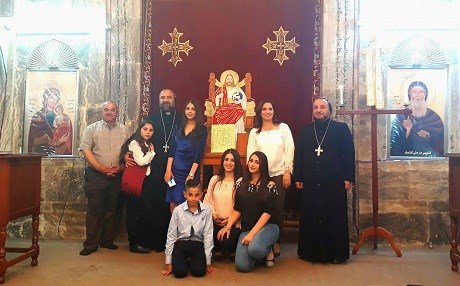
MERGI, Kurdistan Region – Christians traveled to the oldest monastery in existence, Mar Mattai, or St. Matthew's monastery, to bring in the Orthodox Easter with a midnight mass on Saturday night followed by a feast with the resident monks, praying that this Easter brings peace and an end to conflicts in the region.
"We wish that this Easter, with aim of the coming of Jesus, brings peace for all the world," said Father Yusef. "That is my wish, to stop the war, the killing, all bad things. And we need the prayers of all of the faithful people to do that."
The Orthodox Easter, which falls one week after the Catholic or Chaldean Easter, is celebrated with a midnight mass preceded by prayer and followed by music and singing and then a feast with the five resident monks of Mar Mattai.
Easter brings an end to the 48 day fast observed by Orthodox Christians in which they abstain from eating meat and any other animal products or byproducts.
"Orthodox Christians fast for exactly 48 days," Father Yusef explained. "The first 40 days we are fasting according to Jesus' fast. The last eight days are based on his suffering and pain."
"We wish that this Easter, with aim of the coming of Jesus, brings peace for all the world," said Father Yusef. "That is my wish, to stop the war, the killing, all bad things. And we need the prayers of all of the faithful people to do that."
The Orthodox Easter, which falls one week after the Catholic or Chaldean Easter, is celebrated with a midnight mass preceded by prayer and followed by music and singing and then a feast with the five resident monks of Mar Mattai.
Easter brings an end to the 48 day fast observed by Orthodox Christians in which they abstain from eating meat and any other animal products or byproducts.
"Orthodox Christians fast for exactly 48 days," Father Yusef explained. "The first 40 days we are fasting according to Jesus' fast. The last eight days are based on his suffering and pain."
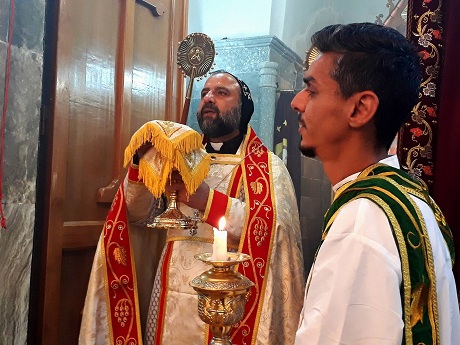
Father Yusef, having lived at Mar Mattai for 12 years, is no stranger to the suffering and pain that the Christian community has experienced.
He said that persecution of the Christians by different groups began in 2006 when a majority of Iraq’s Christians lived in Mosul and Baghdad.
"In May 2006, they killed my older brother in Mosul, as they killed many young Christians," Father Yusef said, adding that the reputation of terror groups caused many Christians to flee Mosul with some settling in the Kurdistan Region and others in villages throughout the Nineveh Plains.
The monastery accepted displaced Christians from Mosul who fled persecution more than once over the years.
"In 2008, in 2009, in 2010 and the last time was in 2014 when ISIS came," Father Yusef said.
"We accepted more than 65 families, [as we have a limited capacity] so we had to prevent visitors coming to the monastery in order to care for the refugees fleeing ISIS and they spent about two months with us," he added. "We tried our best to provide everything they need because we know they left everything behind."
When ISIS approached Mar Mattai, 20 kilometres northeast of Mosul, the monastery could no longer guarantee a safe haven.
"On August 6, it took just one hour for everyone to flee our monastery and all of Nineveh plains Kurdish cities," Father Yusef recounted.
"I went to the Kurdistan Region because I had to take all of the valuable things from the monastery, the documents, manuscripts, a variety of things to keep them safe."
However, the monks stayed at the monastery in addition to one family from Mosul, who, he added "are still living with us to this day."
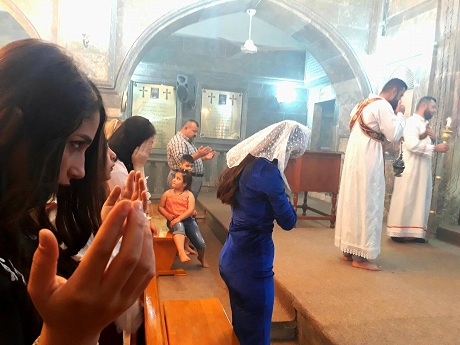
One family, originally from Bartella near Mosul, fled ISIS several times by first going to Ainkawa in Erbil, then Duhok and several times visiting Mar Mattai monastery.
"We wanted to come here in the beginning," said Ghassan al-Tarachi. "But at that time it was too dangerous to come here."
Tarachi used to work in a dealer of wooden products along with his wife, Raida, preparing food for weddings and other events.
Both said Easter was a special day and shared their belief that Iraqi Christians and Iraqis in general want to live in peace.
"We don't want war or anyone to fight us or be against us," Raida said. "We just want to live our lives normal. The Iraqi people deserve a good life because we have many resources and should live in good conditions."
The husband and wife, parents to five daughters and one son, asked the international community provide assistance to those who lost everything when ISIS took over Mosul, their houses destroyed and money stolen.
Tarachi said they had a good life before, but are now living in debt to friends and family members.
Though their family has suffered fear and hardship, their 21-year-old had a message of forgiveness at Easter, the time of rebirth.
"This is a really special day because Jesus gives us freedom, but in reality we don't deserve it because everyone makes mistakes. It's the love of Jesus to forgive our mistakes that shows the real meaning of love," said Hadeel.
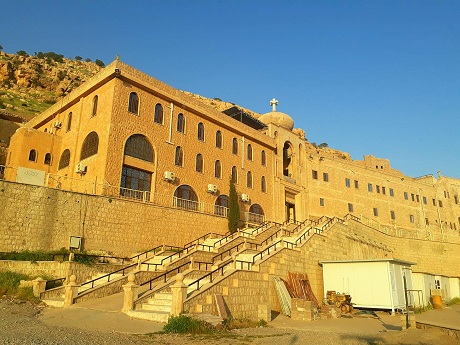
Mar Mattai monastery, part of the Syriac Orthodox Church, sits atop Mount Alfaf and is claimed to be the oldest Christian monastery in existence, established in the year 363.
The monastery is also famous for its library and considerable collection of precious Syriac manuscripts.
Iraq’s Christian population has decreased from half a million in 2003 to an estimated 150,000 today, according to Father Yusef, who anticipated that in a few years the community may be gone, not just from Iraq but all of the Middle East.
"As they say, if they want the Christians to stay in their lands, their historical lands, they should support them with that, in everything," he said in a message to the world. "The most important thing is to guarantee their safety in their lands, and that needs an international decision to do so, as they did in many places, in Bosnia, in Kosovo, so they can keep them there."
Comments
Rudaw moderates all comments submitted on our website. We welcome comments which are relevant to the article and encourage further discussion about the issues that matter to you. We also welcome constructive criticism about Rudaw.
To be approved for publication, however, your comments must meet our community guidelines.
We will not tolerate the following: profanity, threats, personal attacks, vulgarity, abuse (such as sexism, racism, homophobia or xenophobia), or commercial or personal promotion.
Comments that do not meet our guidelines will be rejected. Comments are not edited – they are either approved or rejected.
Post a comment