


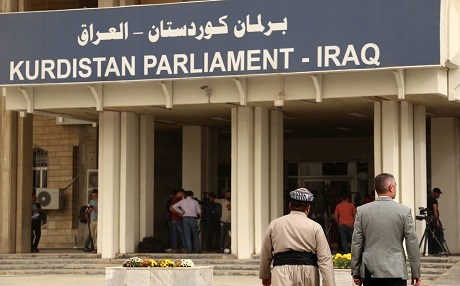
ERBIL, Kurdistan Region — The parliament and political parties will continue consultations on the controversial reform bill after meeting on Tuesday. They are planning additional meetings with the government as they consider options for the pension system, including adopting Iraq’s pension law.
The Kurdistan Region parliament’s leadership and the heads of political blocs met on Tuesday.
"We held a consultations session today. The heads of the factions met with the head of the finance and legal committee. We reached the understanding that the content of the bill needs more understanding," parliamentary secretary Begard Talabani told reporters after the meeting.
She said they have decided to hold a meeting with the government on the matter, noting that the financial situation in the Region has changed since the bill was first passed in February – specifically the payment of public sector salaries has improved the situation of government employees.
“There are no rivalries. There are disagreements,” Talabani insisted, saying suggestions have been made for the betterment of the lives of the people.
One suggestion they discussed was adopting Iraq’s pension law, which Talabani said would need to happen in consultation with the government.
Abdullah Ahmad, a pensioner from Erbil, urged the parliament to amend the law. He complained about the minimum wage.
"If someone falls ill, he cannot take care of the treatment expenses," he said, adding that the minimum wage should be at last 400,000 Iraqi dinars ($336).
Increasing pensions is not the only concern, Omar Fars, a shop owner in Halabja, told Rudaw. He said the government should also completely end the salary-saving system that was introduced in 2016. The KRG has made significant reductions to the salary cuts, capping them at 30 percent for high-earners, but public servants want the system cancelled altogether.
Ahead of the meeting, some had suggested passing the reform bill without the contested Article 3 that addresses high-ranking pensioners.
“There is a high likelihood for the bill to be passed excluding the ‘special ranks’ section as it is highly contested,” Izat Sabir, a PUK MP and the head of the finance committee, told Rudaw.
Describing the meeting as “very important,” Sabir added this suggestion will be put forth if no agreement was reached for Article 3.
“It is possible to put the section on hold for after the Iraqi elections as election campaigning is impeding the passing of the bill completely,” Sabir added.
The parliament passed a reform bill on February 27 that introduced reforms to the salaries of public employees and pensioners, including cleaning the list of beneficiaries, preventing duplicate benefits and double-salary holders, and institutionalizing the pension program.
Article 3, addressing high-ranking pensioners, termed "special ranks,” drew the most attention in the new reform. Special ranks include retired ministers, deputy ministers, consultants, general directors, and some Peshmerga who were awarded the position in return for their service to the Kurdish struggle for freedom before the formation of the KRG when they fought against the previous regime.
The reform bill passed sets the minimum wage for pensioners at 300,000 Iraqi dinars (about $253), while it allocates 4 million dinars (about $3,375) as pensions for Kurdish MPs. This, in part, led to wide-spread public protests about salaries and parliamentarians effectively setting their own wages.
The bill could save the KRG 100-120 billion dinars, the amount needed to end the unpopular salary saving system entirely.
Iraq will hold parliamentary elections on May 12. Campaigning begins on Saturday in Iraq and Sunday in the Kurdistan Region.
The Kurdistan Region parliament’s leadership and the heads of political blocs met on Tuesday.
"We held a consultations session today. The heads of the factions met with the head of the finance and legal committee. We reached the understanding that the content of the bill needs more understanding," parliamentary secretary Begard Talabani told reporters after the meeting.
She said they have decided to hold a meeting with the government on the matter, noting that the financial situation in the Region has changed since the bill was first passed in February – specifically the payment of public sector salaries has improved the situation of government employees.
“There are no rivalries. There are disagreements,” Talabani insisted, saying suggestions have been made for the betterment of the lives of the people.
One suggestion they discussed was adopting Iraq’s pension law, which Talabani said would need to happen in consultation with the government.
Abdullah Ahmad, a pensioner from Erbil, urged the parliament to amend the law. He complained about the minimum wage.
"If someone falls ill, he cannot take care of the treatment expenses," he said, adding that the minimum wage should be at last 400,000 Iraqi dinars ($336).
Increasing pensions is not the only concern, Omar Fars, a shop owner in Halabja, told Rudaw. He said the government should also completely end the salary-saving system that was introduced in 2016. The KRG has made significant reductions to the salary cuts, capping them at 30 percent for high-earners, but public servants want the system cancelled altogether.
Ahead of the meeting, some had suggested passing the reform bill without the contested Article 3 that addresses high-ranking pensioners.
“There is a high likelihood for the bill to be passed excluding the ‘special ranks’ section as it is highly contested,” Izat Sabir, a PUK MP and the head of the finance committee, told Rudaw.
Describing the meeting as “very important,” Sabir added this suggestion will be put forth if no agreement was reached for Article 3.
“It is possible to put the section on hold for after the Iraqi elections as election campaigning is impeding the passing of the bill completely,” Sabir added.
The parliament passed a reform bill on February 27 that introduced reforms to the salaries of public employees and pensioners, including cleaning the list of beneficiaries, preventing duplicate benefits and double-salary holders, and institutionalizing the pension program.
Article 3, addressing high-ranking pensioners, termed "special ranks,” drew the most attention in the new reform. Special ranks include retired ministers, deputy ministers, consultants, general directors, and some Peshmerga who were awarded the position in return for their service to the Kurdish struggle for freedom before the formation of the KRG when they fought against the previous regime.
The reform bill passed sets the minimum wage for pensioners at 300,000 Iraqi dinars (about $253), while it allocates 4 million dinars (about $3,375) as pensions for Kurdish MPs. This, in part, led to wide-spread public protests about salaries and parliamentarians effectively setting their own wages.
The bill could save the KRG 100-120 billion dinars, the amount needed to end the unpopular salary saving system entirely.
Iraq will hold parliamentary elections on May 12. Campaigning begins on Saturday in Iraq and Sunday in the Kurdistan Region.
Updated at 10:21 pm
Comments
Rudaw moderates all comments submitted on our website. We welcome comments which are relevant to the article and encourage further discussion about the issues that matter to you. We also welcome constructive criticism about Rudaw.
To be approved for publication, however, your comments must meet our community guidelines.
We will not tolerate the following: profanity, threats, personal attacks, vulgarity, abuse (such as sexism, racism, homophobia or xenophobia), or commercial or personal promotion.
Comments that do not meet our guidelines will be rejected. Comments are not edited – they are either approved or rejected.
Post a comment