


-
MAKHMOUR FRONT, Kurdistan Region – On this dust-blown war front where both the Iraqi Army and Peshmerga forces are ranged against the Islamic State (ISIS), all lives are not equal: the Kurds have endured three chemical attacks in as many months and have virtually no protective gear; the Iraqi Army has suffered no such horror but is equipped one kit per soldier.
After ISIS lobbed 45 mortars loaded with mustard gas behind Peshmerga lines in February – wounding at least three Kurdish soldiers – it was the Iraq Army that immediately received full body suits and masks for every one of its nearly 14,000 men on the Makhmour frontline.
“Each soldier has his own kit,” confirmed Gen. Bashdar Aziz, an Iraqi Army commander at the front. “We got them when they (ISIS) launched their chemical attack on these fronts” against the Peshmerga, he explained.
The NBC (nuclear, biological, chemical) kit contains a full body suit, gas mask, water canteen, a hydration straw allowing a soldier to drink through the mask, anti-fog spray and extra mask filters. Also included is a first aid kit.
 We are all well-prepared and have the equipment for every soldier,
“We are all well-prepared and have the equipment for every soldier,” confirmed Blnd Hatim, another Iraqi Army officer, deployed since last month about a half-kilometer from the ISIS-held village of al-Nasr. That is one of the most active sectors of the Makhmour front, some 60 kilometers southwest of Erbil, the Kurdish capital.
“There is no fear. We know what to do and we have the tools to protect ourselves,” he told Rudaw English.
Only 35 kilometers northwest of the Iraqi lines, the Peshmerga forces have their bunkers on the Gwer front, where they have seen fellow soldiers fall victim to multiple chemical weapons attacks.
ISIS mortars loaded with mustard gas wounded at least 10 Peshmerga soldiers in three attacks from February to April. In August, ISIS fired 45 mortars loaded with mustard gas on the same front.
Soldiers said their wounded comrades suffered nausea, vomiting and a burning of eyes – the most obvious signs of chemical weapons use. But no soldier has yet died in any of those attacks.
Since the last one, Kurdish soldiers at the front say they received about 75 gas masks – not body suits or full kits.
“For 100,000 Peshmerga soldiers fighting Daesh (ISIS) on the front lines we have less than 5,000 masks that we received from coalition forces,” said Peshmerga ministry spokesman Jabar Yawar. That makes one gas mask for every 20 soldiers.
Gas masks can protect eyes and lungs, but normal military uniforms provide little to no protection, as mustard gas will penetrate clothing and be absorbed across any body surface. What they need, commanders say, are full body suits -- enough for each soldier.
The Kurdistan Regional Government (KRG) has appealed to the United States and other Western allies for thousands of masks alone, said Yawar. But he was not hopeful his men would ever have enough to protect every soldier at the front.
For 100,000 Peshmerga soldiers fighting Daesh (ISIS) on the front lines we have less than 5,000 masks,
Western allies have not been very forthcoming; the KRG is going through a severe cash crisis and cannot afford to pay for the masks or kits itself; and the central government in Baghdad that constitutionally is responsible for the Peshmerga has paid little heed to the KRG’s needs.
“I think the Iraqi government bought the gas masks for its own men out of its own budget,” said Yawar. “But in Kurdistan we are in such a severe financial crisis that we are hardly able to do more than pay our soldiers their salaries. We had asked the Iraqi Army to send us some of their protection kits, but until now we have not received any.”
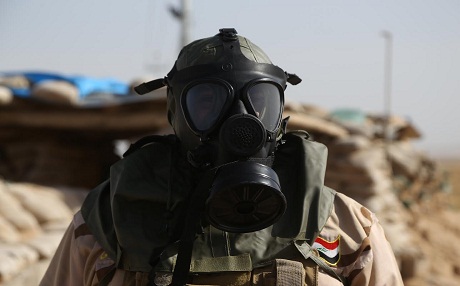
An Iraqi Army soldier tries on his gas mask. Photo: Soran Khateri, Rudaw.
Meanwhile, at the front, the tens of thousands of Peshmerga fighters fight on with little more than household bleach to protect after a poison gas attack.
“We hope to receive the protection suits and gas masks,” wished Rebin Rojbayani, a Peshmerga officer in Gwer, where the last two mustard gas attacks against the Kurdish soldiers took place.
The Peshmerga have been a bulwark against ISIS for more than two years – a war they have been fighting not only to protect their own lands, but against an enemy that has vowed to take the conflict across the world, especially to the West.
The US and Western leaders have lavished much praise on the Peshmerga for their fighting skills, referring to the Kurds as their best allies on the ground.
But it is on the ground that the stark reality of words and deeds collides.
“We’re here actually to pay tribute to the Peshmerga,” the US Consul General in Erbil Matthias Mitman told Rudaw during a visit to the Makhmour front last month. “They are brave, they’re courageous, and they are fighting so the people in Kurdistan Region can live in peace,” he said.
But the United States and most other allies insist on equipping the Peshmerga through the central government in Baghdad, insisting that the force officially remains a part of the Iraqi armed forces.
Kurdish leaders have repeatedly complained that their many rows with Baghdad – and the massive corruption and political instability inside the Iraqi government – has hampered military supplies getting to them.
So, as the Peshmerga stand and fight with an iron will, Washington remains equally iron-willed about refusing direct military supplies to the Kurds.
“We are fighting on one of the most active fronts of this war, and without much protection against the attacks,” complained Rojbayani.
“We don’t have many masks and no body suits at all,” he explained. “There aren’t really even any proper medicines to use when we are attacked.”
Kurdish soldiers have received training against chemical weapons attacks, but they say that is not enough.
we have only water and bleach to wash the injuries,
“We have been taught protective steps and techniques, but without equipment there is little we can do with the knowledge alone,” said Rojbayani, who has himself received training by French experts. Germany also has provided such training to the Peshmerga.
Rojbayani is now teaching his forces what to do in the event of another mustard gas attack by ISIS, with which the Kurdistan Region shares a frontline of more than 1,000 kilometers.
“I teach them all I have learned myself, but at the end of the day we have only water and bleach to wash the injuries,” he explained. “Bleach is the only thing we have in plenty.”
Allan Duncan, a Scottish volunteer who has been fighting ISIS for more than a year alongside the Peshmerga on the Bashiq front near the militants’ stronghold of Mosul, has raised money privately from donors to help himself and a few fellow soldiers. He managed to raise enough money to buy five gas masks, two of which he sent for fellow Peshmerga in Makhmour.
“Everybody is worried about the chemical attacks,” Duncan said. The “West should provide Peshmerga with the equipment and necessary things standard Western soldiers have,” he added, explaining that each mask costs from $80 to $100.
The rise in chemical weapons attacks against the Peshmerga comes at a time when the Kurds, the Iraqi Army and coalition forces are planning for a critical offensive to liberate Mosul, Iraq’s second-largest city and the current ISIS stronghold in Iraq.
Peshmerga soldiers say that, if they are to fight in that war alongside the Iraqis, their lives should be valued as much as those of Iraqi troops.
“If there is a decision that the Peshmerga will fight alongside the Iraqi Army for Mosul, then we must be provided with everything that an Iraqi soldier has, including advanced guns, vehicles and protective gear,” said General Hatim Ali on the Bashiq front.
“It is unfair for the Peshmerga to put their lives at risk without the right equipment to fight Daesh (ISIS).”
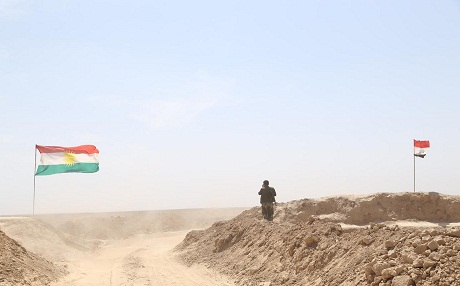
After ISIS lobbed 45 mortars loaded with mustard gas behind Peshmerga lines in February – wounding at least three Kurdish soldiers – it was the Iraq Army that immediately received full body suits and masks for every one of its nearly 14,000 men on the Makhmour frontline.
“Each soldier has his own kit,” confirmed Gen. Bashdar Aziz, an Iraqi Army commander at the front. “We got them when they (ISIS) launched their chemical attack on these fronts” against the Peshmerga, he explained.
The NBC (nuclear, biological, chemical) kit contains a full body suit, gas mask, water canteen, a hydration straw allowing a soldier to drink through the mask, anti-fog spray and extra mask filters. Also included is a first aid kit.
We are all well-prepared and have the equipment for every soldier, “We are all well-prepared and have the equipment for every soldier,” confirmed Blnd Hatim, another Iraqi Army officer, deployed since last month about a half-kilometer from the ISIS-held village of al-Nasr. That is one of the most active sectors of the Makhmour front, some 60 kilometers southwest of Erbil, the Kurdish capital.
“There is no fear. We know what to do and we have the tools to protect ourselves,” he told Rudaw English.
Only 35 kilometers northwest of the Iraqi lines, the Peshmerga forces have their bunkers on the Gwer front, where they have seen fellow soldiers fall victim to multiple chemical weapons attacks.
ISIS mortars loaded with mustard gas wounded at least 10 Peshmerga soldiers in three attacks from February to April. In August, ISIS fired 45 mortars loaded with mustard gas on the same front.
Soldiers said their wounded comrades suffered nausea, vomiting and a burning of eyes – the most obvious signs of chemical weapons use. But no soldier has yet died in any of those attacks.
Since the last one, Kurdish soldiers at the front say they received about 75 gas masks – not body suits or full kits.
“For 100,000 Peshmerga soldiers fighting Daesh (ISIS) on the front lines we have less than 5,000 masks that we received from coalition forces,” said Peshmerga ministry spokesman Jabar Yawar. That makes one gas mask for every 20 soldiers.
Gas masks can protect eyes and lungs, but normal military uniforms provide little to no protection, as mustard gas will penetrate clothing and be absorbed across any body surface. What they need, commanders say, are full body suits -- enough for each soldier.
The Kurdistan Regional Government (KRG) has appealed to the United States and other Western allies for thousands of masks alone, said Yawar. But he was not hopeful his men would ever have enough to protect every soldier at the front.
For 100,000 Peshmerga soldiers fighting Daesh (ISIS) on the front lines we have less than 5,000 masks, Western allies have not been very forthcoming; the KRG is going through a severe cash crisis and cannot afford to pay for the masks or kits itself; and the central government in Baghdad that constitutionally is responsible for the Peshmerga has paid little heed to the KRG’s needs.
“I think the Iraqi government bought the gas masks for its own men out of its own budget,” said Yawar. “But in Kurdistan we are in such a severe financial crisis that we are hardly able to do more than pay our soldiers their salaries. We had asked the Iraqi Army to send us some of their protection kits, but until now we have not received any.”
An Iraqi Army soldier tries on his gas mask. Photo: Soran Khateri, Rudaw.
Meanwhile, at the front, the tens of thousands of Peshmerga fighters fight on with little more than household bleach to protect after a poison gas attack.
“We hope to receive the protection suits and gas masks,” wished Rebin Rojbayani, a Peshmerga officer in Gwer, where the last two mustard gas attacks against the Kurdish soldiers took place.
The Peshmerga have been a bulwark against ISIS for more than two years – a war they have been fighting not only to protect their own lands, but against an enemy that has vowed to take the conflict across the world, especially to the West.
The US and Western leaders have lavished much praise on the Peshmerga for their fighting skills, referring to the Kurds as their best allies on the ground.
But it is on the ground that the stark reality of words and deeds collides.
“We’re here actually to pay tribute to the Peshmerga,” the US Consul General in Erbil Matthias Mitman told Rudaw during a visit to the Makhmour front last month. “They are brave, they’re courageous, and they are fighting so the people in Kurdistan Region can live in peace,” he said.
But the United States and most other allies insist on equipping the Peshmerga through the central government in Baghdad, insisting that the force officially remains a part of the Iraqi armed forces.
Kurdish leaders have repeatedly complained that their many rows with Baghdad – and the massive corruption and political instability inside the Iraqi government – has hampered military supplies getting to them.
So, as the Peshmerga stand and fight with an iron will, Washington remains equally iron-willed about refusing direct military supplies to the Kurds.
“We are fighting on one of the most active fronts of this war, and without much protection against the attacks,” complained Rojbayani.
“We don’t have many masks and no body suits at all,” he explained. “There aren’t really even any proper medicines to use when we are attacked.”
Kurdish soldiers have received training against chemical weapons attacks, but they say that is not enough.
we have only water and bleach to wash the injuries, “We have been taught protective steps and techniques, but without equipment there is little we can do with the knowledge alone,” said Rojbayani, who has himself received training by French experts. Germany also has provided such training to the Peshmerga.
Rojbayani is now teaching his forces what to do in the event of another mustard gas attack by ISIS, with which the Kurdistan Region shares a frontline of more than 1,000 kilometers.
“I teach them all I have learned myself, but at the end of the day we have only water and bleach to wash the injuries,” he explained. “Bleach is the only thing we have in plenty.”
Allan Duncan, a Scottish volunteer who has been fighting ISIS for more than a year alongside the Peshmerga on the Bashiq front near the militants’ stronghold of Mosul, has raised money privately from donors to help himself and a few fellow soldiers. He managed to raise enough money to buy five gas masks, two of which he sent for fellow Peshmerga in Makhmour.
“Everybody is worried about the chemical attacks,” Duncan said. The “West should provide Peshmerga with the equipment and necessary things standard Western soldiers have,” he added, explaining that each mask costs from $80 to $100.
The rise in chemical weapons attacks against the Peshmerga comes at a time when the Kurds, the Iraqi Army and coalition forces are planning for a critical offensive to liberate Mosul, Iraq’s second-largest city and the current ISIS stronghold in Iraq.
Peshmerga soldiers say that, if they are to fight in that war alongside the Iraqis, their lives should be valued as much as those of Iraqi troops.
“If there is a decision that the Peshmerga will fight alongside the Iraqi Army for Mosul, then we must be provided with everything that an Iraqi soldier has, including advanced guns, vehicles and protective gear,” said General Hatim Ali on the Bashiq front.
“It is unfair for the Peshmerga to put their lives at risk without the right equipment to fight Daesh (ISIS).”
Comments
Rudaw moderates all comments submitted on our website. We welcome comments which are relevant to the article and encourage further discussion about the issues that matter to you. We also welcome constructive criticism about Rudaw.
To be approved for publication, however, your comments must meet our community guidelines.
We will not tolerate the following: profanity, threats, personal attacks, vulgarity, abuse (such as sexism, racism, homophobia or xenophobia), or commercial or personal promotion.
Comments that do not meet our guidelines will be rejected. Comments are not edited – they are either approved or rejected.
Post a comment