


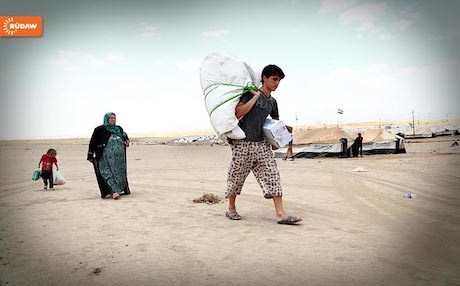
ERBIL, Kurdistan Region— Despite liberation of relatively large parts of Nineveh province where Mosul is the capital, nearly half a million refugees are still reluctant to return to their homes mainly due to security threats and stagnated public services, according to the Centre Crisis Management in the Kurdistan Region.
As the war in Mosul’s western half comes to a slow close, many of the internally displaced people (IDPs) have found their residential homes destroyed in one of the most intense urban warfares in the country’s history with entire neighbourhoods levelled to the ground in the city’s old town.
“Security, basic services such as running water and electricity, and the fact that many homes have been shattered in the city are the main reasons why so many IDPs have chosen to stay in camps and cities in the Kurdistan Region and in Iraq,” said Hoshang Muhammad, head of the crisis office in Erbil.
According to Muhammad around 178,000 IDPs from Mosul are registered to be in the Kurdistan Region but the overall number of the refugees who have fled the violence in the province is far larger and estimated to be around 530,000, many of them residing in nearby camps south of the city in Iraqi-controlled territories.
In Kirkuk alone over 600,000 IDPs have remained, despite liberation of their regions by the Iraqi and Kurdish forces, according to the governor, adding to the shortage of electricity and clean water in the province. Nearly one-third of Kirkuk’s refugees are from Mosul especially from the troubled city of Hawija, still in the hands of ISIS militants.
According to Iraqi lawmakers, around 10,700 homes and buildings have fully or partly been destroyed in western half of Mosul alone following the intense clashes and bombing campaigns over the past months to drive out ISIS militants from their last holdouts in the city.
The operation to retake Mosul from ISIS, named ‘We Are Coming Nineveh,’ started in October last year with the Iraqi army gaining swift victories in eastern half of the city.
But the battle, as anticipated, has been slow in western, more densely populated areas of the city where the old town is located and where narrower roads and pathways have often halted the advancement of army convoys and troops.
As the war in Mosul’s western half comes to a slow close, many of the internally displaced people (IDPs) have found their residential homes destroyed in one of the most intense urban warfares in the country’s history with entire neighbourhoods levelled to the ground in the city’s old town.
“Security, basic services such as running water and electricity, and the fact that many homes have been shattered in the city are the main reasons why so many IDPs have chosen to stay in camps and cities in the Kurdistan Region and in Iraq,” said Hoshang Muhammad, head of the crisis office in Erbil.
According to Muhammad around 178,000 IDPs from Mosul are registered to be in the Kurdistan Region but the overall number of the refugees who have fled the violence in the province is far larger and estimated to be around 530,000, many of them residing in nearby camps south of the city in Iraqi-controlled territories.
In Kirkuk alone over 600,000 IDPs have remained, despite liberation of their regions by the Iraqi and Kurdish forces, according to the governor, adding to the shortage of electricity and clean water in the province. Nearly one-third of Kirkuk’s refugees are from Mosul especially from the troubled city of Hawija, still in the hands of ISIS militants.
According to Iraqi lawmakers, around 10,700 homes and buildings have fully or partly been destroyed in western half of Mosul alone following the intense clashes and bombing campaigns over the past months to drive out ISIS militants from their last holdouts in the city.
The operation to retake Mosul from ISIS, named ‘We Are Coming Nineveh,’ started in October last year with the Iraqi army gaining swift victories in eastern half of the city.
But the battle, as anticipated, has been slow in western, more densely populated areas of the city where the old town is located and where narrower roads and pathways have often halted the advancement of army convoys and troops.
Comments
Rudaw moderates all comments submitted on our website. We welcome comments which are relevant to the article and encourage further discussion about the issues that matter to you. We also welcome constructive criticism about Rudaw.
To be approved for publication, however, your comments must meet our community guidelines.
We will not tolerate the following: profanity, threats, personal attacks, vulgarity, abuse (such as sexism, racism, homophobia or xenophobia), or commercial or personal promotion.
Comments that do not meet our guidelines will be rejected. Comments are not edited – they are either approved or rejected.
Post a comment