


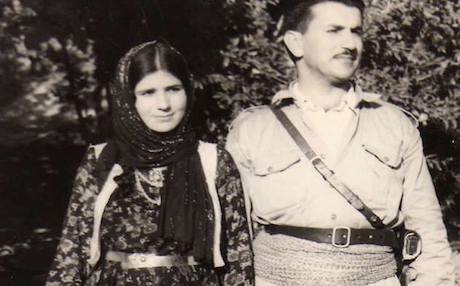
LONDON - Tributes were paid in London on Sunday to Fawzia Amin Abdul Rahman, widow of the assassinated Kurdish leader Sami Abdul Rahman and a nationalist and campaigner in her own right. She died aged 68.
Kurdish and Iraqi political representatives were among several hundred who attended a memorial service for Amin, who was born in Sinjar in 1945 and died on January 26 after suffering a stroke in Erbil, where she had her home.
Speakers, who included long-time friends such as Joyce Blau, the French linguist, said Fawzia’s life encapsulated the contribution of Kurdish women to the nationalist cause.
She died 10 years almost to the day after twin al-Qaeda-linked bombings at the Erbil offices of the region’s two main political parties killed more than 100 people, including Mr. Abdul Rahman, deputy prime minister of the Kurdistan Regional Government (KRG), and their eldest son, Salah.
During the Kurdish struggle against successive Baathist regimes in Baghdad, dating back to the 1960s, Fawzia Abdul Rahman suffered exile abroad and deprivation in the harsh conditions of the mountains of Kurdistan.
She was tried in absentia and sentenced to death, along with her husband, in 1974 and the couple was on the run from the Baathists when they sought refuge in Britain.
By that time, she had already lost an infant daughter who fell ill in the mountains of South Kurdistan (Iraqi Kurdistan) in 1967, far from medicines and medical attention. The couple had fled there from Baghdad soon after their marriage in 1961.
They were forced to live apart for more than a year as Sami Abdul Rahman served as a Peshmarga of the Kurdistan Democratic Party alongside its leader, Mullah Mustafa Barzani.
There was a brief interlude of peace in the early 1970s when Sami Abdul Rahman was named a minister in Baghdad as part of the 1970 Autonomy Agreement. But with the resumption of the armed struggle against the Baathists in 1974, the family was once again forced to quit the Iraqi capital.
With the collapse of the Kurdish rebellion, the couple fled to Iran and then sought asylum in Britain where Fawzia had to make a new home for her young family. But with her husband absent and out of touch for months on end as a leader of the Kurdish resistance, she was forced to raise four young children virtually alone.
“When we moved to the UK in 1976, my parents were still being hunted by the Baathists after they'd been tried in absentia,” according to Bayan, her daughter, who is today the KRG’s representative to Britain.
“She took it all in her stride and never showed to her children or others that her life was in danger,” Bayan Sami Abdul Rahman told Rudaw.
In her British exile, Fawzia taught herself English, learned to drive and educated herself at a local college. From her suburban home near London, she created an archive of English language newspaper articles about Kurdistan as part of her work for the Kurdish Cause.
During the Anfal campaign and the chemical attack on Halabja, she lobbied British members of parliament and the media to urge the British government to do something to stop the genocide.
At last able to return to Kurdistan after the 1991 Gulf war, the couple lived at Salaheddin and later Erbil where her home became a focus for local dignitaries and foreign visitors, even after her husband’s death.
She supported charities and organizations that focused on promoting Kurdish culture and heritage.
However, the trauma of the violent deaths of her husband and son in 2004 led to heart problems and other illness. After suffering a stroke in Erbil, she was transferred for treatment in Ankara, but never recovered.
An obituary issued by the KRG office in London said: “She was the proud wife of a Peshmerga and wholeheartedly believed in the Kurdish cause, despite the many sacrifices it entailed.”
Comments
Rudaw moderates all comments submitted on our website. We welcome comments which are relevant to the article and encourage further discussion about the issues that matter to you. We also welcome constructive criticism about Rudaw.
To be approved for publication, however, your comments must meet our community guidelines.
We will not tolerate the following: profanity, threats, personal attacks, vulgarity, abuse (such as sexism, racism, homophobia or xenophobia), or commercial or personal promotion.
Comments that do not meet our guidelines will be rejected. Comments are not edited – they are either approved or rejected.
Post a comment