


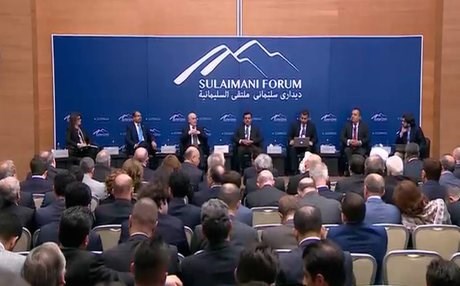
SULAIMANI, Kurdistan Region - A panel of leading experts offered a grim picture Wednesday of security threats posed by extremists across the region, with an emphasis on the Islamic State (ISIS) and the group’s impact on Syria and Iraq.
In a discussion titled “Fertile Crescent in Turmoil,” held at the third annual forum of the American University of Iraq, Sulaimani on Wednesday, the speakers identified a long list of security issues across the Middle East and Africa, with several adding that things would likely get worse before they got better.
The first speaker, Iraq’s Deputy Speaker of Parliament Humam Al Hamoudi, pointed out the area is familiar with upheaval.
“The region of the fertile crescent is rich with rivers and resources, but also with crises. In this region, superpowers have always clashed,” Hamoudi said.
Other speakers also stressed the influence of history on current crises.
“Egypt, Iraq and Syria are states inherited from the Sikes-Picot agreement, and since the beginning of the 2000s, they have all collapsed,” said speaker Cengiz Candar of the Turkish Hurriyet daily, referring to an agreement to carve up the Ottoman Empire after the First World War.
“As functioning states they have been replaced by dysfunctional states, or fragmented territories,” Candar added.
The journalist had strong words for the Turkish government, especially for its operation last month to recover the remains of Ottoman predecessor Suleyman Shah. He also cited Ankara’s alleged reluctance to help resolve what he called an impending “humanitarian catastrophe” in Syria.
Randa Slim, director of the Track II Dialogues initiative at the Middle East Institute and an adjunct research fellow at the New America Foundation, echoed his opinions, saying Syrians are in danger of losing their once-strong national identity.
“I think by the time this is over, there won’t be any state institutions to preserve in Syria; Syria is being emptied of its people,” she said, remarking on the country’s refugee crisis.
“I think Syria is going to become a much more dangerous crisis going forward.”
She also warned that Syrian President Bashar al-Assad would do anything to survive, and could remain a threat to his own people even if ISIS is defeated. “(Assad will) use any tool for survival until the US administration makes up its mind,” she said.
In a similar sentiment, final speaker Kenneth Pollack, a senior fellow at the Brookings Institute, described Washington’s approach to the region as “fundamentally ambivalent.”
Slim continued to criticize US policy on the war against ISIS, saying the superpower would fail in containing the group if it only focused on doing so in Iraq, while not developing a plan for Syria as well.
Italian Deputy Foreign Minister Lapo Pistelli spoke on Europe’s role in the region’s conflict, and expressed his fear of growing extremism worldwide.
“Terrorism is not new in the region, but this is the first time I can say terrorism is a regional threat, maybe more than a regional threat… it’s an unprecedented threat,” he said, adding groups like Boko Haram, al-Qaida in the Islamic Maghreb and al-Shabab in Somalia had compounded these fears.
“I’m afraid of foreign fighters, but more afraid of families moving to the caliphate,” he continued, in reference to the name used by ISIS for its territory.
Pistelli continued: “As a European I looked at this region as the place where all religions began and existed together. Now, I am scared by the black-and-white world, as exemplified by the ISIS flag, in which no diversity is allowed.”
The root causes that created the Islamic State run deep, according to Pollack.
“Present-day Daesh (an Arabic acronym for ISIS) represents a larger movement to capitalize on economic and social problems in Iraq and Syria. The only way we will deal with Daesh is to deal with those problems,” he said.
Comments
Rudaw moderates all comments submitted on our website. We welcome comments which are relevant to the article and encourage further discussion about the issues that matter to you. We also welcome constructive criticism about Rudaw.
To be approved for publication, however, your comments must meet our community guidelines.
We will not tolerate the following: profanity, threats, personal attacks, vulgarity, abuse (such as sexism, racism, homophobia or xenophobia), or commercial or personal promotion.
Comments that do not meet our guidelines will be rejected. Comments are not edited – they are either approved or rejected.
Post a comment