


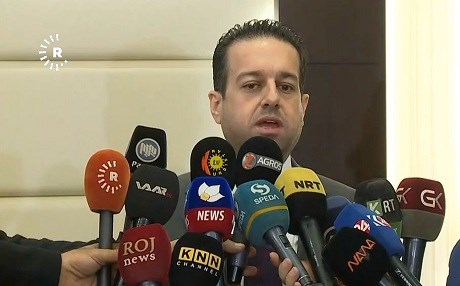
ERBIL, Kurdistan Region — The Kurdistan Regional Government’s (KRG) Finance Minister Rebaz Hamlan announced on Tuesday the next three salaries for government employees will be paid fully and on time because of better relations with Baghdad.
The salaries are late salaries for October, November, and December. They will be released starting in January.
According to Hamlan, they now have very “good relations” with the Iraqi government. Iraq’s Minister of Finance Fuad Hussein has played a “good and positive role” in improving relations between the Kurdistan Regional Government and Iraqi federal government, particularly with the Kurdistan Region’s entitlements.
“Thus, there are good hopes that even if the salary issue doesn’t get solved thoroughly, it will be resolved to a great degree for us to both continue paying salaries every 30 days and also to know what will our entitlements be in 2019,” added Hamlan.
In 2014, Baghdad fully cut Kurdistan Region’s share of the budget, mainly due to disagreements about unilateral oil sales by the Kurdistan Region.
The highly unpopular salary saving system was introduced in 2016 as part of austerity measures designed to address the crippling economic crisis.
Earlier this year, following Baghdad decision to regularly send 317 billion dinars (about $264.6 million) per month, the system was revised, slashing the saving percentage greatly, but still keeping the saving system.
“Good work” has been done in the current outgoing Kurdistan government, and debts owed to private banks have been largely repaid, revealed Hamlan. Contractors are also being regularly repaid. Money owed to oil companies is also being remitted.
They are hopeful that the reform bill sent by the KRG to the parliament, which didn’t pass due to disputes in the last term, could be passed “as soon as possible” in the current term in order to mitigate the salary-saving issue and to address repaying salaries previously saved.
The Council of Minister’s is meeting on Tuesday to discuss how to administer the repayment of the debts owed to the civil servants.
An extra 150 billion Iraqi dinars (about $125 million) are needed to fully abolish the salary saving system, Hamlan explained.
He added that releasing salaries by Baghdad to employees of the Region is a “duty and obligation” according to Iraqi law and the constitution, and has got nothing to do with the control of oil.
“We will continue the same pattern. We will release salaries every 30 days. For these three months (October, November, December), there won’t be salary saving,” Rebaz Hamlan told reporters on Tuesday.
The salaries are late salaries for October, November, and December. They will be released starting in January.
According to Hamlan, they now have very “good relations” with the Iraqi government. Iraq’s Minister of Finance Fuad Hussein has played a “good and positive role” in improving relations between the Kurdistan Regional Government and Iraqi federal government, particularly with the Kurdistan Region’s entitlements.
“Thus, there are good hopes that even if the salary issue doesn’t get solved thoroughly, it will be resolved to a great degree for us to both continue paying salaries every 30 days and also to know what will our entitlements be in 2019,” added Hamlan.
In 2014, Baghdad fully cut Kurdistan Region’s share of the budget, mainly due to disagreements about unilateral oil sales by the Kurdistan Region.
The highly unpopular salary saving system was introduced in 2016 as part of austerity measures designed to address the crippling economic crisis.
Earlier this year, following Baghdad decision to regularly send 317 billion dinars (about $264.6 million) per month, the system was revised, slashing the saving percentage greatly, but still keeping the saving system.
“Good work” has been done in the current outgoing Kurdistan government, and debts owed to private banks have been largely repaid, revealed Hamlan. Contractors are also being regularly repaid. Money owed to oil companies is also being remitted.
They are hopeful that the reform bill sent by the KRG to the parliament, which didn’t pass due to disputes in the last term, could be passed “as soon as possible” in the current term in order to mitigate the salary-saving issue and to address repaying salaries previously saved.
The Council of Minister’s is meeting on Tuesday to discuss how to administer the repayment of the debts owed to the civil servants.
An extra 150 billion Iraqi dinars (about $125 million) are needed to fully abolish the salary saving system, Hamlan explained.
He added that releasing salaries by Baghdad to employees of the Region is a “duty and obligation” according to Iraqi law and the constitution, and has got nothing to do with the control of oil.
The oil sector is privatized in the Kurdistan Region, while it is state-owned elsewhere in Iraq.
Comments
Rudaw moderates all comments submitted on our website. We welcome comments which are relevant to the article and encourage further discussion about the issues that matter to you. We also welcome constructive criticism about Rudaw.
To be approved for publication, however, your comments must meet our community guidelines.
We will not tolerate the following: profanity, threats, personal attacks, vulgarity, abuse (such as sexism, racism, homophobia or xenophobia), or commercial or personal promotion.
Comments that do not meet our guidelines will be rejected. Comments are not edited – they are either approved or rejected.
Post a comment