
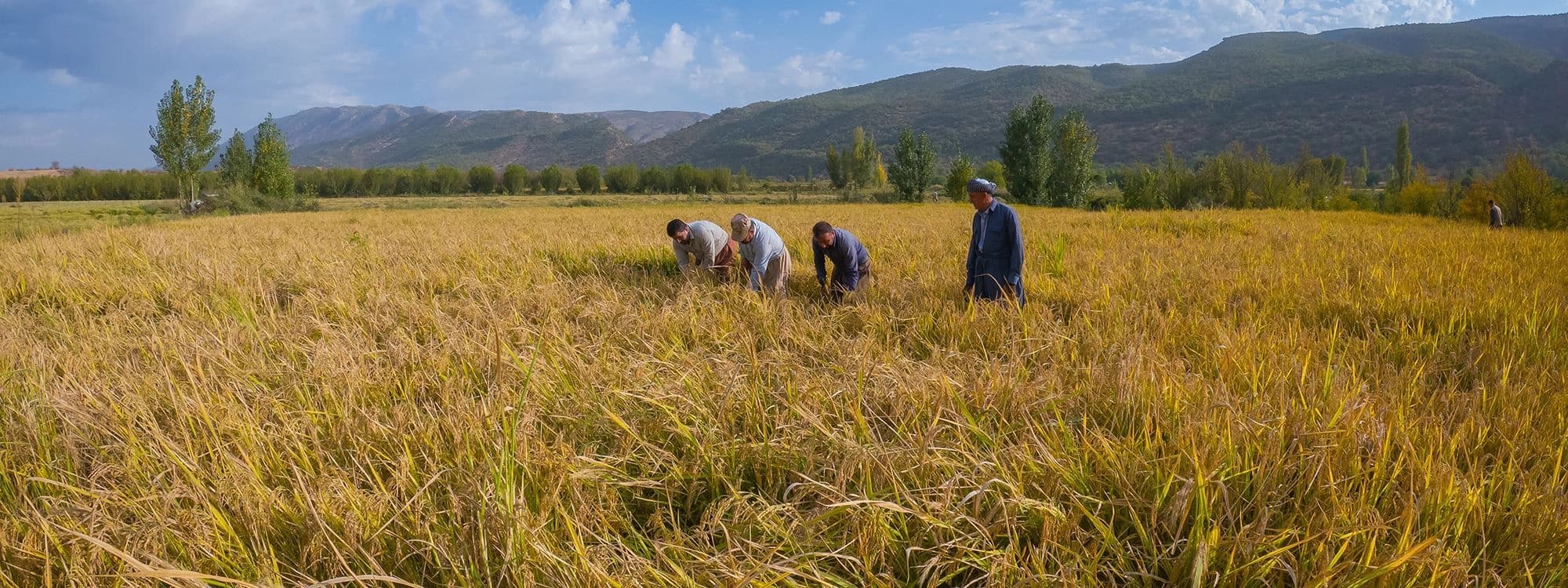

AKRE, Kurdistan Region - The rice harvest season has begun in the villages of Akre district in Duhok province. Farmers use traditional sickles to harvest rice.
Kurdish rice is typically associated with Akre, a small town in Duhok province 60 kilometers north of Erbil, which is also known for its produce in the region.
Rice is planted between April and May. The harvest season usually begins in mid-October every year. Akre cultivate more than ten types of local and global rice types, including those Chinese and Japanese one. The famous local rice is called Sadri, which is in high demand.
This year's drought has led to a decline in rice production in the region. Engineer Fazel Mustafa Rashid, head of Akre's agriculture department, told Rudaw "this year's production is down compared to last year. Rice was cultivated on 12,000 dunams of land last year. As a result of shortages of water and drought, the number is down to 6,000 dunams."
"Each dunam typically produces 800-1,000 kilograms of rice," said Mustafa.
The Kurdistan Region is in the midst of a water crisis due to a lack of rain, government funds, and dams being built in neighboring Iran, officials have told Rudaw earlier this year.
“There’s a water crisis. This year there’s a drought, it’s very clear. The government should have its own plan,” Akram Ahmed, the head of the Kurdistan Regional Government’s (KRG) Dam Directorate told Rudaw in April.
Ahmed previously warned of a potential water crisis after Iran inaugurated a number of important water projects in 2020.
According to Hamdi Bapir Sultan, a rice farmer in the village of Bakirman in the Akre district, the quality of their product is excellent, but the quantity is not up to their expectations, and the cost of production has increased.
“The amount of rice produced in some areas has decreased due to the drought. To cultivate rice, we depend on the Bakirman stream. Although rice is in high demand, we worry about the prices of fertilizers. Fertilizer costs will impact rice prices as well. A bag of fertilizer used to cost 18,000 dinars ($12.30), but now the cost has doubled," said Bapir.
Depending on the quality of the rice, one kilogram of Kurdish rice sells for between 2,000 dinars to 6,000 dinars. Ghanim Rashid, a local merchant in Akre, said, "There is a great demand for Akre rice. People come to our town from Duhok and Erbil just to buy rice.”
Translation by Sarkawt Mohammed