BARDASUR, Kurdistan Region – In the small and modest concrete home in the village of Bardasur in the Kurdistan Region, the family of a Peshmerga soldier beheaded last month by an Islamic State (ISIS) fighter remains in mourning.
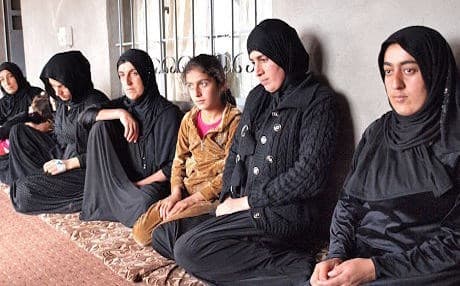
In a room warmed by a glowing kerosene heater and sunlight filtering through the windows, the women of the family sit on the floor, wearing black and remembering Hujam Surchi, the dead soldier whose face has turned into an icon across Kurdistan.
“It is a big honor that he was so brave,” says Evin, the soldier’s 19-year-old daughter, the eldest of 11 children, the youngest only a year old.
Well over 1,000 Peshmerga have been killed in a war with ISIS that began after the extremist Sunni group attacked Iraqi Kurdistan last summer. But Surchi’s death stands out because he was beheaded by a fellow Kurd in a video released by ISIS.
Apart from Western journalists and aid workers, the religious radicals have beheaded hundreds of local people, whose deaths received little or no international media attention. Among them were civilians opposed to ISIS, radicals trying to flee the group and captured soldiers fighting to defeat the insurgents.
Surchi, the commander of a unit of Kurdish fighters, was one such soldier.
A picture showing him kneeling before his ISIS executioner – resigned yet fearless -- went viral on the Internet, inspiring many to draw or paint his portrait. Across Kurdistan, his face covers the special collection boxes placed in local shopping centers to raise money for his large family. Already, nearly $20,000 have been raised by private collections in Sweden and the United States.
Evin, who together with another sibling is handicapped and has stretched her legs on the floor because of problems in her joints, recalls that the picture of her father -- which the family first saw on a Facebook posting -- had greatly shocked and pained the family.
“My father worked all the time to get us our medication,” she says. Now the Barzani Foundation, which is sponsored by the Kurdish government, is providing care.
The family is proud and thankful for all the support, says Evin, sitting in the room dominated by the black dresses of the women – Surchi’s 43-year-old widow, his mother, a sister and his daughters.
“He is our hero,” says Surchi’s cousin Salahadin Abdullah, 50. “He is the pride of Kurdistan because of the way he did not show any fear,” he adds, sitting on the floor opposite the women.
Although Surchi was loyal to the dominant Kurdistan Democratic Party (KDP), other parties also have offered help. The kind support of total strangers has greatly moved the family.
“We hope it will reach the families of other martyrs too,” says Evin, referring to other Peshmerga killed in the war. “We feel connected to all of them.”
But Surchi’s death stands out because his family knows who killed their loved one: the executioner was a Kurdish bread baker in the nearby town of Rovia.
The murderer’s family was known for its support first to al-Qaeda in Iraq, and later to ISIS. Five brothers from the family left to fight alongside the radicals, and caught up with Surchi after he was captured.
“Coincidence is also in the hands of Allah,” says Abdullah, Surchi’s cousin.
As the room fills up with more male family members, he recounts how the executioner’s family was picked up by the Kurdish security police after the brothers had joined ISIS. The government has evicted them all from Rovia, he says.
One of the other ISIS members seen in the video has since been killed by the Peshmerga.
“I am happy they caught him, but not that they beheaded him afterwards,” the cousin says, receiving hums of agreement. “That is a wrong thing for us Kurds to do.”
Surchi’s mother, who is bent over by age, describes her son as a “good boy for his mother. Everybody always listened to him.”
Others describe how he was always concerned for others, but never about himself. He was wounded in the feet, but did not tell anyone, not even his family, recalls his daughter. They only later learned about his wound.
“And because he was wounded he got caught,” explains his cousin.
Surchi was urgently called to the front for an offensive near Mosul, where he lost four men from his unit, and was captured himself.
“We give our lives for our honor, country and culture,” the cousin says, adding that the war against ISIS -- or daesh as locals call it -- “is not our war. If daesh comes to power here the whole world will have a problem.”
For that reason he calls on European countries not only to send good weapons but also ground troops, to help the Peshmerga confront ISIS.
Abdulrahman, one of Surchi’s two sons who followed in his father’s footsteps and joined the Peshmerga, enters the room where the family sits. He has been sent home after his father’s death but is ready to return to the front, even though he is now even more aware of the dangers.
“I go back to avenge my father,” the 21-year-old says quietly, as his sister quickly adds, “and if he gets the chance he will kill our father’s killer with his very own hands.”