


Alexander Whitcomb and Rekar Aziz
CHOMAN, Kurdistan Region - Iraq faces many challenges. In the south, a government must be formed as rival sectarian factions tear the country apart. In the north, a few brave men take on mankind’s oldest foe, nature, setting off on a two week kayak exploration of Kurdistan’s wildest mountain river.
“Does anybody have a knife?” booms Dave Burden, a giant, bearded, ox of a man and “International Paddlesports Ambassador” for the American Canoe Association.
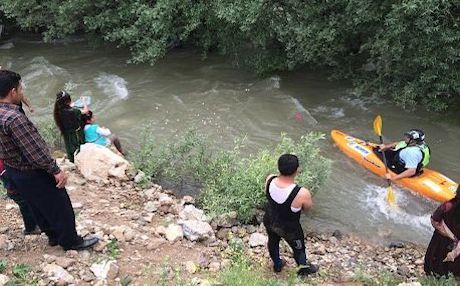
Someone supplies him with a blade. He quickly slices through his jean legs, illustrating the cut-off shorts concept to a bewildered Kurdish crowd. “Much better,” he says, hopping into a bright-orange river kayak and slipping into the water.
Andreas Bleiker, a Swiss adventure guide, launches another kayak. The crowd chases the two men as they quickly disappear down the river’s considerable rapids.
This begins a two-week kayaking exploration of an 80 kilometer stretch of the Choman-Rawanduz River in the northeast corner of Iraq. The paddlers start in Halgurd Sakran National Park, home to 1,100 square kilometers of protected land in the stunning Zagros Mountain range bordering Iran. It boasts the country’s tallest peak, Halgurd Mountain, at an altitude of 3,609 meters, along with a range of wildlife, including lynx, leopards, bears, and wolves.
The expedition will finish where the river flows into the Great Zab, the region’s last free-flowing river.
Nature Iraq, one of the organizers of the trip, is filming the journey from the boats and from the shore, documenting the natural beauty of their trip as well as interactions with locals -- many of whom have never seen boats on their river before. The film and the event itself is designed to raise awareness about the region’s significant tourism potential, as well as the importance of sustainable water practices needed to safeguard Kurdistan’s rivers.
After some time on the rapids Dave Burden emerges drenched in water, at a festival area prepared by the National Park and Choman city organizers.
“We really wanted to show you have incredible river resources here. This river is one of the best I have ever paddled, it’s really fun,” he says, still panting.
“People are learning that if you take care of the river, then the river can take care of you. It’s a very viable resource, but if you pollute it, if you put garbage in it, then you left it less valued tremendously -- we can’t come in to paddle, we can’t fish, can’t drink the water. If you keep putting pollution to it, it doesn’t go away, it ruins your river right at your home.”
As he speaks, Andreas Bleiker pulls himself onto shore, bleeding from his hand. While he had turned over his boat in the rapids, he cut himself on a nail while climbing out of the water. “You won’t just have to stop polluting, you’ll have to start cleaning the river up,” Bleiker announces to the hundreds of schoolchildren and locals who came to celebrate the expedition.
It will take time to change attitudes toward the river. Contradictions abound: As schoolchildren sing songs about nature and the history of the region, their classmates throw dozens of plastic balloons into the water. Local media mindlessly flick cigarette butts and drop garbage while they film children painting serene river landscapes.
Abdulwahid Gwany, mayor of Choman and the director of the national park, hopes that environmental education and nature tourism will engender more respect for water resources.
“Kurdish people’s attitude towards rivers is not necessarily good,” he says. “Right now they put the garbage into rivers as a force of habit. We want to make a loving relationship between people and rivers.”
The energetic and ambitious mayor is a reason to be hopeful. He has built a bona fide national park in an area that was devastated by warfare not long ago.
Landmines from the Iraq-Iran war of the 1980s still litter the mountains. It will take 20 to 30 years before the area can be fully cleared, but Adbulwahid has established safe areas for tourists to explore. He has enlisted the whole community to build his dream, from high school students to retired Peshmarga fighters.
Comments
Rudaw moderates all comments submitted on our website. We welcome comments which are relevant to the article and encourage further discussion about the issues that matter to you. We also welcome constructive criticism about Rudaw.
To be approved for publication, however, your comments must meet our community guidelines.
We will not tolerate the following: profanity, threats, personal attacks, vulgarity, abuse (such as sexism, racism, homophobia or xenophobia), or commercial or personal promotion.
Comments that do not meet our guidelines will be rejected. Comments are not edited – they are either approved or rejected.
Post a comment