


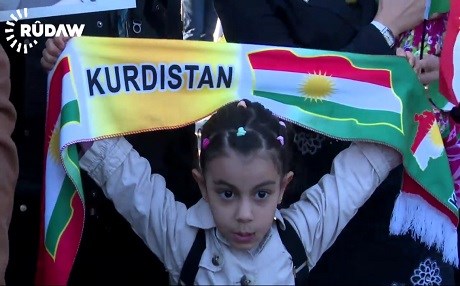
ERBIL, Kurdistan Region— On a sunny winter day in Erbil, a group of men, women and children, walk through the streets of the Kurdish capital and ask for their rights to be respected.
These are the forgotten Faili Kurds trapped between the bureaucratic systems of Iraq and its Kurdistan region.
“We want the same rights as any Kurd in this region; we want to vote here and we want to work here,” says a middle aged Faili Kurdish woman who has lived in Erbil since 2005 but still lacks the basic rights that other Kurds enjoy in Kurdistan, she says.
“The authorities tell me to go back to Diyala (north of Baghdad) and ask for my rights there; and there they tell us you are Kurds, go back to where you came from” she says.
“We want to be recognized as Kurds, first and foremost, but also as Faili Kurds with our own Kurdish national identity,” says another demonstrating man.
There are roughly 1.5 million Faili Kurds in Iraq with the majority of them living outside Kurdish administrated areas in provinces of Diyala, Khanaqeen and Baghdad. An estimated 10,000 Faili Kurds live in the Kurdistan region.
“I’ve lived here for 15 years and also built a family here, but now when I want to renew my identity card they tell me to issue it in Diyala. But I’m Kurdish, why should I go there,” asks another demonstrator who has come to the office of the Kurdistan presidency in Erbil hoping to find someone who would listen to his grievances.
During the Baath reign in Iraq, especially in the 1980s, many of Faili Kurds were deported either to Iran or out of Baghdad where there was a large Faili population prior to the Iran-Iraq war.
Nearly 30,000 Faili Kurds died in prisons and captivity during this period for which Iraq’s then foreign minister, Tariq Aziz, among others, was charged and convicted in 2010.
Iraq’s former ruler, Saddam Hussein, saw Failis, who were both Kurds and Shiites, as a threat to the Sunni system especially as the Failis were far from being marginalized in the Iraqi society before the Baathist rule with a high number of educated and largely active in the business sectors.
The official Iraqi policy viewed Failis as Iranian nationals as Iran already had a sizable Faili Kurdish community in a number of cities including in Kermanshah and Qasr-e Shirin.
Khanaqeen is largely controlled by Kurdish forces, but the rest of Diyala is outside the administration of Kurdistan Regional Government (KRG).
“We want to be represented in the KRG cabinet and the parliament; we want to have a voice as any other Kurdish group with distinctive identity and history,” said another demonstrator.
Kurdish language and national identity is home to a wide range of distinct dialects and faiths including the Yezidis, the Shabaks, the Kakayis and the Failis, among others, most of whom identify themselves primarily as Kurds.
Comments
Rudaw moderates all comments submitted on our website. We welcome comments which are relevant to the article and encourage further discussion about the issues that matter to you. We also welcome constructive criticism about Rudaw.
To be approved for publication, however, your comments must meet our community guidelines.
We will not tolerate the following: profanity, threats, personal attacks, vulgarity, abuse (such as sexism, racism, homophobia or xenophobia), or commercial or personal promotion.
Comments that do not meet our guidelines will be rejected. Comments are not edited – they are either approved or rejected.
Post a comment