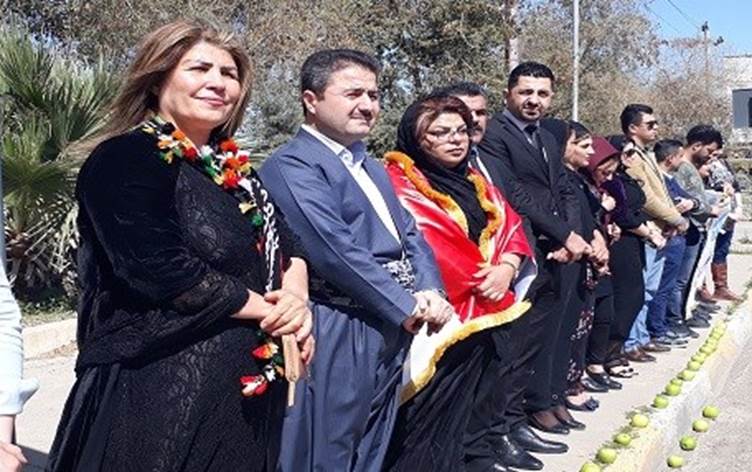


ERBIL, Kurdistan Region — Maryam, who has been separated from her family since the Halabja genocide, received support and comfort on the 30th anniversary of the attack from the University of Kurdistan-Hewler (UKH), where she currently studies.
UKH and its student union held a special ceremony on Halabja Street in Erbil on Friday morning because Maryam was unable to travel to and participate in commemoration events being held at her place of birth.
Nechirvan Mando, the president of the UKH Student Union, explained they wanted to memorialize the genocide in 1988.
“Since Maryam is one of our students and she’s a symbol of Halabja in Kurdistan, we thought it was important to organize this event today,” he said. “It was a sad day for all Kurds. “5,000 people gave their lives and it should never be forgotten.”
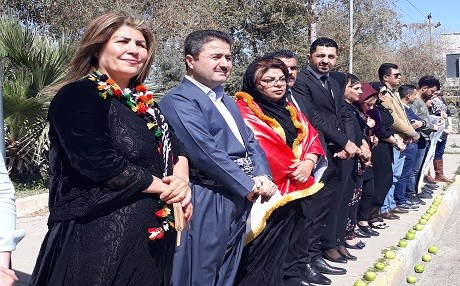
Standing in front of the Halabja Street sign not far from the UKH campus, Maryam, with a Kurdistan flag draped around her shoulders, was surrounded by people who care about her and wanted to bring her comfort on one of the most mournful days in Kurdish history.
Dozens of green apples had been placed on the street in front of her to symbolize how survivors have described the smell of chemicals on the day that Halabja was brutally bombed. Each person also released a white dove.
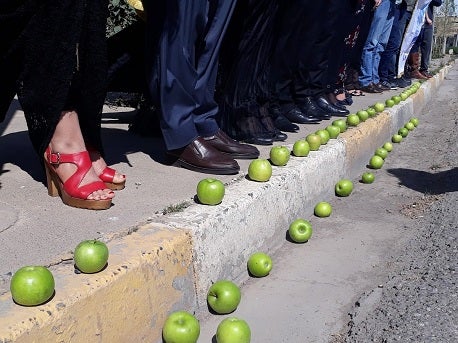
Survivors of Halabja have described how the chemical agents used in the Halabja attack smelled of apples. Photo by author
“These friends came with me today so that I am not alone, to show that I am not without close people,” Maryam told Rudaw. “I lost all of my family and they could not be found.”
Maryam, since being told by the man she knew as her father on his death bed in Iran that she was adopted and her place of birth, has been on a quest to find her biological family and return to her Kurdish roots for more than a decade.
In the chaos of the chemical attack many people from Halabja fled into Iran for shelter.
“They will remain with me as I am alive now, that I am still here, that Halabja is still alive,” she added.
Christine Crawford, Maryam’s English instructor at UKH for the past year-and-a-half, also spoke to Rudaw English.
“I’ve seen her struggle with all of this since I’ve known her,” she said of Maryam’s search for her biological family. “It’s painful, it’s really painful for her.”
When asked how Maryam has developed since she first started attending UKH, Crawford said she believed that being at the university has provided her with “a sense of a as normal of a life as possible.”
“It’s a community to support her,” the instructor added. “The fact that she has people around her who care for and look out for her, that’s helped.”
Crawford added that it was important for people to be at the ceremony to show their support for not only for Maryam, but for everyone else who lost loved ones, “whose lives have been altered in a way that they’ll never forget.”
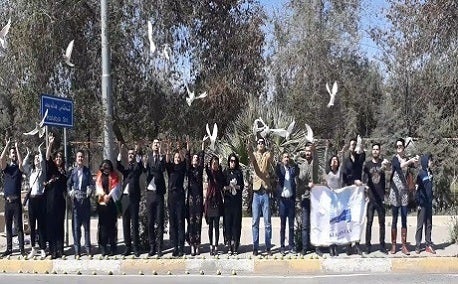
Friends of Maryam release doves in Erbil on March 16, 2018. Photo by author
Some 179 children have been reported missing by 73 families since the chemical attack 30 years ago, according to the Halabja Victims' Society. As of now, only eight children have rejoined their families. A further ten have come forward claiming to be lost children, but are still searching for proof through DNA testing.
Three years ago, Maryam thought she had finally discovered her true identity and been reunited with her mother and brother. But the DNA test results which had briefly brought her solace were found to be mistaken.
Maryam told Rudaw that she had a message, not only for greater Kurdistan, but for the world.
“We will stand against the mass killing of people,” she said. “We will stand against the genocide of people. We have Afrin, we had Shingal, we had Kobane, we have Yemen and Syria, and all of these places, but the powerful countries are silent for their own interests.”
“These people are innocent,” she added. “Halabja was the largest genocide. 5000 people were killed and 10,000 injured, but nobody cared to follow up and treat them.”
“We cannot do anything under the shadow of Iraq,” Maryam continued. “Political interests must end.”
Comments
Rudaw moderates all comments submitted on our website. We welcome comments which are relevant to the article and encourage further discussion about the issues that matter to you. We also welcome constructive criticism about Rudaw.
To be approved for publication, however, your comments must meet our community guidelines.
We will not tolerate the following: profanity, threats, personal attacks, vulgarity, abuse (such as sexism, racism, homophobia or xenophobia), or commercial or personal promotion.
Comments that do not meet our guidelines will be rejected. Comments are not edited – they are either approved or rejected.
Post a comment