


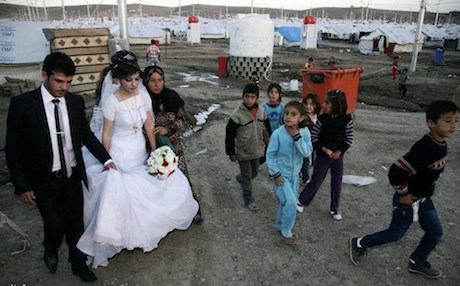
ERBIL, Kurdistan Region – At least 2,000 Yezidi couples have tied the knot over the last two years at refugee camps in Sulaimani and Duhok provinces, as life continues even in desperate circumstances and away from home, according to an official source.
“According to data we have collected at the refugee camps about marriage among the Yezidis, 2,000 couples have gotten married since 2014,” after the Islamic State (ISIS) attacked their city, Shingal, said Sozan Safar, head of Dak Organization to develop Yezidi Women, speaking to Rudaw.
Where they used to hold wedding parties at halls, dancing to drums and flutes, Kurdish dol and zurna, they now hold their wedding celebrations and honeymoons in the camps.
A week ago, a Kurdish Yezidi couple tied the knot under a tent at the Ashti refugee camp in Sulaimani. They say their displacement from home did not prevent them from fulfilling their dream of getting married.
“Displacement did not prevent us from getting married and fulfilling our dream,” Faris Hassan, who married Nahida Iddo, 17, told Rudaw.
Hassan, 22, is from Shingal. Two years ago, when ISIS overran the city, he fled alongside his family to Sulaimani and has been living at Ashti camp since then.
An official at Ashti camp revealed to Rudaw that since mid-2014, 22 young men and 12 young women have gotten married at the camp.
At Sharia camp in Duhok, the biggest Yezidi camp in the Kurdistan Region, the number is dramatically more.
“Nearly 360 Yezidis from both genders have gotten married at Sharia camp” since 2014, Saaud Misto, who runs the camp, told Rudaw.
One family did not support their young daughter’s relationship, so she and her boyfriend ran away to get married.
“My wife’s family was a neighbor of my sister in Sharia camp. In the beginning her family did not agree with my marriage proposal to her. Therefore we fled together to the house of my father’s uncle in Pishkhabour,” on the Kurdistan Region-Syria border, Wahid Saydo, 16, who is married to a15 year-old girl, told Rudaw.
Saydo added that for the marriage he gave his father-in-law 3,675,000 IQD ($ 2,600).
“I made my little family in debt and now I am unemployed, but we are happy in our life.”
Thousands of Yezidis are living in refugee camps. There are seventeen camps in Duhok and two in Sulaimani. Although many of the Yezidis have family members still being held captive by ISIS, they are continuing with their lives and forming new families under the tents of their camps.
A Yezidi woman, also 15, married her boyfriend eight months ago. She used to live in a refugee camp in Duhok, but her and her husband decided to start their new life outside the misery of the refugee camps.
“I had a love relationship with my husband for three years. We were not sure of our returning to our home [Shingal]. That is why we decided to tie the knot at the refugee camp,” said Ibtisam Khalid.
Hassan Rasho, Faris’s father, believes Yezidi girls are still afraid that ISIS may return and so are choosing to marry rather than remain single.
“Even now, our girls are afraid of the return of ISIS. Therefore we let our daughters get married early. Before, we would not let our girls get married until they had finished their studies,” said Rasho.
But, Rasho explained that "we do not force our girls to marry.”
The head of Ashti camp agrees with Rasho. “Probably, [the Yezidi] families are still afraid of ISIS and that’s why they let their girls married at an early age.”
And head of the Dak organization blames financial stress for child marriage describing it as a “dangerous phenomenon.”
“It is true that life has not stopped at the Yezidi camps and there are marriages among them and this makes us happy. What really concerns us is that girls under 18 are getting married and this is all because of their miserable economic conditions. Unfortunately, this has become a dangerous phenomenon,” said Safar.
Comments
Rudaw moderates all comments submitted on our website. We welcome comments which are relevant to the article and encourage further discussion about the issues that matter to you. We also welcome constructive criticism about Rudaw.
To be approved for publication, however, your comments must meet our community guidelines.
We will not tolerate the following: profanity, threats, personal attacks, vulgarity, abuse (such as sexism, racism, homophobia or xenophobia), or commercial or personal promotion.
Comments that do not meet our guidelines will be rejected. Comments are not edited – they are either approved or rejected.
Post a comment