


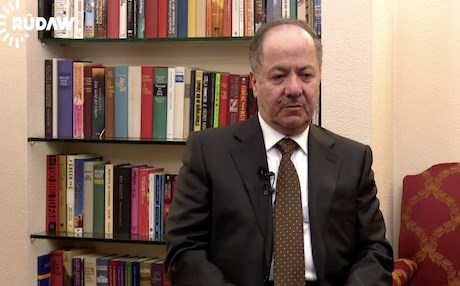
DAVOS, Switzerland — Kurdish President Masoud Barzani told Rudaw from Davos that it is expected the new US Donald Trump-led administration will support the Kurdistan Region because many of those who are set to take leadership roles in the new US administration are friends with Kurds.
“Fortunately, many of those who are supposed to take high positions are acquainted and friends with me personally and Kurdistan,” Barzani said. The US Vice President-elect [Mike Pence] emphasized to me on the phone his support and friendship [to the Kurdistan Region]. We are confident there will even more support to us.”
In an interview with Kurdish media, Barzani answered range of questions from Rudaw's Alla Shali with regards to an independence referendum, Erbil-Baghdad relations, internal issues in the region, and the Kurdish roles in Turkey and Syria.
Barzani said on the sidelines of the World Economic Forum in Davos, Switzerland, that if diplomatic efforts between Kurdistan Region and the government of Iraq fail, the Kurdistan Regional Government (KRG) will make moves toward independence.
“We will not give up on the independence process for the Kurdistan Region," said Barzani. “I discussed this subject with Baghdad when I visited Baghdad.”
“Reaching an agreement with Baghdad on this will pave the way for many other countries to recognize us. That is why we will continue until we exhaust the way of dialogue with Baghdad to reach a positive result, so we don’t have to take other steps. But we will certainly take other steps if we lose hope in this [dialogue with Baghdad].”
A time frame for referendum was not set.
“The best thing is to engage in serious work and fewer words,” Barzani added. “We are trying to do everything we can as soon as possible.”
Barzani emphasized that talks between the two governments haven’t been productive. The Kurdistan Region has been suffering a financial crunch after its budget share was withheld by the former Prime Minister Nouri al-Maliki in mid-2014.
“We can be good neighbors with the future Iraq," Barzani said. "We were unable to be good partners. This is the reality and those who do not recognize this, do not want the truth to be known.”
Barzani spoke toward KRG’s role in upcoming peace talks toward a ceasefire in the nearly six-year Syrian civil war, which has international powers backing various factions within the country.
“The Kurdistan Region will not take part in Astana talks,” Barzani remarked. “We wanted to be assistive for Kurdish participation in it. We are not invited so the Kurdistan Regional Government is not going to take part in it. Overall, I am pessimistic about the future of Syria, as it has become very complicated. Unfortunately, I do not see a delightful future for Syria, nor the Kurds, in particular.”
Barzani expressed that there is no easy solution in Syria.
“It is a tough question as the Russia and America with their strength are stuck and cannot solve it,” he said. “ It has become so complicated and needs time.”
With the peace process between Ankara and Kurds in Turkey shattered, Barzani said when asked, he would not hesitate to help restart negotiations.
“War is bad. A year of talks is better than an hour of fighting,” Barzani said, repeating his words from a recent visit to Turkey. “I was afraid of the consequence of what we see now in Turkey. Unfortunately, the time has not come yet to resume peace process. When we see there is an opportunity to restart the peace process we will not hesitate to help resume the process. But, unfortunately, bad things have happened until now.”
Barzani met with high-ranking officials over the past three days in Davos at the forum which was attended by 3,000 of the world’s leaders in economics, business and politics, including outgoing US Vice President Joe Biden and Dutch Prime Minister Mark Rutte.
“We saw many of the attending officials,” Barzani said. “They showed a lot of respect to the endeavors and sacrifices of the Peshmerga and the resilience of our nation. And we are proud of this. They all showed commitment to continue their current support and future relations with the Kurdistan Region.”
Among the topics discussed was continued financial support for Kurdistan after conflicts around Mosul settle down.
“They can help us in building a strong economic system and fulfill our reforms policy in the Kurdistan Region,” Barzani said. “It is, however, difficult for them to give us cash. This is not that easy. There is, however, a possibility that they can contribute financially in some matters, namely in the case of refugees and some other projects which can benefit the people of Kurdistan. But the most important thing is that they are ready to come and help us build a robust economic infrastructure in the Kurdistan Region.”
Commenting on internal issues and a political stalemate which the region has been suffering from for nearly two years, Barzani stressed the importance of an agreement between his party, the Kurdistan Democratic Party (KDP), and the Patriotic Union of Kurdistan (PUK) to resolve all existing crises within the Kurdistan Region.
“Reaching an agreement with the Patriotic Union of Kurdistan is very important and will affect other parties,” Barzani said. “But the Kurdistan Democratic Party will not return to what was known as the five-pronged meetings.”
Kurdish Peshmerga forces have been embroiled in a fight with ISIS since 2014, and more than 1.8 million refugees and displaced people from Iraq have sought refuge in the Kurdistan Region.
The five major parties in the Kurdistan Region jointly had been meeting together since August 2016, but the talks hadn’t progressed.
“I no longer accept this notion, nor will the KDP participate in these five-pronged meetings anymore,” Barzani said. “The meetings should be broader. At least, the parties involved in running the government and the parliament should take part, and others should be consulted. I am personally OK with all of them to participate in the meetings. But the five-pronged meetings are over.”
Comments
Rudaw moderates all comments submitted on our website. We welcome comments which are relevant to the article and encourage further discussion about the issues that matter to you. We also welcome constructive criticism about Rudaw.
To be approved for publication, however, your comments must meet our community guidelines.
We will not tolerate the following: profanity, threats, personal attacks, vulgarity, abuse (such as sexism, racism, homophobia or xenophobia), or commercial or personal promotion.
Comments that do not meet our guidelines will be rejected. Comments are not edited – they are either approved or rejected.
Post a comment