


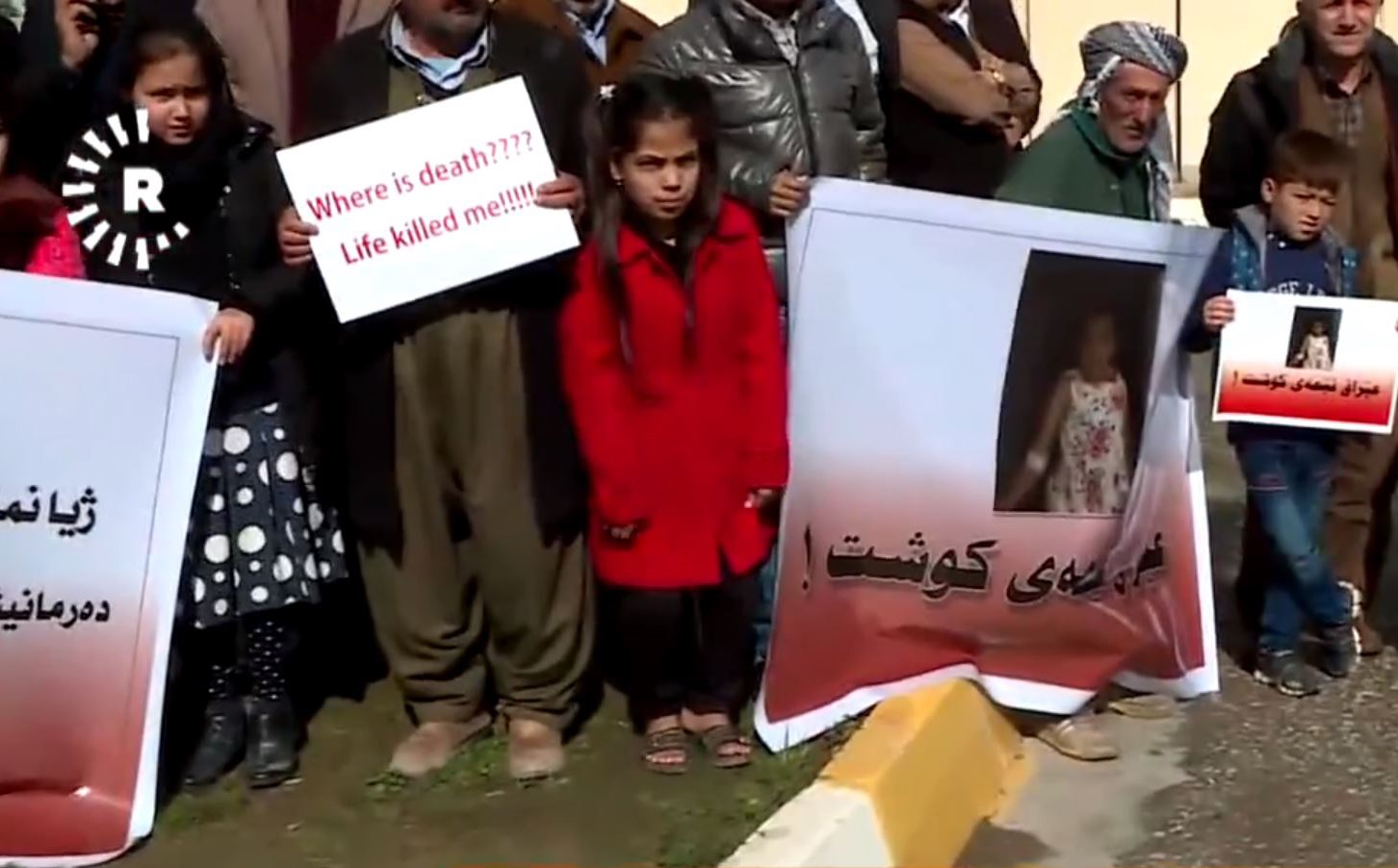
ERBIL, Kurdistan Region – A small group of people suffering from cancer, thalassemia, and other illnesses gathered on Monday in front of the UN compound in Erbil to protest the Iraqi government withholding Kurdistan Region’s share of medicines.
“Throughout the time medicine has not been sent, we have faced numerous issues. I was hospitalized for five months. The issue with medicine is truly a great injustice,” a young patient suffering from thalassemia told Rudaw.
He accused the leaders of politicizing a health matter.
“[Lack of medicine] resulted in my heart, most of my body and even my kidneys becoming weak,” he added.
The tens of protestors, who also included some diagnosed with autism, raised signs with slogans like “Iraq killed us” and “Our lives are dependent on medicine and medicine is with the Iraqi government.”
At least 15 individuals suffering from thalassemia have died recently due to the lack of medicine or needed medical care, the KRG’s office responsible for humanitarian aid, the Joint Crisis Coordination Centre (JCC), reported at the beginning of the year.
According to the JCC, of 3,600 thalassemia patients in the Region, only 211 have been able to travel abroad for necessary treatment since the international flight ban that was imposed by Baghdad after the independence referendum. Their health is put at further risk because Baghdad has failed to send the Region the medicines needed to treat the disease.
The protestors have written a letter to the UN in both Kurdish and English. They plan to remain in front of the UN building, continuing their protest for three days.
The international flight ban has had a crippling effect on humanitarian aid and health of the residents of the Kurdistan Region.
In September, 219 tons of humanitarian aid – health and non-food items – were brought into the Region through Erbil and Sulaimani airports.
After the flight ban came into effect on September 29, that number dropped dramatically. In October, a mere two tons of aid was brought in through the airports and none at all in November and December, according to JCC figures.
Additionally, the KRG has not received adequate medical supplies from the Iraqi government since Baghdad cut its budget in 2014.
The 1.8 million refugees and IDPs sheltering in the Kurdistan Region have exacerbated the medicine shortage.
KRG’s Health Minister Dr. Rekawt Hama Rasheed told Rudaw at the end of January that the Iraqi government will send the KRG medicine and other medical necessities worth 170 billion Iraqi dinars ($143 million) in 2018.
“Throughout the time medicine has not been sent, we have faced numerous issues. I was hospitalized for five months. The issue with medicine is truly a great injustice,” a young patient suffering from thalassemia told Rudaw.
He accused the leaders of politicizing a health matter.
“[Lack of medicine] resulted in my heart, most of my body and even my kidneys becoming weak,” he added.
The tens of protestors, who also included some diagnosed with autism, raised signs with slogans like “Iraq killed us” and “Our lives are dependent on medicine and medicine is with the Iraqi government.”
At least 15 individuals suffering from thalassemia have died recently due to the lack of medicine or needed medical care, the KRG’s office responsible for humanitarian aid, the Joint Crisis Coordination Centre (JCC), reported at the beginning of the year.
According to the JCC, of 3,600 thalassemia patients in the Region, only 211 have been able to travel abroad for necessary treatment since the international flight ban that was imposed by Baghdad after the independence referendum. Their health is put at further risk because Baghdad has failed to send the Region the medicines needed to treat the disease.
The protestors have written a letter to the UN in both Kurdish and English. They plan to remain in front of the UN building, continuing their protest for three days.
The international flight ban has had a crippling effect on humanitarian aid and health of the residents of the Kurdistan Region.
In September, 219 tons of humanitarian aid – health and non-food items – were brought into the Region through Erbil and Sulaimani airports.
After the flight ban came into effect on September 29, that number dropped dramatically. In October, a mere two tons of aid was brought in through the airports and none at all in November and December, according to JCC figures.
Additionally, the KRG has not received adequate medical supplies from the Iraqi government since Baghdad cut its budget in 2014.
The 1.8 million refugees and IDPs sheltering in the Kurdistan Region have exacerbated the medicine shortage.
KRG’s Health Minister Dr. Rekawt Hama Rasheed told Rudaw at the end of January that the Iraqi government will send the KRG medicine and other medical necessities worth 170 billion Iraqi dinars ($143 million) in 2018.
Comments
Rudaw moderates all comments submitted on our website. We welcome comments which are relevant to the article and encourage further discussion about the issues that matter to you. We also welcome constructive criticism about Rudaw.
To be approved for publication, however, your comments must meet our community guidelines.
We will not tolerate the following: profanity, threats, personal attacks, vulgarity, abuse (such as sexism, racism, homophobia or xenophobia), or commercial or personal promotion.
Comments that do not meet our guidelines will be rejected. Comments are not edited – they are either approved or rejected.
Post a comment