


Kurdistan

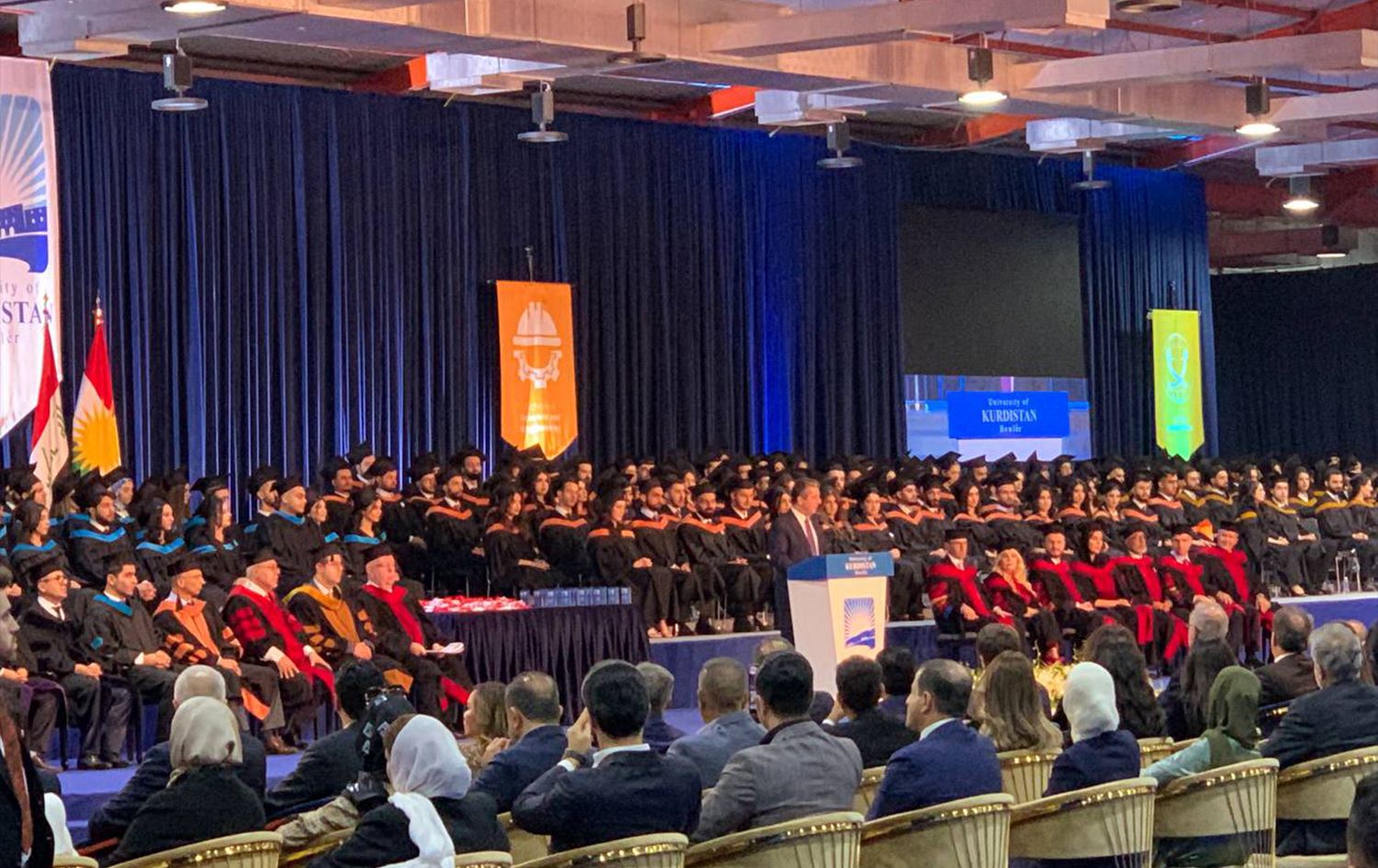
Kurdistan Region Prime Minister Masrour Barzani addressing 235 students during the UKH graduating class of 2022 on October 20, 2022. Photo: Julian Bechocha/Rudaw
ERBIL, Kurdistan Region - All fears of employment expressed by students of a top Erbil private university were curbed by Prime Minister Masrour Barzani, who assured the graduating class during a ceremony on Thursday of their potentially promising role in the region’s economy in a region yet to fully recover from conflict and years of economic turmoil during the war with the Islamic State (ISIS).
Addressing the University of Kurdistan Hewler (UKH) graduating class of 2022, Kurdistan Region Prime Minister Masrour Barzani conveyed to the graduates their status as having emerged from a “prestigious” institution in the country and one whose students the premier said “find themselves a role in the public and private workforce for the development of Kurdistan.”
Barzani shone light on what he called the Kurdistan Region’s “greatest asset” - human capital - and stressed that his government will provide the tools necessary, including loans, for graduates to unlock their greatest strengths and utilize them for the betterment of the Region.
“Our government will soon be announcing loans to small, medium, and scalable businesses to jumpstart projects in key industries including agriculture, tourism, and technology,” Barzani said while expressing optimism about the Region’s future, particularly the ongoing digitalization initiative whose progress the prime minister called “extraordinary.”
In a bid to transform government services, Barzani on Wednesday announced the Kurdistan Regional Government’s (KRG) Digital Transformation Strategy, which aims to ease access for the Region’s citizens to “simpler, faster, connected, secure, and transparent services that are tailored to their needs” by 2025. The strategy also aims to make interactions between KRG’s agencies completely paperless by 2023.
UKH was founded by Kurdistan Region President Nechirvan Barzani in 2006 and is widely regarded across the Kurdistan Region as an institution whose graduates receive significantly higher employment opportunities and maintain a strong favorability while applying to vacancies in the private sector.
A total of 235 undergraduate, graduate, and postgraduate students received their degrees during the graduation ceremony on Thursday.
“I have seen graduates, including from this university, helping deliver tax and social security reform and new agriculture exports into Gulf markets, and fixing our banking sector. I have been humbled to receive their informed views of challenges and questions ... this is what we are capable of,” Prime Minister Barzani added.
The premier, however, said that the Kurdistan Region’s future is influenced by what happens in Iraq and that events in Baghdad “affect and disrupt” the Region. Despite the remark, Barzani commended the expediting of the government formation process in Iraq and praised the country’s new political leaders, expecting them to enact change.
“We have always extended a hand of support to Iraqis in Baghdad. I will do so again today, with ways to capture flared gas and managing digitalization and public finances,” the premier said.
Keith Sharp, president of the UKH, stressed during his opening remarks how rapid technological advancements are changing the global economy and the world of work, and how tackling those changes requires effort from the educators.
He urged educators to face these challenges through innovating their curriculums in ways “which anticipate the skills needs of the future,” as well as asking them to equip students with high levels of flexibility and adaptability to prepare them for the ever-changing world.
Rudaw English spoke to Sharp about the university’s high employment rate and what distinguishes it from other institutions in the region.
“We know that the employment rate of our students is at over 95 percent. It is a very high rate, and by that we mean people who have either gone into employment or in many cases on to further studies such as a master’s degree,” Sharp said, distinguishing the university from other private and public institutions by saying its “academic standards are very, very high.”
“We try to encourage our students to be creative, critical thinkers, to be problem solvers, and not to accept the world around them as it is … they are innovators and that is what employers look for,” the president added, calling the university a “genuinely international benchmarked” one that compares to elite universities in Europe and the United States.
Marshall Billingslea, Chair of the UKH’s Governing Board, congratulated the students on their graduation, urging them to become leaders and catalysts for change.
Billingslea stated that his ties with the Kurdistan Region go back to a quarter of a century ago, and highlighted the significant progress the Region has made during that period of time.
“The Kurdish people were the largest nation on Earth without their own nation. But in the past 25 years, all of that has changed, under the leadership of your president, your prime minister, and their predecessors; you finally have your own land. Erbil has become a city of light and a beacon to the rest of Iraq. It’s also a beacon of hope for Kurds in neighboring regions who are being prosecuted and slaughtered by some of your neighbors,” said Billingslea.
UKH is located in the center of the Region’s capital of Erbil and offers studies at the undergraduate and graduate levels in science, engineering, social sciences, medicine, and business in the English language.
A major deterrent to high school graduates seeking a seat in one of UKH’s many departments is very high tuition, ranging from $3,000 all the way to $10,500 per year. While students contest for scholarships provided at the beginning of every academic year, their number is very limited, alienating students of lower income from securing a seat.
On @UKH_official graduation today : a lot of UKH students are upper-middle class citizens graduated from private schools. I hope to see more from public school students ( economically not so well), then one can observe a real development through positive social mobilization.
— Hemin H Mirkhan (@MirkhanHemin) October 20, 2022
When asked about whether a plan exists to increase scholarships awarded at the university, Sharp called on companies and organizations in the Kurdistan Region to pledge financial resources for students seeking to pursue studies at the university.
“This is one of the most important acts of generosity the businesses and good people of Kurdistan can offer by sponsoring a student who is brilliant but maybe doesn’t have the financial resources to study at the university,” he said.
Glar Sabah Hussein, a computer engineering graduate, labeled UKH as a beacon of stability in a region of tense geopolitics and unstable economics while affirming Sharp’s claims of an above 95% graduate employment rate through her own experience.
“I was in my final stage during my final exam and a couple of companies, including Schlumberger, British Council, and Vision Education reached out to me and I can say that I’m quite happy with the amount of education and experience I received in UKH that prepared me for the real world,” Hussein told Rudaw English, adding that she has already been employed for three months and is “very satisfied” with her job.
Meanwhile, business and management graduate Lucas Salah Kika also told Rudaw English he has found a stable, well-paying job thanks to the education and mentorship he received at UKH, expressing hope to one day start his own agency.
“I was extremely satisfied with the employment offers I received immediately upon graduating which really goes to show the high-quality education I obtained from UKH and moreover eliminates any potential regret for not seeking my undergraduate studies elsewhere,” Kika said.
As the ceremony came to a close, Sara Abdulrazaq, another graduate, gave a speech on behalf of all the students and expressed her gratitude for UKH as it was the “starting point” of her achievements.
“We learned that words can be strong enough to change the destiny of a nation. You would love your university enough to criticize it and participate in changing it,” Abdulrazaq ended.


Comments
Rudaw moderates all comments submitted on our website. We welcome comments which are relevant to the article and encourage further discussion about the issues that matter to you. We also welcome constructive criticism about Rudaw.
To be approved for publication, however, your comments must meet our community guidelines.
We will not tolerate the following: profanity, threats, personal attacks, vulgarity, abuse (such as sexism, racism, homophobia or xenophobia), or commercial or personal promotion.
Comments that do not meet our guidelines will be rejected. Comments are not edited – they are either approved or rejected.
Post a comment