ERBIL, Kurdistan Region - Kurdish Journalism Day is marked annually on April 22, commemorating the release of the first issue of Kurdistan newspaper in 1898, a milestone that laid the foundation for Kurdish media and continues today with publications like Riya Teze, which has remained in print for nearly a century.
Kurdistan newspaper, published in Cairo in 1898 by the renowned Kurdish literary figure Miqdad Midhat Bedir Khan, was written in the Kurmanji dialect. A total of 31 issues were published over four years. It faced intense scrutiny and censorship from the Ottoman Empire, which forced it to cease operations after its 31st issue in 1902.
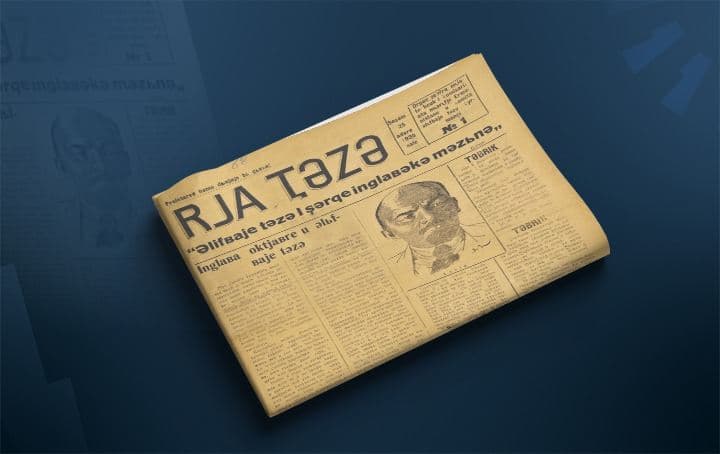
Kurdish intellectuals later found new space for cultural visibility and journalistic expression in cities such as the Armenian capital Yerevan, then part of the Soviet Union. There, they established Riya Teze (The New Path) in 1930. It played a key role in standardizing Kurmanji Kurdish. Initially published using the Latin alphabet, it switched to Cyrillic from 1937 to 2001, in line with Soviet policies.
Ninety-six years after its founding, Riya Teze continues to publish in Kurdish today using the Latin alphabet.
The first issue, published on March 25, 1930, featured the rallying cry from Karl Marx and Friedrich Engels’ Communist Manifesto: “Workers of the World, Unite!” It also included a photograph of Vladimir Lenin, accompanied by his quote: “The new alphabet is a great revolution in the East.”
Next to Lenin’s photo, the headline read: “The October [1917] Revolution and the New Alphabet.” Soviet leaders viewed the process of “Latinization” as a way to expand literacy, unify non-Russian nations, and weaken traditional ties between Soviet Muslims and the Middle East.
Before the collapse of the Soviet Union in 1991, four official daily newspapers were published in the region - in Russian, Kurdish, Azeri, and Armenian. Riya Teze was the official Kurdish-language publication. It had a circulation of around 4,000 copies per issue, distributed across the Soviet Union and reaching Europe, the United States, and Canada.
In 1932, copies of Riya Teze, along with several books published in Yerevan, were delivered to Jaladat Ali Bedir Khan, the nephew of Miqdad Midhat Bedir Khan. The Bedir Khan family are descendants of the medieval Kurdish principality of Bohtan (1335–1855). In response, Jaladat wrote in the eighth issue of Hawar:
"A Kurmanji newspaper, written in the modern alphabet and in fluent Kurmanji, is being published in Yerevan in a beautiful and orderly manner. Recently, several issues reached our hands. Our eyes were brightened by them, and our hearts were filled with joy and cheer. Beyond the newspaper, the Kurds of Yerevan have also published several books. We spent three or four days engrossed in them. Within their rich, fresh pages, one could catch the scent of the poppies of Mount Alagaz [Aragats in Armenian - northwest of Yerevan] and the breeze of the high pastures of Sarhad [Northeastern of today’s Turkey]. In their photographs, one could see the traditional Kurdish shel u shapik, along with the daggers and belts of our forefathers."
Hawar, established by Jaladat in 1932, published 57 issues before closing in 1943. Like Riya Teze, it played a major role in standardizing the Kurdish alphabet and advancing Kurdish literature.
In the same piece, Jaladat acknowledged his peer: "Riya Teze newspaper - as its name suggests, it is fresh and a new arrival—is actually older than Hawar, and its history is longer. The latest issue that has reached our hands is number 59. Given that Riya Teze is a newspaper published every ten days, it is clear that it has been in circulation for a year and a bit."
Kurdish leaders commemorate Kurdish Journalism Day
Kurdish leaders on Tuesday marked the 128th anniversary of the first issue of Kurdistan and the 28th anniversary of the Kurdistan Journalism Syndicate, reaffirming support for journalists and press freedom.
President Masoud Barzani, in a statement, expressed “sincere wishes for the success and prosperity to all our dear journalists and media professionals in Kurdistan.”
He also reiterated support for journalists in their “important role in defending the just cause of our people” and promoting coexistence, as well as preserving the “lofty values of Kurdish society.”
Kurdistan Region President Nechirvan Barzani, in a statement, described freedom of the press as a “fundamental pillar of democracy and an advanced civil society,” reaffirming commitment to protecting that right.
He also encouraged media workers to “enhance the spirit of patriotism and love for the homeland.”
Kurdistan Region Prime Minister Masrour Barzani also expressed support for journalism.
“Today we recall our commitment to defending the freedom of the press and journalism and facilitating the work of journalists in Kurdistan,” he said.