


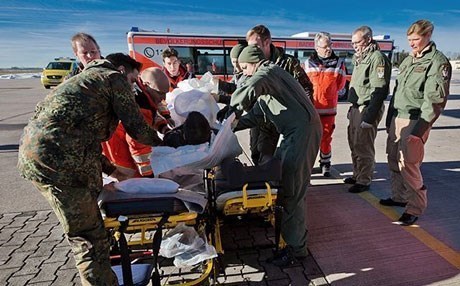
ERBIL, Kurdistan Region—Sixty-two wounded Peshmerga are due to travel to Turkey on Friday to receive treatment, paid for by Turkey, Kurdish officials have confirmed.
The Turkish government has agreed to treat 62 wounded Peshmerga, Abdulkhaliq Muhammad, media officer at the Kurdistan Regional Government’s (KRG) Department of Foreign Affairs, confirmed to Rudaw.
The head of the Peshmerga Ministry’s department of health, Major General Muhsin Mohammad Rasheed also confirmed to Rudaw that the wounded Peshmerga were travelling through Erbil airport to Turkey on Friday.
Turkey had stated it was ready to provide medical treatment to wounded Peshmerga in a meeting earlier this month between Turkey’s consul general in Erbil, Akif Inam, and Kurdish head of foreign relations Falah Mustafa.
Medical treatment for wounded Peshmerga is a serious concern.
Since the outbreak of war between Kurdish forces and the Islamic State (ISIS), more than 8,700 Peshmerga soldiers have been wounded, the Peshmerga ministry said in June. Some of them have been treated in foreign countries while most are still “in urgent need medical help.”
Maj. Rasheed told Rudaw in June that many of the 1,500 Peshmerga deaths could have been prevented if there were proper medical facilities on the frontlines to treat the soldiers at the time of injury with good follow up in hospitals later on.
Some Peshmerga have been sent abroad to receive treatment, racking up a debt of several million dollars for the Kurdish government.
“The ministry now owes 2 million dollars to hospitals abroad and can’t pay the bills,” Maj. Rasheed said in June. “About 1 million euros to Greece, $410,000 to Turkey, 400 million Iraqi dinars to VIN hospital in Dohuk, and some million Iraqi dinars to hospitals in Erbil.”
The Turkish government has agreed to treat 62 wounded Peshmerga, Abdulkhaliq Muhammad, media officer at the Kurdistan Regional Government’s (KRG) Department of Foreign Affairs, confirmed to Rudaw.
The head of the Peshmerga Ministry’s department of health, Major General Muhsin Mohammad Rasheed also confirmed to Rudaw that the wounded Peshmerga were travelling through Erbil airport to Turkey on Friday.
Turkey had stated it was ready to provide medical treatment to wounded Peshmerga in a meeting earlier this month between Turkey’s consul general in Erbil, Akif Inam, and Kurdish head of foreign relations Falah Mustafa.
Medical treatment for wounded Peshmerga is a serious concern.
Since the outbreak of war between Kurdish forces and the Islamic State (ISIS), more than 8,700 Peshmerga soldiers have been wounded, the Peshmerga ministry said in June. Some of them have been treated in foreign countries while most are still “in urgent need medical help.”
Maj. Rasheed told Rudaw in June that many of the 1,500 Peshmerga deaths could have been prevented if there were proper medical facilities on the frontlines to treat the soldiers at the time of injury with good follow up in hospitals later on.
Some Peshmerga have been sent abroad to receive treatment, racking up a debt of several million dollars for the Kurdish government.
“The ministry now owes 2 million dollars to hospitals abroad and can’t pay the bills,” Maj. Rasheed said in June. “About 1 million euros to Greece, $410,000 to Turkey, 400 million Iraqi dinars to VIN hospital in Dohuk, and some million Iraqi dinars to hospitals in Erbil.”
Comments
Rudaw moderates all comments submitted on our website. We welcome comments which are relevant to the article and encourage further discussion about the issues that matter to you. We also welcome constructive criticism about Rudaw.
To be approved for publication, however, your comments must meet our community guidelines.
We will not tolerate the following: profanity, threats, personal attacks, vulgarity, abuse (such as sexism, racism, homophobia or xenophobia), or commercial or personal promotion.
Comments that do not meet our guidelines will be rejected. Comments are not edited – they are either approved or rejected.
Post a comment