


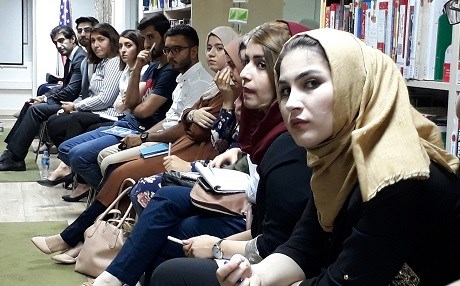
ERBIL, Kurdistan Region – The role of youth in building social cohesion within their communities, post-ISIS was the focus of a Global Shapers event in Erbil this week.
“Overall, indeed this was a very crucial session with different perspectives,” said Eman Ibrahim, a curator of the event that gathered a group of youths from varying backgrounds, ethnicities and religions at the University of Kurdistan-Hewler (UKH). “I know there are a lot of youth with great ideas who just don’t have the facilities to share them.”
Kurdish Muslims, Iraqis and Syrians, Christians and Yezidis, and diaspora Kurds and expats discussed issues like what roles youth play in shaping social cohesion post-ISIS, diminishing racism and breaking taboos or stereotypes, and how the government can help youth engage more within their community.
“As you can see, there weren’t a lot of people criticizing each other,” Ibrahim said of the discussions. “There was more of an understanding. They all agreed on one point which is going out into the community to encourage more dialogue among youths” to improve relationships between different communities.
“In this kind of dialogue, you get to know more people, you know their struggles, you know their concerns which create more ideas for future dialogues and discussions,” she added.
“Overall, indeed this was a very crucial session with different perspectives,” said Eman Ibrahim, a curator of the event that gathered a group of youths from varying backgrounds, ethnicities and religions at the University of Kurdistan-Hewler (UKH). “I know there are a lot of youth with great ideas who just don’t have the facilities to share them.”
Kurdish Muslims, Iraqis and Syrians, Christians and Yezidis, and diaspora Kurds and expats discussed issues like what roles youth play in shaping social cohesion post-ISIS, diminishing racism and breaking taboos or stereotypes, and how the government can help youth engage more within their community.
“As you can see, there weren’t a lot of people criticizing each other,” Ibrahim said of the discussions. “There was more of an understanding. They all agreed on one point which is going out into the community to encourage more dialogue among youths” to improve relationships between different communities.
“In this kind of dialogue, you get to know more people, you know their struggles, you know their concerns which create more ideas for future dialogues and discussions,” she added.

Small group sessions and roundtable discussions were part of the Global Shapers event.
Ibrahim suggested the idea of going out from UKH to other universities as well as camps for Internally Displaced Persons (IDPs) or refugees to create more dialogue on making change in the future and possibly providing psychological support.
“When you have people who have undergone a lot of instability and trauma, the first thing you have to do is provide some sort of stabilization which is actually a good method to bring people together,” said one participant who asked not to be named.
He went on to say that by people sharing their own experiences, this would eventually create cohesion and understanding between different communities.
The Global Shapers Erbil Hub, the only one in Iraq, is one of 250 other similar hubs worldwide working to empower youth through dialogue, action and change within their communities.
“What we do is try to impact the communities through development programs and capacity building programs,” explained another curator of the event, Biza Barzo, a political researcher who also works on humanitarian issues.
“We are all volunteers here,” she said. “We get together and we brainstorm what’s the gap to be filled in the society, what can we do, what’s in our hands and what’s tangible and then we come up with projects.”
She explained that this week’s brainstorming session was the first of several which will continue throughout implementation stages of encouraging change and bringing different ethnic and religious communities together.
For the next step, Barzo said, youth will be put into concentrated groups and assigned tasks such as capacity building programs or delivering leadership programs, followed by delivering their projects to the community.
Barzo explained that Global Shapers Erbil Hub has been doing such work since 2015 and have so far completed between 40 and 50 projects mostly for recent university or high school graduates to encourage them to use certain skills to help build their future.
“We have had the privilege to learn it elsewhere,” said Barzo, who grew up in Sweden. “These people have not had the privilege to learn this.”
She said she felt “absolutely amazing” about the discussions that day.
“We hear them all and talk about it and we get ideas,” she said mentioning there were great ideas from all of the different communities.
“We want to give society a hand to help themselves with, so that they stop relying on the government or any other power to help them, but start with themselves.”
“We [the volunteers] are just here for a jump start,” she explained. “We hope this will be a butterfly effect on the community.”
Comments
Rudaw moderates all comments submitted on our website. We welcome comments which are relevant to the article and encourage further discussion about the issues that matter to you. We also welcome constructive criticism about Rudaw.
To be approved for publication, however, your comments must meet our community guidelines.
We will not tolerate the following: profanity, threats, personal attacks, vulgarity, abuse (such as sexism, racism, homophobia or xenophobia), or commercial or personal promotion.
Comments that do not meet our guidelines will be rejected. Comments are not edited – they are either approved or rejected.
Post a comment