


Kurdistan

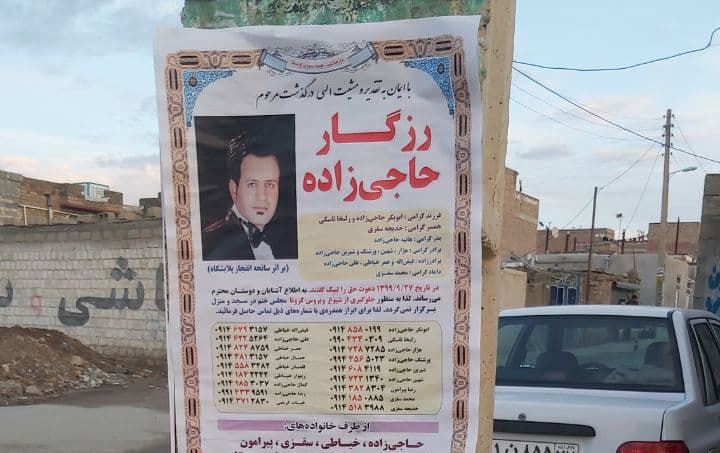
Rizgar’s funeral announcement in the Majburawa neighbourhood of Bokan,Kurdistan province on December 23, 2020. Photo: Jabar Dastbaz / Rudaw
SULAIMANI, Kurdistan Region — Khadija’s heart skipped a beat when a friend of her husband told her that her husband, Rizgar, was in hospital. She left her sleeping daughter and rushed to his bedside, but she was too late. In the absence of her loved ones, who were hundreds of miles away, she mourned her husband’s untimely death alone.
Like thousands before him, Rizgar Hajizadeh left the Kurdish west of Iran for the Kurdistan Region in search of work, hoping that he’d be able to permanently return home in time to enrol his three-year-old daughter at school. But the 30-year-old died on December 17, 2020, in an explosion at the illegally-established oil refinery he worked at in Duhok.
The surge of Iranians across their home country’s western border in search of work followed US sanctions imposed from 2018 onwards that devastated Iran’s economy. Before the coronavirus brought cross-border travel to an end for much of 2020, there were some 35,000 Iranians being paid on a daily basis for their work in the Kurdistan Region, news agency ILNA said, citing “unofficial statistics”.
Most leave without a guaranteed job waiting for them, and without the necessary papers they need. They take on high-risk jobs that other people don’t want to take on, mostly in construction. Without legal or company backing, they are not compensated in the event of a work accident causing death or injury, leaving their dependent families in the lurch.
Rizgar left his hometown of Bokan, West Azerbaijan province for the Kurdistan Region six years ago “because of a lack of job opportunities”, his older brother Hazhar said. He worked in Erbil for four years, then Duhok, where he soldered at the oil refinery, zipping back home now and again for precious time with relatives – but border closures brought on by the coronavirus compelled him, his wife and his children to stay in Bokan for six months, until the borders were reopened three months ago.
News of his death and a call to attend his funeral is plastered across the walls of Majburawa, the impoverished Bokan neighbourhood where Rizgar’s family lives. Well-wishers pour into their home to offer their condolences, his parents, siblings, and wife sat grief-stricken.
“We talked on the phone the night before he died, he was joyful, I told him “I’ve missed you,” and he said ‘dear father, I will work a bit more and I will be back to visit you’,” Rizgar’s father Abubakir told Rudaw English, wiping tears from under his glasses.
“I won’t recover from this sorrow. But I am urging relevant parties of this incident help Rizgar’s wife and daughter because we are a poor family and need aid,” Abubakir said.
“We were renting a house near Rizgar’s workplace for $80. Rizgar was getting paid $700, and we were satisfied with our life, but what can we do?” said Khadija, his wife of seven years.
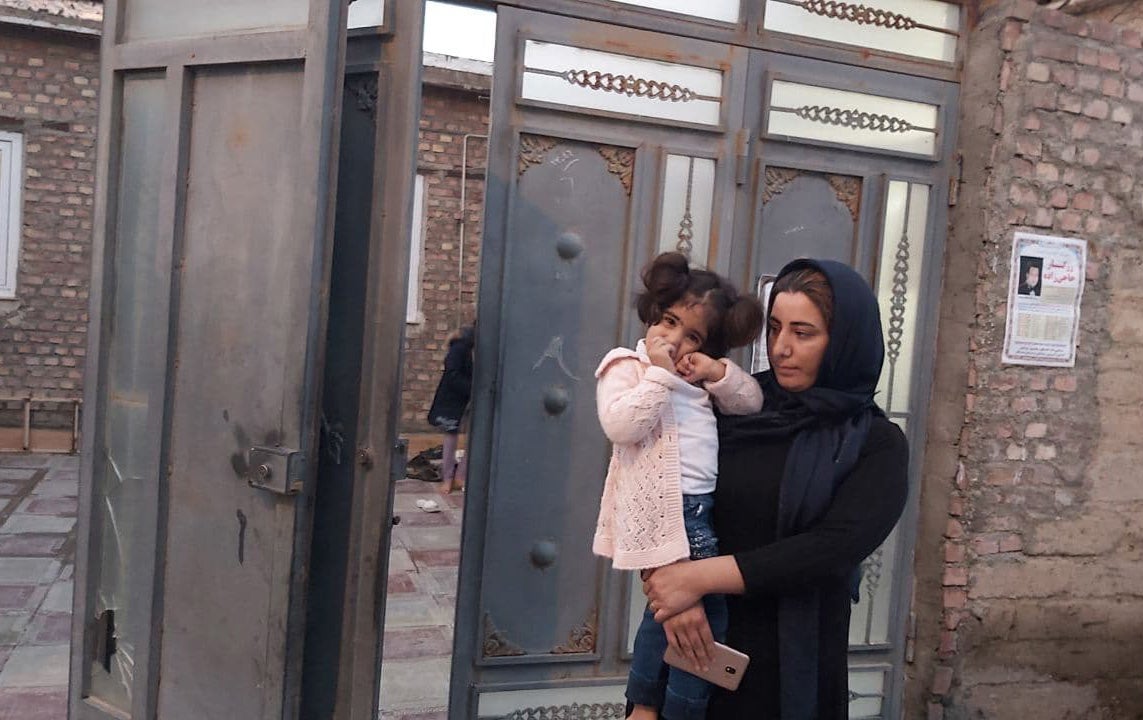
“I have no complaints about his employer, because he was very good to us – I only ask them to keep an eye on my daughter, because we really have no income,” she said, her three-year-old daughter Hania in her arms.
Though their illegal travel means there are no official numbers on the number of Iranians who go the Kurdistan Region. But at the Bashmakh crossing at the Iraq-Iran border, workers can be seen travelling both ways.
Waiting to get his passport stamped for entry into the Kurdistan Region is Kawa Ahmedi, a 35-year-old father of two from Sanandaj, the capital of western Iran’s Kurdistan province. On his back he carried two sacks holding winter clothing and reminders of home.
“I have a wife and two children, and I have been working in the electricity sector for six years in the Kurdistan Region,” said Kawa, eyes red with exhaustion.
“Most Iranian workers working in the Kurdistan Region enter on the pretext of tourism, then return after a month. They will stamp our passports for one month as tourists – after that we have to go back to Iran, because it expires.”
“People occasionally get a work visa when they come here if a company supports them, and if they are specialists, not normal workers”.
At a three-story building in Sulaimani’s Bakrajo Street was 57-year-old construction worker Mustafa Stari, who came to the Kurdistan Region five years ago.
“We used to be well paid, but a foreman gets paid 30,000 dinars and a worker 15,000 dinars a day. Although this is twice the amount for the same work in Iran, it’s not without its trouble,” he said, dusting off his moustache.
Despite the pay reduction, many employers fail to pay Iranian migrant workers for their work, Mustafa said.
“I was working for a man in Erbil three years ago, he went into hiding and didn’t give me my $600. I filed a complaint with the Asayesh (security forces), but to no avail.”
“This hasn’t happened just to me. Most of those who come from Iran to work here don’t get paid all their money by the employers. If you don’t know someone here, people won’t do anything for you.”
Mustafa, who came to Sulaimani from Paveh, Kermanshah province with his friends, also bemoaned the lack of a safety net for Iranian workers in the Kurdistan Region.
“There is no insurance here, if anything happens you are responsible and you won’t be compensated. One month ago, someone from Sina (Sanandaj) died from electrocution, but his family wasn’t compensated.”
You can easily spot the Iranian workers near Sulaimani’s grand mosque, the skin on their cheeks scratched and their clothes ragged, waiting at a food stall for chickpea sandwiches costing 1,000 dinars. Among them is Hamid Saadi, a 27-year-old from Saqqez, Kurdistan province, who sends his mother and three sisters money every month to cover their basic expenses.
“I’ve been painting buildings here for four years, because not only are jobs scarce in Iran, but the money wasn’t worth anything,” he told Rudaw English.
Hamid, in his work clothes, shows me an old hotel, paint peeling from its window frames, in which he rents a room with three of his friends, “I work for 20,000 dinars a day, I pay 5,000 to the hotel, but the lack of electricity during the heat and cold devastates us. This winter we've been shivering from the cold at times, but what can we do?"
Translation by Khazan Jangiz


Comments
Rudaw moderates all comments submitted on our website. We welcome comments which are relevant to the article and encourage further discussion about the issues that matter to you. We also welcome constructive criticism about Rudaw.
To be approved for publication, however, your comments must meet our community guidelines.
We will not tolerate the following: profanity, threats, personal attacks, vulgarity, abuse (such as sexism, racism, homophobia or xenophobia), or commercial or personal promotion.
Comments that do not meet our guidelines will be rejected. Comments are not edited – they are either approved or rejected.
Post a comment