


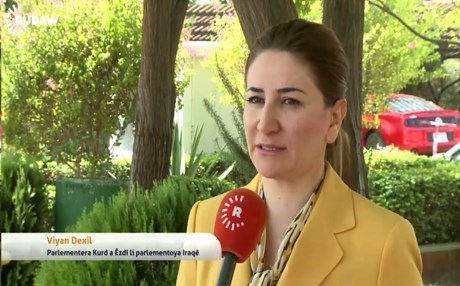
PARIS, France-- The prominent Yezidi lawmaker Vian Dakhil says trust among Iraq's diverse communities has been lost after decades of ethnic cleansing against the country's minority groups to a point that its probable restoration is possible only by direct international support.
Speaking at a conference titled "The Future of Yezidis and Christians After the Mosul War," Dakhil said religious persecutions in Iraq have put large groups of ethnic minorities on the run which now constitute one of the largest refugee groups in the world.
"The Yezidis faced the persecution because of their faith, which is why international commitment is a precondition for the restoration of trust," she said.
"The Yezidis are a people in dire conditions, living in refugees camps across the Kurdistan Region which has already hosted millions of other displaced families. It's a condition imposed on the Yezidis," she added.
Dakhil, a member of the Iraqi parliament, made international headlines in 2014 after her emotional cry for help in the wake of Islamic State militants' onslaught on Yezidi city of Shingal in August 2014.
Speaking live on Rudaw TV on August 4, as the ISIS rampage was still unfolding, Dakhil was likely the first person who disclosed the abduction of Yezidi women following the ISIS invasion.
"It's a genocide in the making," she said during a moving speech at the time. "It's the responsibility of the Iraqi government, the Kurdish government and the international community to stop this vicious crime against my people," she said fighting tears.
In Paris, Dakhil told the conference that around 3,000 Yezidi women were still missing, the majority of them still in ISIS captivity, probably in Syria. She also said many of the rescued women had suffered from "unimaginable traumas" and needed professional medical care.
According to official reports conducted by the Iraqi parliament, over 2700 Yezidi children have lost one or both parents while 600 children and the elderly have died when escaping to the Mount Shingal after the initial attack on Shingal and the surrounding Yezidi villages on August 3, 2014.
The reports indicate that nearly 6000 Yezidi men, women and children were abducted in the first days of ISIS attack. Many of the female prisoners were transferred to Syria where they were treated as war trophies, while the majority of the men were executed, multiple eyewitnesses have told Human Rights’ Watch.
In July, a special UN commission established that the violations committed by the ISIS militants against the Yezidi minority in Iraq constitute genocide, which also calls for international protection of the group.
But the Yezidis are far from the only minority group facing persecution and war crimes in the country.
Christians, Shabaks and Kurds have in the past seen lengthy and often government-backed campaigns of forceful dislocations, imprisonments and outright genocide.
According to the rights groups, nearly half of the country's 2 million Christians have fled Iraq since 2003 after systematic attacks by various militia groups on their communities in Baghdad and elsewhere in the country.
The Iraqi government in 2009 officially recognized the genocide of the Kurds during 1980s, known as the Anfal Campaign, in which according to Kurdish government 180,000 people, Kurds, Christians and Turkmen lost their lives in concentration camps across southern deserts in Iraq.
The Iraqi government has also recognized war crimes committed against Shiites in the closing days of first Gulf War in 1991 as over 100,000 Shiites were killed in former regime's crackdown of the popular revolt.
"Iraq has been a home of crises for the Yezidis and Christians," Dakhil said. "There are to date no Christian or Yezidi cabinet member in the Iraqi government which says a lot about the country," she added.
Speaking at a conference titled "The Future of Yezidis and Christians After the Mosul War," Dakhil said religious persecutions in Iraq have put large groups of ethnic minorities on the run which now constitute one of the largest refugee groups in the world.
"The Yezidis faced the persecution because of their faith, which is why international commitment is a precondition for the restoration of trust," she said.
"The Yezidis are a people in dire conditions, living in refugees camps across the Kurdistan Region which has already hosted millions of other displaced families. It's a condition imposed on the Yezidis," she added.
Dakhil, a member of the Iraqi parliament, made international headlines in 2014 after her emotional cry for help in the wake of Islamic State militants' onslaught on Yezidi city of Shingal in August 2014.
Speaking live on Rudaw TV on August 4, as the ISIS rampage was still unfolding, Dakhil was likely the first person who disclosed the abduction of Yezidi women following the ISIS invasion.
"It's a genocide in the making," she said during a moving speech at the time. "It's the responsibility of the Iraqi government, the Kurdish government and the international community to stop this vicious crime against my people," she said fighting tears.
In Paris, Dakhil told the conference that around 3,000 Yezidi women were still missing, the majority of them still in ISIS captivity, probably in Syria. She also said many of the rescued women had suffered from "unimaginable traumas" and needed professional medical care.
According to official reports conducted by the Iraqi parliament, over 2700 Yezidi children have lost one or both parents while 600 children and the elderly have died when escaping to the Mount Shingal after the initial attack on Shingal and the surrounding Yezidi villages on August 3, 2014.
The reports indicate that nearly 6000 Yezidi men, women and children were abducted in the first days of ISIS attack. Many of the female prisoners were transferred to Syria where they were treated as war trophies, while the majority of the men were executed, multiple eyewitnesses have told Human Rights’ Watch.
In July, a special UN commission established that the violations committed by the ISIS militants against the Yezidi minority in Iraq constitute genocide, which also calls for international protection of the group.
But the Yezidis are far from the only minority group facing persecution and war crimes in the country.
Christians, Shabaks and Kurds have in the past seen lengthy and often government-backed campaigns of forceful dislocations, imprisonments and outright genocide.
According to the rights groups, nearly half of the country's 2 million Christians have fled Iraq since 2003 after systematic attacks by various militia groups on their communities in Baghdad and elsewhere in the country.
The Iraqi government in 2009 officially recognized the genocide of the Kurds during 1980s, known as the Anfal Campaign, in which according to Kurdish government 180,000 people, Kurds, Christians and Turkmen lost their lives in concentration camps across southern deserts in Iraq.
The Iraqi government has also recognized war crimes committed against Shiites in the closing days of first Gulf War in 1991 as over 100,000 Shiites were killed in former regime's crackdown of the popular revolt.
"Iraq has been a home of crises for the Yezidis and Christians," Dakhil said. "There are to date no Christian or Yezidi cabinet member in the Iraqi government which says a lot about the country," she added.
Comments
Rudaw moderates all comments submitted on our website. We welcome comments which are relevant to the article and encourage further discussion about the issues that matter to you. We also welcome constructive criticism about Rudaw.
To be approved for publication, however, your comments must meet our community guidelines.
We will not tolerate the following: profanity, threats, personal attacks, vulgarity, abuse (such as sexism, racism, homophobia or xenophobia), or commercial or personal promotion.
Comments that do not meet our guidelines will be rejected. Comments are not edited – they are either approved or rejected.
Post a comment