


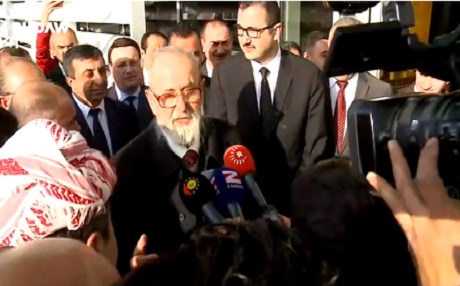
ERBIL, Iraq — The leader of the Yezidi community Mir Tahsin Beg arrived in Erbil on Sunday presumably to attend the memorial services for her deceased wife Tirko Shex Jondi who died Wednesday in Kurdistan Region at the age of 75.
The Yezidi leader left Kurdistan nearly three years ago for urgent medical treatment in the United Kingdom.
“Now that I’m here I am well, thank God,” the 84 year old Tahsin Beg said who has been a religious and community leader since 1944 after his father Saeid Beg died.
It was not immediately known whether the Yezidi leader would hold any meetings with Iraqi or Kurdish officials regarding the Yezidi refugee crisis and the reconstruction of their main city of Shingal.
Mir Tahsin Beg is expected to visit Yezidi refugee camps in Erbil and Dohuk and also travel to Shingal which so far remains a ghost town as few families have decided to return to the city.
The Kurdish official estimates say roughly 1 million people see themselves as the followers of the Yezidi faith but many have migrated from the country after as well as before ISIS assault.
According to the directorate of the Yezidi affairs in the Kurdish government, half of the entire Yzidi population live in southern parts of Kurdistan in Dohuk, Musol, Shekhan and Shingal areas.
Lalesh is the holy center of Yezidis. It is located north of the Shekhan town in southern part of Kurdistan, where even Shekh Adi Musafir is buried. There are a number of other Yezidi sites across Kurdistan, which attract hundreds of pilgrims each year.
In July, a special UN commission established that the violations committed by the ISIS militants against the Yezidi minority in Iraq constitute genocide, which also calls for international protection of the group.
Comments
Rudaw moderates all comments submitted on our website. We welcome comments which are relevant to the article and encourage further discussion about the issues that matter to you. We also welcome constructive criticism about Rudaw.
To be approved for publication, however, your comments must meet our community guidelines.
We will not tolerate the following: profanity, threats, personal attacks, vulgarity, abuse (such as sexism, racism, homophobia or xenophobia), or commercial or personal promotion.
Comments that do not meet our guidelines will be rejected. Comments are not edited – they are either approved or rejected.
Post a comment