


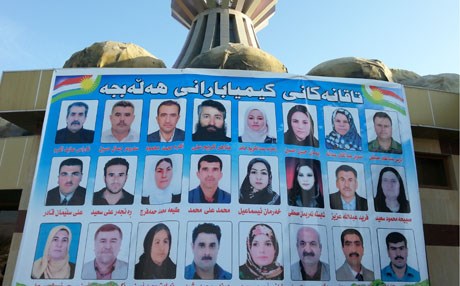
HALABJA, Kurdistan Region — Two survivors of the 1988 Halabja chemical attack have died awaiting long-delayed treatments because of budget cuts by the Iraqi government, raising to 89 the number of initial survivors who have died since 2003.
The Iraqi government under the Saddam Hussein regime bombarded Halabja with banned chemical weapons on March 16, 1988, which immediately resulted in an estimated 5,000 dead Halabjans and left another 10,000—many who cannot afford costly treatments outside Iraq—injured.
Haji Mahmud, who was blinded by the attack, died last week. Another survivor, Akram Rashid, died in January from health complications.
According to the Halabja Chemical Victims Society, there are now 400 attack survivors who need treatment for cancer, respiratory and dermatological problems; 254 of whom need urgent special treatment abroad.
The Kurdistan region has been struggling with a financial crisis since January 2014 when the Iraqi government cut its budget in opposition to Kurdistan’s independent oil exports. As a result, salaries were delayed, projects put on hold and social and health programs slashed, including the treatment program for Halabja victims funded by the Kurdistan Regional Government.
Under a Baghdad-Erbil deal struck in December 2014, the Iraqi government is supposed to send the KRG’s budget payments in return for the Kurds exporting 550,000 barrels per day (BPD). The monthly payments are often delayed and have not been enough to cover the KRG’s expenses.
“The lives of human beings should not be linked to a financial crisis,” the Halabja Chemical Victims Society said in a statement last week. It also called on the KRG and Iraqi government to fulfil their responsibilities to victims.
The treatment program began in 2005 when the regional government of Carinthia in Austria agreed to cover the treatment costs of eight injured survivors for two weeks. Then the Kurdistani presidency funded the program for 65 injured in 2007 and finally the KRG’s ministry of Martyrs and Anfal Affairs took over responsibility.
The Iraqi High Criminal Court recognized the Halabja massacre as an act of genocide in March 2010. On April 14, the remembrance day of the Anfal genocide campaign in Kurdistan, the KRG said in a statement that Baghdad should be held accountable for the Kurdish genocide and has “morale and legal obligations” to compensate the survivors.
The Iraqi government under the Saddam Hussein regime bombarded Halabja with banned chemical weapons on March 16, 1988, which immediately resulted in an estimated 5,000 dead Halabjans and left another 10,000—many who cannot afford costly treatments outside Iraq—injured.
Haji Mahmud, who was blinded by the attack, died last week. Another survivor, Akram Rashid, died in January from health complications.
According to the Halabja Chemical Victims Society, there are now 400 attack survivors who need treatment for cancer, respiratory and dermatological problems; 254 of whom need urgent special treatment abroad.
The Kurdistan region has been struggling with a financial crisis since January 2014 when the Iraqi government cut its budget in opposition to Kurdistan’s independent oil exports. As a result, salaries were delayed, projects put on hold and social and health programs slashed, including the treatment program for Halabja victims funded by the Kurdistan Regional Government.
Under a Baghdad-Erbil deal struck in December 2014, the Iraqi government is supposed to send the KRG’s budget payments in return for the Kurds exporting 550,000 barrels per day (BPD). The monthly payments are often delayed and have not been enough to cover the KRG’s expenses.
“The lives of human beings should not be linked to a financial crisis,” the Halabja Chemical Victims Society said in a statement last week. It also called on the KRG and Iraqi government to fulfil their responsibilities to victims.
The treatment program began in 2005 when the regional government of Carinthia in Austria agreed to cover the treatment costs of eight injured survivors for two weeks. Then the Kurdistani presidency funded the program for 65 injured in 2007 and finally the KRG’s ministry of Martyrs and Anfal Affairs took over responsibility.
The Iraqi High Criminal Court recognized the Halabja massacre as an act of genocide in March 2010. On April 14, the remembrance day of the Anfal genocide campaign in Kurdistan, the KRG said in a statement that Baghdad should be held accountable for the Kurdish genocide and has “morale and legal obligations” to compensate the survivors.
Comments
Rudaw moderates all comments submitted on our website. We welcome comments which are relevant to the article and encourage further discussion about the issues that matter to you. We also welcome constructive criticism about Rudaw.
To be approved for publication, however, your comments must meet our community guidelines.
We will not tolerate the following: profanity, threats, personal attacks, vulgarity, abuse (such as sexism, racism, homophobia or xenophobia), or commercial or personal promotion.
Comments that do not meet our guidelines will be rejected. Comments are not edited – they are either approved or rejected.
Post a comment