


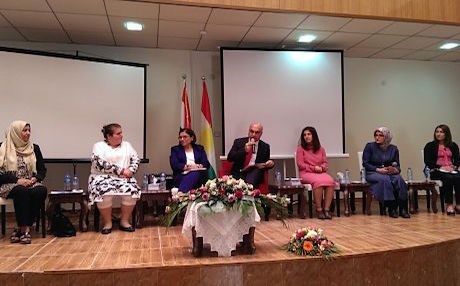
LALESH, Kurdistan Region - Reconciliation is a must if Iraq is to have a future, a mixed Kurdish, Arabic and international audience was told at the holy Yezidi town of Lalesh on Monday where there was a discussing about ways to restart life after the Islamic State (ISIS) occupation.
While the first Lalesh Peace and Coexistence conference, last year, came up with a roadmap for rebuilding the Sinjar region where thousands of Yezidis were kidnapped and killed, the second one now focussed on steps needed before any rebuilding could start such as addressing the anger.
With a large part of Sinjar now free, the organisers of Ashti Women Leaders for Peace Group, the Emma Organisation for Humanitarian Development and the Dutch NGO Hivos, invited outsiders and experts to look at possible ways forward.
During the conference it was clear that for many it is too early for any practical talk about rebuilding. That it still is important to talk about their grievances against those in their communities who worked with ISIS, and those who they feel did not do enough to help. The call to rescue the around 2,500 Yezidis still in ISIS captivity was repeated time and again.
Emotions ran high when the first panel focused on examples from the past that could help reconciliation and rehabilitation in Iraq.
Former speaker of the Kurdistan Parliament and Patriotic Union of Kurdistan (PUK) politician, Adnan Mufti, recalled the role of the Kurdistani Front formed by Kurdish parties in the eighties, as “a stepping stone after the uprising” of 1991 to the Kurdistan Government of today.
He hailed the amnesty that after 1991 was issued for all those involved in the battles, including those who fought for the Iraqi dictator Saddam Hussein, as one of the most important effects of the Front. “The public pardon was to encourage people not to seek revenge. Otherwise we would have all turned into gangsters.”
When someone in the audience rose, demanding to know how a pardon could be considered for perpetrators of the savage crimes against Yezidis, and how this could possibly prevent repetition, panellist Dr. Gregory Stanton of Genocide Watch hastened to declare that “for genocide there can never be amnesty.”
As he called the ISIS crimes against Yezidis, Christians and other smaller religious groups in Iraq “classic genocide”, he pointed out that justice after any genocide is something for the International Criminal Court.
He added that for instance for Rwanda that was not even enough, suggesting this might be the case for Iraq, too. “It had its own courts; thousands of trials to restore those people who were the survivors.”
Rosemary Willey-Al’Sanah of the United Nation’s development organisation UNDP stressed the need for justice to prevent revenge, and for the expertise in this process of those who already went through the same process.
“We will not rebuild any houses by revenge killings in Mosul,” she stated, pointing to the “fine line between justice and revenge. We have to understand the difference, knowing that revenge will only fuel the fire.”
Restoring justice is just as important as rebuilding, reconnecting services and creating livelihoods, she said. “We have to convince those who are hurt and raw to get beyond revenge.”
Courses and workshops “may seem silly” but do make a difference, she said, quoting a Yezidi woman after a course: “She said: after I escaped and heard of bombing in Mosul, I wanted all to die, even the children. Now I understand we need to end this violence together.”
Women are key to the healing process, said Niemat Ahmadi of the Save Darfur Coalition, an eyewitness of the genocide in Sudan’s Darfur region who works on reconciliation.
“The women of Darfur have gone through the same as the Yezidis,” she said, calling rape “an instrument of war. When you attack a woman, you attack a whole society, because it affects mothers, sisters, daughters.” For that reason, she called on men to become more involved, and speak out against it.
Like her, Gregory Stanton pointed to the role women could play in the process towards coexistence. “Women talk until they resolve the conflict. If we use women, we have a better chance towards reconciliation,” he said, adding that “men must learn to think like women; not one war was ever planned by a woman, while they did have powerful queens.”
It is the United Nation’s policy to involve women in peace talks and conflict resolutions, and calls were heard during the conference for this to happen in Iraq, too.
But at the same time, panellists pointed to the conservative culture. “We love women to be peacemakers and decision makers,” said one, “but will they listen to them?”
“The community has to accept the idea of women playing a role in creating peaceful coexistence,” stated Pakshan Zangana, who leads the Women’s High Council inside the Kurdistan government. “We have to work against the taboo.”
And she called on Kurdish leaders to “instead of just making statements, engage women on all levels and create the same opportunities for all.”
Comments
Rudaw moderates all comments submitted on our website. We welcome comments which are relevant to the article and encourage further discussion about the issues that matter to you. We also welcome constructive criticism about Rudaw.
To be approved for publication, however, your comments must meet our community guidelines.
We will not tolerate the following: profanity, threats, personal attacks, vulgarity, abuse (such as sexism, racism, homophobia or xenophobia), or commercial or personal promotion.
Comments that do not meet our guidelines will be rejected. Comments are not edited – they are either approved or rejected.
Post a comment