

Error occured during this request! Please try again later.

Najah Mohammed, 11, poses for a photo at her house in Basrma camp on May 24, 2022. Photo: Karwan Faidhi Dri/Rudaw
After waiting for a year for the celebration of the Kurdish New Year, Newroz, Najah Mohammed and her family excitedly headed to the famous Kashkoul market in the Syrian capital on the eve of the event on March 20, 2018. Little did they know that a merciless rocket would tear through the market, kill five of the family members, and leave the rest with life-changing injuries. The 11-year-old Najah, whose left leg was severely wounded, pleaded through Rudaw English on Tuesday for her leg to be saved, as doctors have warned that it will have to be amputated if she does not immediately receive medical care abroad.
The family had been searching for a peaceful life by moving to different parts of Syria, fleeing the country’s civil war which began with an uprising in 2011. They resided in the regime-controlled Jaramana city located in southeast Damascus province, believing that these areas would be more secure than the ones held by the rebels, Najah’s mother, Layla Attallah, told Rudaw English on Tuesday.
Layla said her children wanted to buy some sweets for her for Newroz, on March 21, coinciding with Mother’s Day. Kurds picnic during Newroz celebrations and wear Kurdish clothes.
At least 35 people were killed and tens were injured in the rocket attack on the bustling market the Kurdish family visited. The market is close to the eastern parts of the then-rebel-controlled Ghouta which saw constant clashes between both sides. The regime claimed that the rebels had carried out the attack but many victims blamed the army.
The Kurdish family was featured by both local and international media due to the heavy toll the attack took on their lives. Layla showed Rudaw English several videos by news outlets which featured her as one of the main witnesses of the bombing.
Najah has a vague recollection of what happened on that deadly day, but her mother vividly remembers the day that changed their lives forever.
“I suddenly found myself lying on the ground. I saw Najah lying under the sweets table … I realised that there was something in my mouth - it was mud. I saw about 60 people lying on the ground. I still did not realise what had happened,” the 37-year-old mother told Rudaw English at her house in Basrma refugee camp in Erbil province on Tuesday.
“My son [Alaa] came and put his head on my leg. I asked what had happened to him but he died right away. My daughter [Leen] could not even move as her stomach had torn up,” she recounted, holding back the tears that filled her eyes.
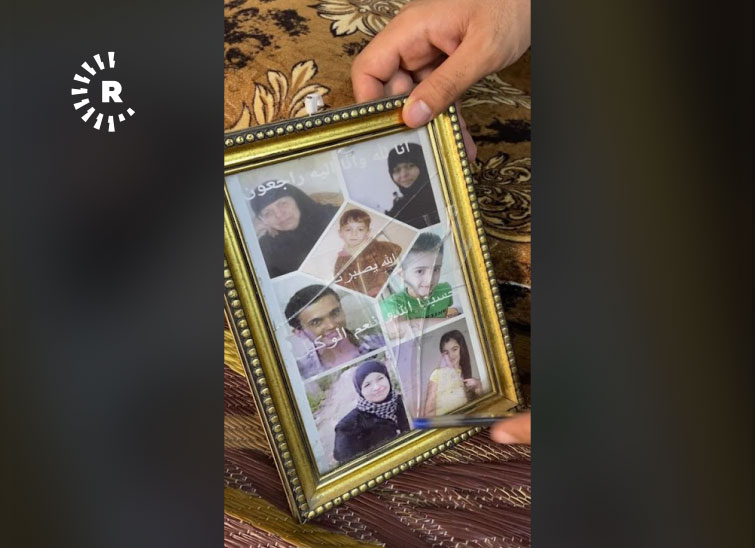
In addition to Alaa and Leen, their step brother, his mother, and aunt also met their end in the attack.
Journey to save Najah’s leg
Layla, whose left leg has been amputated due to the rocket attack, decided to knock on all doors to avoid a similar fate for her daughter.
She has taken Najah to several hospitals in Syria to try and save her leg. Two years ago, she moved to Basrma camp with her daughter and newly-born son. Her husband, who was also injured in his right arm in the incident, joined them last year.
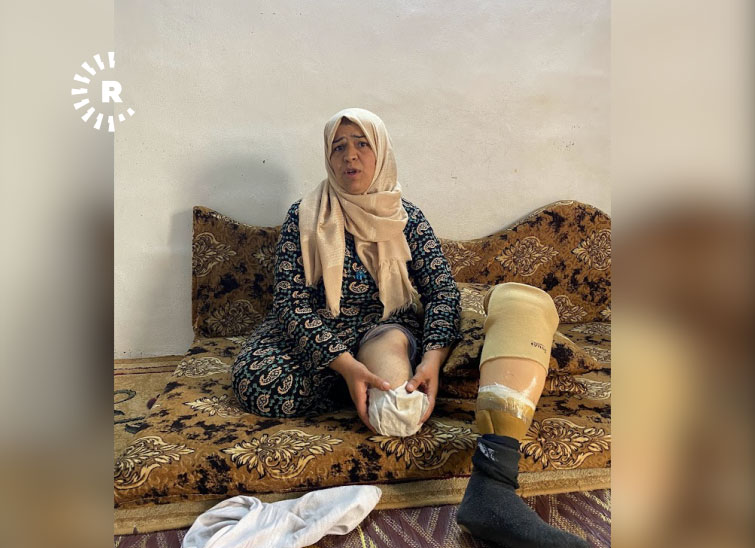
The mother showed Rudaw English medical reports, demonstrating the severity of Najah’s injury, including a report, signed by Kurdistan Regional Government’s (KRG) health minister Saman Barzanji, telling the United Nations International Children's Emergency Fund (UNICEF) that the girl “needs treatment from a developed center outside the country” and calling on the agency to send her abroad for treatment.
“My friends keep asking me to join them when they play but I tell them that … I can’t,” Najah told Rudaw English, struggling to finish her sentence due to sobbing. Najah later called on philanthropists and all relevant authorities and institutions to treat her before she loses her left leg.
Layla said doctors have told them “the girl has to be treated as soon as possible before she loses her leg.”
The child cannot go to school and needs special care around the clock.
Najah’s fate
Rudaw English has informed both UNICEF and the Swedish SWEDO organization, which operate in Basrma camp, about Najah’s case. Both have said that they will follow the case but were not available for a comment.
Bombings and displacement have been a reality endured by most Syrians in the last decade.
On the 11th anniversary of Syrian uprising on March 15, the UN said in a statement that only last year nearly 900 children lost their lives or were injured in the country, “bringing the total number killed and injured, since the beginning of the war, to close to 13,000.”
“Landmines, explosive remnants of war and unexploded ordnance were the leading cause of those child casualties in 2021, leaving many with lifelong disabilities,” it added.
“We have a long road to go to help more children with disabilities and other children impacted by the war so they can reach their full potential and grow up protected from harm, healthy and educated,” the statement quoted UNICEF Syria Representative, Bo Viktor Nylund.
It is not clear what will happen to Najah’s leg as UNICEF and SWEDO have failed to guarantee that she will be sent abroad for much-needed treatment, while the Syrian government and the KRG have failed to provide any assistance to the family.
Despite the setbacks, the family is determined to do their best to prevail in their last attempt to save Najah’s leg and bring back her smile.
This year, Najah and the remaining members of her family celebrated Newroz in Erbil province, four years after the rocket attack that destroyed the hopes of the family. She told Rudaw English that she dreams of returning to school and playing with friends.


Comments
Rudaw moderates all comments submitted on our website. We welcome comments which are relevant to the article and encourage further discussion about the issues that matter to you. We also welcome constructive criticism about Rudaw.
To be approved for publication, however, your comments must meet our community guidelines.
We will not tolerate the following: profanity, threats, personal attacks, vulgarity, abuse (such as sexism, racism, homophobia or xenophobia), or commercial or personal promotion.
Comments that do not meet our guidelines will be rejected. Comments are not edited – they are either approved or rejected.
Post a comment