


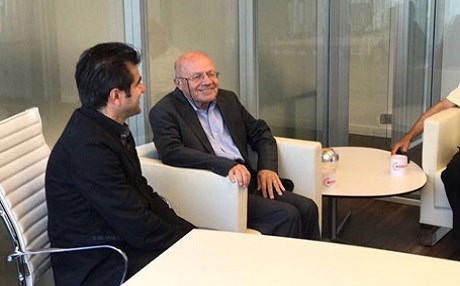
DUSSELDORF, Germany - Ismail Besikci, a Turkish sociologist renowned for his pro-Kurdish writings, says the time for Kurdistan independence not only is ripe, but also late. He believes the people of Turkey will accept an overwhelming ‘Yes’ vote.
"Let us presume, in the September 25 referendum, the 80 percent of the votes were positive, such result will be accepted by the Turkish nation," Besikci said in an interview at Rudaw’s Dusseldorf bureau in Germany on Monday.
Besikci, a former Nobel Prize nominee, was among tens of thousands of Kurds and others who rallied in the German city of Cologne on Saturday in support of the Kurdistan Region's September 25 independence referendum.
The PEN International honorary member, who served 17 years of a 100-year sentence in Turkish prisons for his pro-Kurdish writings, has argued for Kurds not only in his country's southeast but also for other parts of Kurdistan to establish their own enclaves.
He commented about the timing of the referendum which the United States has deemed to be wrong.
"Indeed the time has come. We could say it is even late. It is a problem which had to be addressed in the 1920s," said Besikci, calling the referendum "valuable."
After World War I, Kurdish nationalists pinned their hopes on treaties like Sykes-Picot and Sevres. With the dissolution of the Ottoman Empire, the Treaty of Lausanne partitioned Kurdish territory between Turkey, the British mandate of Iraq, the French mandate of Syria, and the Shah’s Persia.
Again after World War II, the international community sat down in San Francisco, but no state was agreed upon for Kurds.
Besikci explained that when the Middle East was partitioned after the Second World War by the Allies, a state for Kurdistan also should have been created.
"For example, when Iraq associated with Great Britain, it was established, and Jordan and Palestine were established. And Syria and Lebanon, which were associated with France, were also established — Kurdistan had to be established as well," he explained, adding that although these countries were colonies of the superpowers, they did not even allow for the establishment of a colonized Kurdistan state.
The scholar, who was named Rudaw Media Network’s Person of the Year in 2014, noted that 50 million Kurdish people do not have a single representative in the United Nations, at the Islamic conferences, or at the Olympiads.
Besikci dismissed world and neighboring countries’ comments on the process, saying what is really important is the voice of the Kurds.
"What Iran says, what Iraq says, what America says — let them say whatever they want, what really matters is what Kurds say. Kurdish insistence in this subject is very important."
Ankara has called the referendum a “wrong step.” Turkish Foreign Minister Mevlut Cavusoglu told Rudaw in Erbil after meeting with Kurdistan President Masoud Barzani on August 23 that trade relations between the two have no connection with the referendum.
"Let us presume, in the September 25 referendum, the 80 percent of the votes were positive, such result will be accepted by the Turkish nation," Besikci said in an interview at Rudaw’s Dusseldorf bureau in Germany on Monday.
Besikci, a former Nobel Prize nominee, was among tens of thousands of Kurds and others who rallied in the German city of Cologne on Saturday in support of the Kurdistan Region's September 25 independence referendum.
The PEN International honorary member, who served 17 years of a 100-year sentence in Turkish prisons for his pro-Kurdish writings, has argued for Kurds not only in his country's southeast but also for other parts of Kurdistan to establish their own enclaves.
He commented about the timing of the referendum which the United States has deemed to be wrong.
"Indeed the time has come. We could say it is even late. It is a problem which had to be addressed in the 1920s," said Besikci, calling the referendum "valuable."
After World War I, Kurdish nationalists pinned their hopes on treaties like Sykes-Picot and Sevres. With the dissolution of the Ottoman Empire, the Treaty of Lausanne partitioned Kurdish territory between Turkey, the British mandate of Iraq, the French mandate of Syria, and the Shah’s Persia.
Again after World War II, the international community sat down in San Francisco, but no state was agreed upon for Kurds.
Besikci explained that when the Middle East was partitioned after the Second World War by the Allies, a state for Kurdistan also should have been created.
"For example, when Iraq associated with Great Britain, it was established, and Jordan and Palestine were established. And Syria and Lebanon, which were associated with France, were also established — Kurdistan had to be established as well," he explained, adding that although these countries were colonies of the superpowers, they did not even allow for the establishment of a colonized Kurdistan state.
The scholar, who was named Rudaw Media Network’s Person of the Year in 2014, noted that 50 million Kurdish people do not have a single representative in the United Nations, at the Islamic conferences, or at the Olympiads.
Besikci dismissed world and neighboring countries’ comments on the process, saying what is really important is the voice of the Kurds.
"What Iran says, what Iraq says, what America says — let them say whatever they want, what really matters is what Kurds say. Kurdish insistence in this subject is very important."
Ankara has called the referendum a “wrong step.” Turkish Foreign Minister Mevlut Cavusoglu told Rudaw in Erbil after meeting with Kurdistan President Masoud Barzani on August 23 that trade relations between the two have no connection with the referendum.
Comments
Rudaw moderates all comments submitted on our website. We welcome comments which are relevant to the article and encourage further discussion about the issues that matter to you. We also welcome constructive criticism about Rudaw.
To be approved for publication, however, your comments must meet our community guidelines.
We will not tolerate the following: profanity, threats, personal attacks, vulgarity, abuse (such as sexism, racism, homophobia or xenophobia), or commercial or personal promotion.
Comments that do not meet our guidelines will be rejected. Comments are not edited – they are either approved or rejected.
Post a comment