


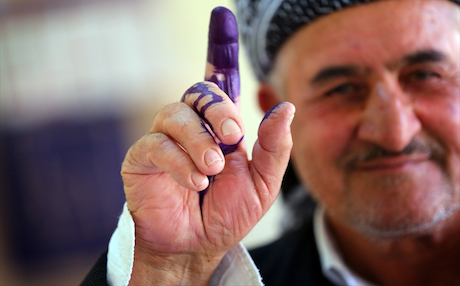
SULAIMANI, Kurdistan Region – The number of voters in the autonomous Kurdistan Region has grown by more than 100,000, statistics show. But this does not translate into more Kurdish seats in the Iraqi parliament because of the way that population figures are counted by Baghdad.
The central government decides population figures on the basis of coupons issued for food rations by the trade ministry in Baghdad, not on provincial population statistics.
“We count on the database for food coupons, not the figures of the directorates of statistics,” said Hendren Mohammed Salih, head of the Independent High Electoral Commission (IHEC) in Erbil.
The issue resurfaces as Iraq awaits two elections in April, the Iraqi legislative elections and the provincial polls in Kurdistan. People born in 1996 will be eligible to vote.
According to data by authorities in the three provinces of the Kurdistan Region, the number of Kurdish voters in 2014 is up by some 102,000: 41,000 in Sulaimani, 34,000 in Erbil, and 27,000 in Duhok.
The Kurds will be contesting 44 seats in the Iraqi legislative elections. Candidates will be fighting for 89 seats for the Kurdish provincial polls, 32 for Sulaimani, 30 for Erbil and 27 for Duhok.
The KRG regularly accuses Baghdad of waging political wars against the Kurds and believes that the Kurdish population is much larger than what Baghdad declares.
Saman Fawzi, an MP in the Iraqi parliament, said that the IHEC had been asked to review the data. “We revised the available data and we succeeded to add one seat for each in Sulaimani, Erbil, and Duhok,” Fawzi said.
“The IHEC has no choice but to rely on the data from the Ministry of Trade for food coupons,” said Abdulrahman Khalifa, former head of public relations at the IHEC. He noted that, even if the increase in the Kurdish population is counted, it will not have a great impact on Kurdish representation because the Arab population – among both Shiites and Sunnis – has grown much more.
Iraqi Trade Minister Khairollah Hassan, who is a Kurd, explained that the growth rate among the Arab population is greater, largely due to polygamy.
“The average number of children in Kurdistan is two to three per family, while the average per family in the rest of Iraq is eight to nine children,” Hassan noted. “Polygamy is a very common phenomenon in the rest of Iraq and it has a huge impact on the population growth rate,” he said.
Comments
Rudaw moderates all comments submitted on our website. We welcome comments which are relevant to the article and encourage further discussion about the issues that matter to you. We also welcome constructive criticism about Rudaw.
To be approved for publication, however, your comments must meet our community guidelines.
We will not tolerate the following: profanity, threats, personal attacks, vulgarity, abuse (such as sexism, racism, homophobia or xenophobia), or commercial or personal promotion.
Comments that do not meet our guidelines will be rejected. Comments are not edited – they are either approved or rejected.
Post a comment