


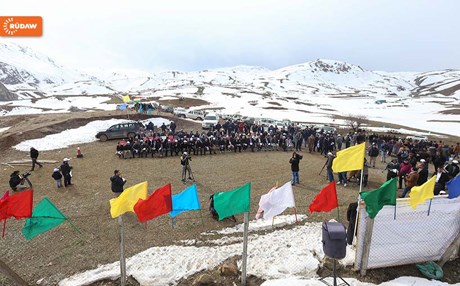
SORAN, Kurdistan Region-- Thousands of faithful spectators show up every Friday morning in this mountainous resort area of Haj Omran, to watch a winter Rallycross performed by professionals as well as amateurs who drive their well-equipped cars through thick blankets of snow.
The town of Haj Omran is often in the news because of the border crossing that lies just outside of the city, which connects the Kurdistan region to its neighboring Iran in the east.
But the area is also well known for its low temperatures in an otherwise extremely hot region.
The combination of snow and hilltops has made this bordering area an almost perfect place for rally enthusiasts who can meet up here and hold competitions, said Fayiq Sediq, the head of Sulaimani rally race group.
“The Kurdistan region could host successful rally competitions and we could even take part in World Olympics since we have already some very good drivers,” Sediq said and believed that many young people would join the competitions because of the geographic location of Haj Omran which he said was “perfect” for the sports.
“You have almost everything that such athletic activity requires, that are the mountains, the snow, the valleys and the plains which give it a perfect combination.
Winter rally crosses are popular sport activities, which attract tens of thousands of onlookers and enthusiasts in many parts of the world with considerable financial revenues.
Although the sport is relatively new in Kurdistan but arrangers hope the geographic location will attract more people even from neighboring Iran and Turkey.
“There are good race drivers in most Kurdish cities but there is no systematic effort to gather them in one event and select the best ones for international or regional competitions,” said Hiwa Bayiz, a rally driver.
Before the economic crisis and the war with the ISIS, the relative peace and prosperity in the Kurdistan region attracted thousands of holidaymakers from the rest of Iraq and neighboring Iran.
An estimated 2.2 million tourists visited the Kurdistan region in 2013, the year before ISIS’ shock offensive in the country.
Several new tourist sights and hotels were constructed in main the Kurdish cities to cope with the predicted rise of visitors.
But now instead of tourists the region has sheltered some 1,5 million refugees from Iraq and Syria with no immediate prospect of return for the majority of the displaced families who live in poor condition in the region.
Comments
Rudaw moderates all comments submitted on our website. We welcome comments which are relevant to the article and encourage further discussion about the issues that matter to you. We also welcome constructive criticism about Rudaw.
To be approved for publication, however, your comments must meet our community guidelines.
We will not tolerate the following: profanity, threats, personal attacks, vulgarity, abuse (such as sexism, racism, homophobia or xenophobia), or commercial or personal promotion.
Comments that do not meet our guidelines will be rejected. Comments are not edited – they are either approved or rejected.
Post a comment