


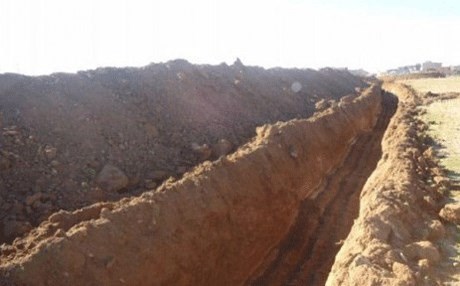
ERBIL, Kurdistan Region – Officials in the disputed town of Sadiya, in Diyala province, have ordered a massive defense trench be constructed to protect residents against the vehicle-borne suicide attacks of ISIS militants, a city official told Rudaw.
Ahmed Sabir Zargushi, a top local official, said on Friday the security trench to would "enhance security and stability of the town and protect civilians from Daesh [ISIS] suicide attacks.”
Zargushi said that no motorcycles or vehicles can cross the trench, making the area a safe zone for residents who are returning to their homes after fleeing ISIS.
“That can be a guarantee for displaced people coming back to the town,” Zargushi added.
Kurdish forces and Shiite militias, known as Hashd al-Shaabi (Popular Mobilization Units), have engaged in heavy fighting with ISIS around the towns of Sadiya and Jalawla.
The towns were liberated by Peshmerga units backed by US-led coalition airstrikes on November 23, an operation in which at least 18 Peshmerga soldiers were killed.
The area around Sadiya is still marked by sporadic attacks from ISIS.
Ahmed Sabir Zargushi, a top local official, said on Friday the security trench to would "enhance security and stability of the town and protect civilians from Daesh [ISIS] suicide attacks.”
Zargushi said that no motorcycles or vehicles can cross the trench, making the area a safe zone for residents who are returning to their homes after fleeing ISIS.
“That can be a guarantee for displaced people coming back to the town,” Zargushi added.
Kurdish forces and Shiite militias, known as Hashd al-Shaabi (Popular Mobilization Units), have engaged in heavy fighting with ISIS around the towns of Sadiya and Jalawla.
The towns were liberated by Peshmerga units backed by US-led coalition airstrikes on November 23, an operation in which at least 18 Peshmerga soldiers were killed.
The area around Sadiya is still marked by sporadic attacks from ISIS.
Comments
Rudaw moderates all comments submitted on our website. We welcome comments which are relevant to the article and encourage further discussion about the issues that matter to you. We also welcome constructive criticism about Rudaw.
To be approved for publication, however, your comments must meet our community guidelines.
We will not tolerate the following: profanity, threats, personal attacks, vulgarity, abuse (such as sexism, racism, homophobia or xenophobia), or commercial or personal promotion.
Comments that do not meet our guidelines will be rejected. Comments are not edited – they are either approved or rejected.
Post a comment