


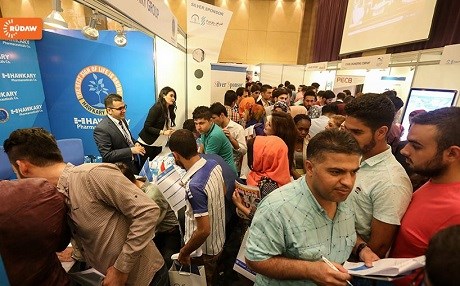
ERBIL, Kurdistan Region—Ambitious and hopeful recent university graduates packed a job fair held in Erbil, the capital of the Kurdistan Region, on Monday, hungry for the opportunity to start their careers.
“I’m just looking for a decent job,” said Nadeen Uran, a participant at the job fair.
Uran comes from the Christian community in Koya and graduated from Salahaddin University-Erbil with a bachelor’s degree in geology. She came to the event looking for any opportunity for employment.
“Unfortunately, there’s not a lot of jobs in geology here,” she said. “I need to pay my bills.”
The job fair was put together through a joint collaboration between the Rwanga Foundation and Foras Project.
“This event is important because the youth in Kurdistan are very disappointed for not having any jobs,” said Zirak A. Hamad, the director of public relations and media for the Rwanga Foundation. “This job fair gives hope to the youth that they will find a job and in the right career.”
The job fair attracted unemployed and underemployed youth from throughout the Kurdistan Region and Iraq.
Abdurame Saleh and his wife Hadeel Hamid came from Baghdad with their one-year-old daughter. He is looking to improve his career in electrical engineering while his wife is a recent graduate from the University of Technology in Baghdad with a degree in biotechnology. She is looking to break into her desired career as a lab specialist.
Saleh is looking for a new job and stressed the desire to work for an international company rather than a local one.
“I’m looking for an international company here,” Saleh said. “They tend to have better company policies, more respect and a higher standard.”
Saleh would also like to remain in the Kurdistan Region. “There’s just more opportunity here than in Baghdad,” he explained.
According to Sector of Economy & Investment Council of Ministers for the Kurdistan Regional Government (KRG), unemployment among the Kurdish population is at 20%, a 9% increase from when the Region’s financial crisis began in 2014.
Despite daunting unemployment numbers, Rawand Qassab from EMP, a service providing support for local businesses in the Kurdistan Region and Iraq, is optimistic about this generation’s chances for employment.
“The job market now is better than in past years,” said Qassab. “Graduates are more ambitious and excited for work with more drive.” Qassab went to say that graduates today are more focused on being better prepared with “English skills, computer skills and knowledge in social media.”
“Of course,” he add, “there still are applicants who don’t have proper resumes and lack language skills.”
At another event a week prior to the job fair, a workshop was held by MyeDream in collaboration also with the Rwanga Foundation and the Foras Project to facilitate entrepreneurial dreams among recent graduates.
According to Rebeen Pasha, the founder of MeDream, the startup incubator, more needs to be done to involve youth in the job market to rebuild the economy.
“It’s about time we refocus on engaging youth in the economy to rebuild the country,” Pasha says, “and it takes all of us working in partnership to make it happen.”
“I’m just looking for a decent job,” said Nadeen Uran, a participant at the job fair.
Uran comes from the Christian community in Koya and graduated from Salahaddin University-Erbil with a bachelor’s degree in geology. She came to the event looking for any opportunity for employment.
“Unfortunately, there’s not a lot of jobs in geology here,” she said. “I need to pay my bills.”
The job fair was put together through a joint collaboration between the Rwanga Foundation and Foras Project.
“This event is important because the youth in Kurdistan are very disappointed for not having any jobs,” said Zirak A. Hamad, the director of public relations and media for the Rwanga Foundation. “This job fair gives hope to the youth that they will find a job and in the right career.”
The job fair attracted unemployed and underemployed youth from throughout the Kurdistan Region and Iraq.
Abdurame Saleh and his wife Hadeel Hamid came from Baghdad with their one-year-old daughter. He is looking to improve his career in electrical engineering while his wife is a recent graduate from the University of Technology in Baghdad with a degree in biotechnology. She is looking to break into her desired career as a lab specialist.
Saleh is looking for a new job and stressed the desire to work for an international company rather than a local one.
“I’m looking for an international company here,” Saleh said. “They tend to have better company policies, more respect and a higher standard.”
Saleh would also like to remain in the Kurdistan Region. “There’s just more opportunity here than in Baghdad,” he explained.
According to Sector of Economy & Investment Council of Ministers for the Kurdistan Regional Government (KRG), unemployment among the Kurdish population is at 20%, a 9% increase from when the Region’s financial crisis began in 2014.
Despite daunting unemployment numbers, Rawand Qassab from EMP, a service providing support for local businesses in the Kurdistan Region and Iraq, is optimistic about this generation’s chances for employment.
“The job market now is better than in past years,” said Qassab. “Graduates are more ambitious and excited for work with more drive.” Qassab went to say that graduates today are more focused on being better prepared with “English skills, computer skills and knowledge in social media.”
“Of course,” he add, “there still are applicants who don’t have proper resumes and lack language skills.”
At another event a week prior to the job fair, a workshop was held by MyeDream in collaboration also with the Rwanga Foundation and the Foras Project to facilitate entrepreneurial dreams among recent graduates.
According to Rebeen Pasha, the founder of MeDream, the startup incubator, more needs to be done to involve youth in the job market to rebuild the economy.
“It’s about time we refocus on engaging youth in the economy to rebuild the country,” Pasha says, “and it takes all of us working in partnership to make it happen.”
Comments
Rudaw moderates all comments submitted on our website. We welcome comments which are relevant to the article and encourage further discussion about the issues that matter to you. We also welcome constructive criticism about Rudaw.
To be approved for publication, however, your comments must meet our community guidelines.
We will not tolerate the following: profanity, threats, personal attacks, vulgarity, abuse (such as sexism, racism, homophobia or xenophobia), or commercial or personal promotion.
Comments that do not meet our guidelines will be rejected. Comments are not edited – they are either approved or rejected.
Post a comment