


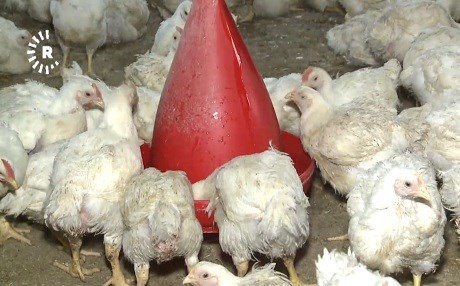
ERBIL, Kurdistan Region — The Kurdistan Region has placed a ban on chicken imports from 39 countries after bird flu spread in central Iraq and Iran.
"Necessary [measures] for preventing the sickness from spreading to the Kurdistan Region have been undertaken by the Ministry. The prevention committee in the KRG has been reactivated again. Quarantine rooms for individuals suspected of being infected will be prepared in hospitals in the cities," Dr. Khalis Qadir, a spokesperson for the KRG's Ministry of Health, told Rudaw.
Earlier this month, two people diagnosed with swine flu died in Saladin province in the town of Dujail about 60 kilometers north of Baghdad.
Iraq’s agriculture ministry also found a case of bird flu at a poultry house in Diyala province on January 7.
Nearly 40 million chickens have been culled in Iran and central Iraq due to infection over the course of the three-week bird flu epidemic.
The Ministry of Agriculture said it had requested 1 billion Iraqi dinars (about $840,000) to tackle the epidemic, but has so far only received 430 million dinars.
"It might not be sufficient to meet all our needs, but it is better than nothing," Hamadamin added.
There are around 1,300 poultry farms in the Kurdistan Region, producing 100,000 tons of chicken annually. The Region imports a further 60,000 tons.
On Sunday, the KRG's Ministry of Health announced that no cases of bird flu have been discovered in the Region. The health ministry said it is preparing to coordinate with the agriculture ministry should the disease spread.
The KRG banned chicken and egg imports from Iran following an outbreak in 2016.
Human infections are primarily acquired through direct contact with infected animals or contaminated environments, according to the World Health Organization, avian, swine and other zoonotic influenza viruses have not acquired the ability of sustained transmission among humans.
“To minimize public health risk, quality surveillance in both animal and human populations, thorough investigation of every human infection and risk-based pandemic planning are essential,” WHO published in its general influenza fact sheet published this month.
Symptoms range from mild upper respiratory tract infection (fever and cough), early sputum production and rapid progression to severe pneumonia, sepsis with shock, acute respiratory distress syndrome and even death.
WHO has stated poultry and eggs cooked above 70 Celsius kill the bird flu (H5N1) virus, but no birds from flocks with disease should enter the food chain.
"Necessary [measures] for preventing the sickness from spreading to the Kurdistan Region have been undertaken by the Ministry. The prevention committee in the KRG has been reactivated again. Quarantine rooms for individuals suspected of being infected will be prepared in hospitals in the cities," Dr. Khalis Qadir, a spokesperson for the KRG's Ministry of Health, told Rudaw.
Earlier this month, two people diagnosed with swine flu died in Saladin province in the town of Dujail about 60 kilometers north of Baghdad.
Iraq’s agriculture ministry also found a case of bird flu at a poultry house in Diyala province on January 7.
Nearly 40 million chickens have been culled in Iran and central Iraq due to infection over the course of the three-week bird flu epidemic.
"When we found out that the bird flu had spread in these places, we directly told the detection points that are quarantined in the Kurdistan Region not to accept poultry imports from places where there is bird flu," Dr. Khalis Ahmed Hamadamin, a senior official in the KRG's Ministry of Agriculture, told Rudaw.
The Ministry of Agriculture said it had requested 1 billion Iraqi dinars (about $840,000) to tackle the epidemic, but has so far only received 430 million dinars.
"It might not be sufficient to meet all our needs, but it is better than nothing," Hamadamin added.
There are around 1,300 poultry farms in the Kurdistan Region, producing 100,000 tons of chicken annually. The Region imports a further 60,000 tons.
On Sunday, the KRG's Ministry of Health announced that no cases of bird flu have been discovered in the Region. The health ministry said it is preparing to coordinate with the agriculture ministry should the disease spread.
The KRG banned chicken and egg imports from Iran following an outbreak in 2016.
Human infections are primarily acquired through direct contact with infected animals or contaminated environments, according to the World Health Organization, avian, swine and other zoonotic influenza viruses have not acquired the ability of sustained transmission among humans.
“To minimize public health risk, quality surveillance in both animal and human populations, thorough investigation of every human infection and risk-based pandemic planning are essential,” WHO published in its general influenza fact sheet published this month.
Symptoms range from mild upper respiratory tract infection (fever and cough), early sputum production and rapid progression to severe pneumonia, sepsis with shock, acute respiratory distress syndrome and even death.
WHO has stated poultry and eggs cooked above 70 Celsius kill the bird flu (H5N1) virus, but no birds from flocks with disease should enter the food chain.
Comments
Rudaw moderates all comments submitted on our website. We welcome comments which are relevant to the article and encourage further discussion about the issues that matter to you. We also welcome constructive criticism about Rudaw.
To be approved for publication, however, your comments must meet our community guidelines.
We will not tolerate the following: profanity, threats, personal attacks, vulgarity, abuse (such as sexism, racism, homophobia or xenophobia), or commercial or personal promotion.
Comments that do not meet our guidelines will be rejected. Comments are not edited – they are either approved or rejected.
Post a comment