


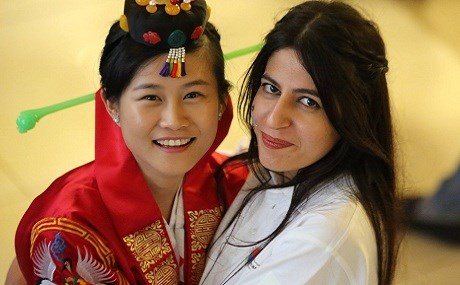
ERBIL, Kurdistan Region – Korea came to Erbil’s University of Kurdistan – Hewler (UKH) on Saturday for the second Korean culture festival.
Unlike last year’s “Friends of Korea” festival, which was sponsored by the South Korean government, 2018’s event relied on the support of 150 volunteers, donations, and contributions from Korean companies in the Region.
“The initiative was not from either the Korean or Kurdistan Regional Government but it was the initiative of the youth,” organizer Sookie Hong told Rudaw English.
“They came together from Duhok, Sulaimani and Erbil and became friends and made this festival happen,” she added.
Organized by UKH’s Center for Korean Studies, the festival – which welcomed up to 1,500 visitors – included traditional music and modern K-Pop performances, Korean writing and language workshops, string art, face painting, and a display of traditional Korean costumes called “Hanbok”.
Visitors were offered samples of Korean food, such as “gimbap” – rice and vegetables rolled into sheets of dried, seasoned seaweed – and “hobak jeon” – zucchini dipped in flour and eggs and deep fried.
Hemin Mahdi Qadir, who is a Taekwondo master, gave a martial arts demonstration. Taekwondo originated in Korea and has gained global popularity.
Khakan Adnan, a final year Petroleum Engineering student at Koya University, was impressed by what he saw.
“I got to try some Korean foods, which were really delicious,” said Khakan. “This was my first experience of Korean culture and I can tell you that it was really good.”
Saturday’s festival was attended by Young Kyu Park, General Consul of the Republic of Korea in Erbil, and Falah Mustafa, the Kurdistan Regional Government (KRG) Head of Foreign Relations.
“The main focus of this event is to expand our relations and exchange,” Park told Rudaw English.
Park acknowledged several cultural, historical, and geopolitical similarities between Iraq and the Kurdistan Region and the divided Korean peninsula, but lauded recent progress in Erbil-Baghdad relations and this year’s elections.
“I understand the negotiations and discussions are going in a positive way and I expect some long standing issues will be resolved in a peaceful and amicable way in the very near future,” said Park.
South Korean does not allow its citizens to travel to Iraq, citing security concerns. Organizer Hong insists the Kurdistan Region is completely different.
“Kurdistan is very different than the rest of Iraq. I really want the Korean government to treat Kurdistan differently and freely open the doors for Koreans to come here, do business, and make more friendships, and have more academic and business exchanges,” she said.
“If we don’t do that, it’s going to be a loss for both Kurdistan and Korea. This is a peaceful place and the youth here have the same heart as Koreans so we have to recognize this,” Hong added.
The Kurdistan Region and the Republic of Korea enjoy warm bilateral relations. A South Korean army unit carried out peacekeeping and reconstruction tasks in the Region between 2004 and 2008.
Korea has also donated millions of dollars to support IDPs and humanitarian work.
Sulaimani hosted its own “Korean Culture Festival” last month with the backing of the Korean government.
Comments
Rudaw moderates all comments submitted on our website. We welcome comments which are relevant to the article and encourage further discussion about the issues that matter to you. We also welcome constructive criticism about Rudaw.
To be approved for publication, however, your comments must meet our community guidelines.
We will not tolerate the following: profanity, threats, personal attacks, vulgarity, abuse (such as sexism, racism, homophobia or xenophobia), or commercial or personal promotion.
Comments that do not meet our guidelines will be rejected. Comments are not edited – they are either approved or rejected.
Post a comment