


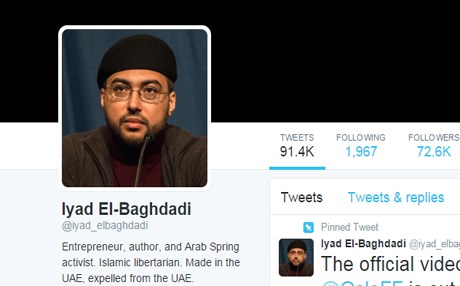
An Arab man’s Twitter account was suspended because he shares the same surname as the leader of the Islamic State (ISIS) Abu Bakr al-Baghdadi.
Iyad El-Baghdaddi said the suspension of his account by Twitter administrators for his Arabic surname was “overt racism”.
According to a BBC report El-Baghdadi “had been misidentified as IS leader Abu Bakr al-Baghdadi in Indonesian newspaper Republika and the New York Post.”
El-Baghdad criticized Twitter for this action, writing that his account had brought 100 million twitter views last year.
El-Baghdadi who calls himself the Arab Spring man has more than 72,000 followers on Twitter.
Social media networks have come under pressure from governments to crack down on accounts related to terrorists or such organizations, particularly after the rise of the Islamic State (ISIS) in 2014.
Twitter has not commented on this specific case, but El-Baghdadi said he had been told by the company that he had violated the rules, according to BBC.
He tweeted: "I don't think a single Arab country exists that doesn't have a family with the surname El-Baghdadi."
Iyad El-Baghdaddi said the suspension of his account by Twitter administrators for his Arabic surname was “overt racism”.
According to a BBC report El-Baghdadi “had been misidentified as IS leader Abu Bakr al-Baghdadi in Indonesian newspaper Republika and the New York Post.”
El-Baghdad criticized Twitter for this action, writing that his account had brought 100 million twitter views last year.
El-Baghdadi who calls himself the Arab Spring man has more than 72,000 followers on Twitter.
Social media networks have come under pressure from governments to crack down on accounts related to terrorists or such organizations, particularly after the rise of the Islamic State (ISIS) in 2014.
Twitter has not commented on this specific case, but El-Baghdadi said he had been told by the company that he had violated the rules, according to BBC.
He tweeted: "I don't think a single Arab country exists that doesn't have a family with the surname El-Baghdadi."
Comments
Rudaw moderates all comments submitted on our website. We welcome comments which are relevant to the article and encourage further discussion about the issues that matter to you. We also welcome constructive criticism about Rudaw.
To be approved for publication, however, your comments must meet our community guidelines.
We will not tolerate the following: profanity, threats, personal attacks, vulgarity, abuse (such as sexism, racism, homophobia or xenophobia), or commercial or personal promotion.
Comments that do not meet our guidelines will be rejected. Comments are not edited – they are either approved or rejected.
Post a comment