


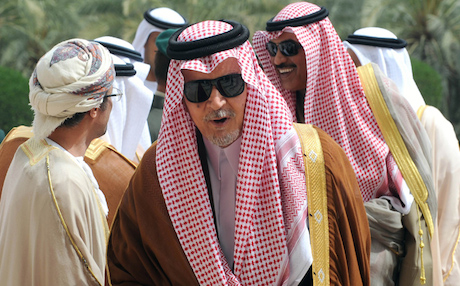
LONDON – The Gulf Cooperation Council (GCC), established in 1981 during the early months of Saddam Hussein’s eight-year war with Iran, is in danger of coming apart at the seams.
The Arab states of the lower Gulf are engaged in the latest and potentially most serious of their periodic family squabbles, which this week provoked three of them to withdraw their ambassadors from tiny Qatar.
The Qatar government expressed regret and surprise at Wednesday’s decision by the “sisterly countries” of Saudi Arabia, United Arab Emirates and Bahrain, but said it did not plan to retaliate by pulling out its own envoys.
All four states, together with Kuwait and Oman, are members of the GCC.
The official reason for the diplomatic spat is Qatar’s alleged failure to live up to a recent commitment not to interfere in the internal affairs of fellow GCC states.
The three conservative states are particularly distressed that Qatar continued to provide a platform for Yousuf Al Qaradawi, a Qatar-based Egyptian cleric, to use his fiery sermons to attack Saudi Arabia and the UAE despite Riyadh’s threat to freeze relations unless he were silenced.
But the Qaradawi case is merely a symptom of Qatar’s growing estrangement from its GCC neighbors over how to respond to turmoil in the wider Middle East.
Gas-rich Qatar sought to garner an influence well beyond its size by backing anti-regime revolts at the start of the Arab Spring. That set it apart from its conservative neighbors, who feared that the infection of rebellion might spread to their own shores.
Subsequent events in Egypt have sharpened a rift between Qatar, which continues to support the now outlawed Muslim Brotherhood, and the Gulf conservatives, who back the new military rulers in Cairo.
There are also differences over Syria, where Qatar took the lead in funding and supplying Islamist groups. A competition for influence in the Syrian conflict between Qatar and Saudi Arabia has led the two states to back rival rebel movements.
Qatar has also aroused the suspicions of its partners by seeking closer relations with Iran, with which it shares the world’s largest gas field, and with Turkey.
Meanwhile, the output of Qatar’s Al-Jazeera television network has proved to be a long-running irritant in inter-GCC relations. Qatar’s neighbors have frequently condemned the network’s coverage as both hostile to them and sympathetic towards the hated Muslim Brotherhood.
Saudi Arabia and its conservative partners may be disappointed that a change of leadership in Qatar last year, in which new ruler Sheikh Tamim al-Thani replaced his father Sheikh Hamad bin Khalifa, has apparently failed to temper the emirate’s tendency to go it alone in regional affairs.
The latest crisis in relations throws further doubt on plans for the GCC six to tighten security cooperation, which is already opposed by Oman and has prompted reservations in Kuwait.
The dispute with Qatar highlights the reality that, although the Arab Gulf states have much in common, what really brought the six together in 1981 was their fear of Iran in the aftermath of the 1979 Islamic revolution.
The kingdoms and emirates of the lower Gulf decided to hunker down as Iran and Iraq confronted each other in a war that was to last eight years, all the while praying for an Iraqi victory.
They inevitably turned against Saddam when his forces invaded Kuwait in 1990. However, following his defeat in 1991 by a US-led international coalition, they bluntly refused to support the post-war rebellions against the Iraqi dictator by the Kurds and the Arab Shiite.
Since then, the GCC countries have had to come to terms with the reality of an autonomous Kurdistan in northern Iraq. Some have set aside past hostility towards what they saw as Kurdish separatism in order to establish economic relations with the Kurdish Regional Government.
Qatar Airways and the UAE’s Emirates both offer direct flights to Erbil, reflecting growing GCC investment in the region. In January, residents of Kuwait, Qatar and the UAE became the first from any Arab countries to be granted entry at the region's airports without having to obtain a visa in advance.
In the latest sign of closer ties, Abu Dhabi’s majority state-owned National Energy Company, Taqa, won KRG approval late last year for plans to invest about $1.2 billion developing the Atrush oil and gas block.
Comments
Rudaw moderates all comments submitted on our website. We welcome comments which are relevant to the article and encourage further discussion about the issues that matter to you. We also welcome constructive criticism about Rudaw.
To be approved for publication, however, your comments must meet our community guidelines.
We will not tolerate the following: profanity, threats, personal attacks, vulgarity, abuse (such as sexism, racism, homophobia or xenophobia), or commercial or personal promotion.
Comments that do not meet our guidelines will be rejected. Comments are not edited – they are either approved or rejected.
Post a comment