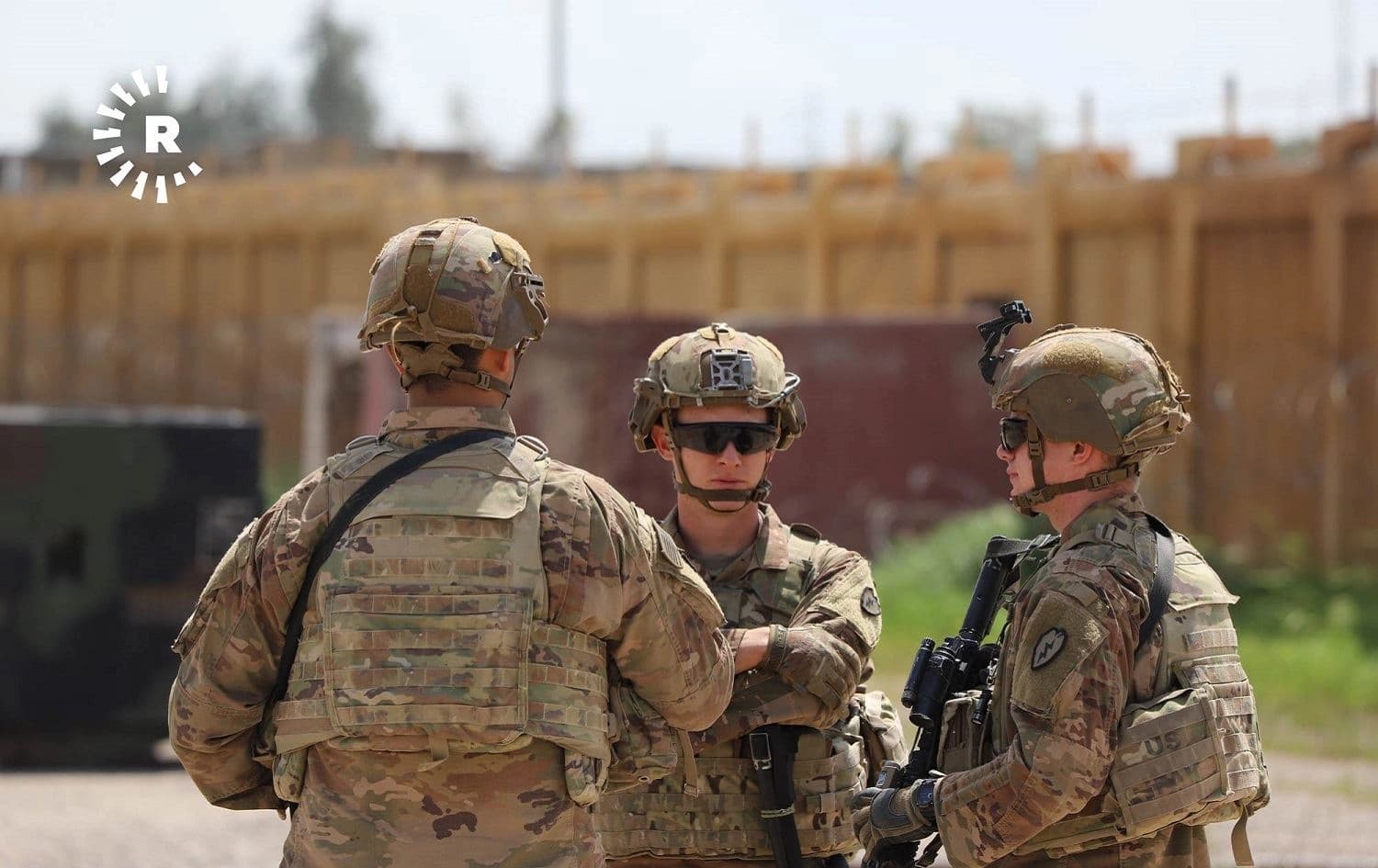

ERBIL, Kurdistan Region – Coalition forces will resume their training mission in Iraq and Syria when “conditions permit”, military officials said Thursday.
The US-led coalition to defeat the Islamic State group (ISIS) suspended training operations in early March to protect personnel from the coronavirus.
“The Political Directors agreed that Operation Inherent Resolve’s training role, temporarily suspended due to the pandemic, will resume as conditions permit,” the coalition said in a statement.
“The Political Directors agreed to maintain maximum pressure on Daesh/ISIS despite the several and multifaceted challenges,” the statement reads.
Coalition forces have been in Iraq since 2014 to train and advise Iraqi and Kurdish forces in the fight against ISIS. Over the border, they have also collaborated with the Kurdish-led Syrian Democratic Forces (SDF).
Colonel Myles B. Caggins III, the coalition spokesman, told Rudaw Radio on Monday that coalition and NATO commanders are in talks with Kurdistan Region Government (KRG) to resume Peshmerga training by end of next month.
Although operations have been scaled back in recent weeks, they have not stopped altogether. Coalition jets launched an airstrike in support of an anti-ISIS ground operation in Wadi Ashai, southern Kirkuk on Monday, killing 20 militants, according to a statement published Friday.
The pandemic has not slowed the ISIS resurgence either. The group’s insurgent activities have increased in recent weeks, with militants killing an Iraqi federal police officer at a checkpoint in Hawija, western Kirkuk on Sunday.
This was the third deadly attack on Iraqi and Kurdish security forces in the disputed territories in just one week.
Two Peshmerga fighters were killed and another wounded in an ISIS attack in Kolajo in the Garmiyan area in early April, followed two days later by the killing of two Popular Mobilization Forces (PMF) fighters in Tuz Khurmatu.
The attacks come as coalition troops have reduced their presence in bases across Iraq, citing recent successes in the fight against ISIS.
In the space of a month, the coalition has handed over control of six military bases to the Iraq Security Forces (ISF), including Abu Ghraib near Baghdad, K1 in Kirkuk, al-Qaim near the Syrian border, Qayyarah in western Iraq, al-Sqoor in Mosul, and Al-Taqaddum in Anbar.
The consolidation of forces also follows a series of rocket attacks targeting US troops stationed at Iraqi bases. Washington believes Iran-backed militias are behind the attacks.
Kurdish military officials have warned the coalition that ISIS is regrouping in the disputed territories.
The group was declared territorially defeated in Iraq in December 2017. However, a low intensity insurgency has continued, exploiting security vacuums between rival forces.
Iraq’s disputed territories, which Erbil and Baghdad have long contested, and some western Sunni-majority regions including Anbar, have seen a recent uptick in insurgent activities, including bombings, ambushes, kidnappings, extortion, and arson.
On Sunday, Vice President of the Kurdistan Region Jaafar Sheikh Mustafa told Rudaw Radio that ISIS is stronger than at any time since December 2017.
Last week, Jabar Yawar, chief of staff at the Ministry of Peshmerga Affairs, said the ISIS resurgence has been underway for some time.
“According to our data, the group increased its activities in 2018 and 2019, especially in Kurdistani areas outside of the Kurdistan Region administration, including Diyala, Hamrin, Kirkuk, Tuz Khurmatu, and Qarachogh. In Qarachogh, they even established bases,” Yawar told Rudaw.