


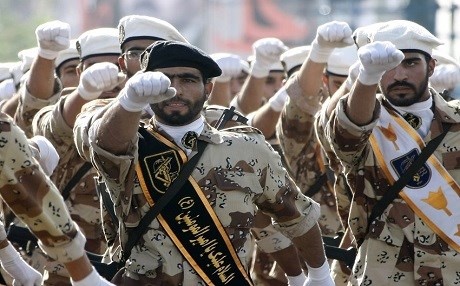
ERBIL, Kurdistan Region-- Iran's elite forces known as the Revolutionary Guards or the Pasdaran have announced plans to launch new investment projects in Kurdish regions of the country where unemployment rates have been among the highest in the Islamic Republic.
Muhammad Rajabi, Pasdaran commander in the main Kurdish city of Sanandaj told the Iranian media that nearly 3000 projects had been completed in the province with more than half of them involving reconstruction and revival of the heavily underdeveloped economy of the region.
Rajabi said around 500 projects were underway in Sanandaj worth an estimated 20 billion tomans of investments.
The Pasdaran, which was established in the aftermath of the Islamic Revolution in 1979 as its guardian, has been heavily involved in strategic economic projects in the country, holding stakes in dozens of national industries and owning key financial operations, including the vast Irancell tele-communications.
The paramilitary group has over the past decade increased its influence in the Iranian market despite widespread criticism from lawmakers in the Iranian parliament and government officials who have often accused the Pasdaran of corruption and illegal business ventures.
Iran's moderate President Hasan Rouhani has said "the concentration of power in hands of a certain group will lead to corruption," without mentioning the group by name.
"When intelligence, arms, money, capital, the Internet, newspapers and news agencies are all run by the same hands, it will eventually corrupt even if you are Abu Zar or Salman," the president said referring to two Muslim historical figures known for their integrity.
But the Pasdaran has also been heavily involved in providing basic services to underprivileged local people around the country. The group has built schools, homes for the elderly, mosques, playgrounds, bridges, libraries, constructing clean water pipelines to remote villages and building new roads to these areas.
Many have compared the social involvement of the Pasdaran with the services that the Muslim Brotherhood have provided in Egypt, with the difference that the Brotherhood, now banned under Egyptian law, has largely been a non-military organisation while the Pasdaran has it own air force, infantry divisions and a powerful marine force and has been enlisted in US terror list for much of its existence.
"The Pasdaran's strategic plan in the Kurdish regions is to undermine and even dismantle the influence of the Peshmerga," says Kawa Bahrami, a senior official with the Kurdistan Democratic Party-Iran (PDKI).
"They want to show to the people in these areas that if it was not for the Peshmerga, they would be much better off. Their goals in the long run have much to do with security than strategic planning to reduce unemployment or raise the standard of living there," Bahrami told Rudaw.
With nearly 10 million Kurds living mostly in the western and northwestern parts of the country, Iran is home to the second largest population of Kurds after Turkey.
The governates of West Azerbaijan, Kurdistan, Kermanshah and Ilam are the four largest provinces with predominantly Kurdish inhabitants.
Kermanshah province, with a population of 1 million, has repeatedly topped the list of least developed provinces in the country, according official data.
Comments
Rudaw moderates all comments submitted on our website. We welcome comments which are relevant to the article and encourage further discussion about the issues that matter to you. We also welcome constructive criticism about Rudaw.
To be approved for publication, however, your comments must meet our community guidelines.
We will not tolerate the following: profanity, threats, personal attacks, vulgarity, abuse (such as sexism, racism, homophobia or xenophobia), or commercial or personal promotion.
Comments that do not meet our guidelines will be rejected. Comments are not edited – they are either approved or rejected.
Post a comment