


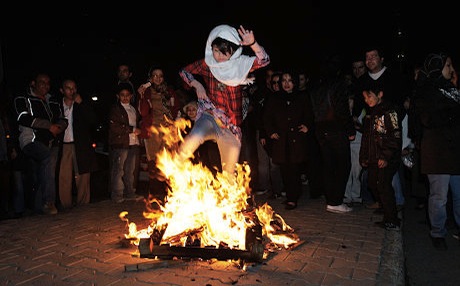
ERBIL, Kurdistan Region – Every year Iranians, Afghans, Tajiks and the Kurds mark the coming of spring and their new year on the last Wednesday in March, when families get together and jump over small bonfires in an ancient, pre-Islamic festival that goes back hundreds of years.
Red Wednesday, as the festival is known, comes just before the first day of new year on March 21. The celebration has no clear date of origin and does not belong to any one nation or ethnicity, though among the Kurds it is celebrated by the Kurds in Iran.
Ali Sardari, a Kurdish-Iranian author, believes its origins date back 2,500 years. “Red Wednesday is almost considered like a legend. Its history belongs to the time of the Mesopotamians,” he said.
Sardari said that the festival is mentioned in the Shahnameh, or the “Book of Kings,” a Persian epic written by the poet Ferdowsi around 1,000 AD.
“A Persian king by the name of Keyomars, while on his way back down a mountain, saw a snake and quickly picked up a stone to kill it. But the rock hit another stone and the spark started a fire, and that is said to be the origin of the story,” as described in the book, he said.
There are other beliefs about the origins of the festival. In ancient times, it is said, fire makers traveled through the villages and towns, lighting flames that burned through dawn, to inform people of the coming of the new year.
As they jump over the fires, people ask the flames to take away their ills, and grant them good health during the coming year.
Asked why Red Wednesday is only celebrated by Iranian Kurds, Sardari said, “Before Kurdistan was divided between the Othman and Persian empires in 1514, this day was celebrated by all the Kurds. However, the division led to changes in their cultures and traditions.”
Since the 1979 Islamic revolution, Iran’s religious authorities have frowned on the pagan rituals. But despite their efforts at cracking down on the celebrations and convincing people to shun the rituals, the festivities are still celebrated nationwide.
“After the Islamic revolution, the religious leaders thought people would turn their backs on their old traditions,” said Said Paywandi, a university professor in France. “But the Iranian people have been upholding their old traditions, which they have practiced before the dawn of Islam,” he said.
Comments
Rudaw moderates all comments submitted on our website. We welcome comments which are relevant to the article and encourage further discussion about the issues that matter to you. We also welcome constructive criticism about Rudaw.
To be approved for publication, however, your comments must meet our community guidelines.
We will not tolerate the following: profanity, threats, personal attacks, vulgarity, abuse (such as sexism, racism, homophobia or xenophobia), or commercial or personal promotion.
Comments that do not meet our guidelines will be rejected. Comments are not edited – they are either approved or rejected.
Post a comment