


Iraq

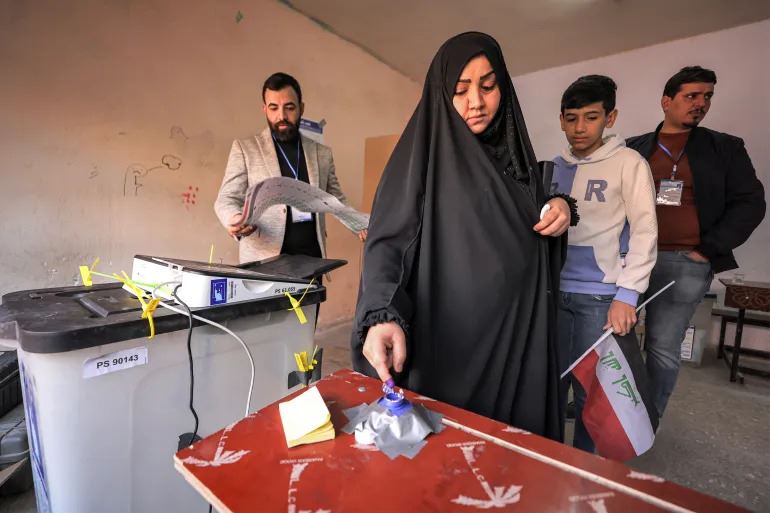
A woman dips her finger in ink after voting in Iraqi provincial council elections, in eastern Baghdad, in December 2023. AFP file photo
ERBIL, Kurdistan Region - Iraq’s electoral commission stated on Tuesday that the United Nations will have a “monitoring” role in the country’s November legislative elections - a day after a top UN official confirmed to Rudaw the international organization lacks the mandate for such oversight, clarifying that its involvement would be limited to "technical assistance" only.
“The United Nations is part of the main monitoring group for the parliamentary elections,” Imad Jamil, head of the media team at Iraq’s Independent High Electoral Commission (IHEC), told Rudaw, adding that the United Nations Assistance Mission for Iraq (UNAMI) has “a dedicated office” within the IHEC headquarters with their logo.
Iraq is set to hold its key elections seven days away on November 11.
In a response to a question from Rudaw about the UN’s role in monitoring the key ballot, Farhan Haq, Deputy Spokesperson for the UN Secretary-General, clarified on Monday, “I can tell you that the UN does not have a mandate to observe the parliamentary elections in Iraq.”
Haq reiterated, however, that the UN is “providing robust technical assistance to Iraq's Independent High Electoral Commission [IHEC] on the electoral process, which is what we have done for the 17 previous elections since 2004."
“The UN is providing technical assistance to support the IHEC’s efforts to promote transparency, inclusion, and trust in the electoral process,” added the deputy spokesperson for the UN secretary-general.
Despite this, the IHEC’s media officer, Jamil, insisted that around 300 international parties, including UMAMI, have registered to observe the November 11 vote.
"So far, about 300 foreign parties and organizations have registered to observe the parliamentary elections, including UMAMI, the European Union and the Arab League, in addition to the presence of representatives of most embassies," he noted.
According to the IHEC, around 21.4 million eligible voters have renewed their biometric cards, signaling intent to vote.
A total of 31 alliances, 38 parties, 23 independent candidates, and 56 quota candidates will compete for 329 parliamentary seats, including nine reserved for minorities.
Over 7,700 candidates are registered to run, with more than 39,000 polling stations set to open across 8,703 centers, along with additional stations for special and displaced voters.


Comments
Rudaw moderates all comments submitted on our website. We welcome comments which are relevant to the article and encourage further discussion about the issues that matter to you. We also welcome constructive criticism about Rudaw.
To be approved for publication, however, your comments must meet our community guidelines.
We will not tolerate the following: profanity, threats, personal attacks, vulgarity, abuse (such as sexism, racism, homophobia or xenophobia), or commercial or personal promotion.
Comments that do not meet our guidelines will be rejected. Comments are not edited – they are either approved or rejected.
Post a comment