


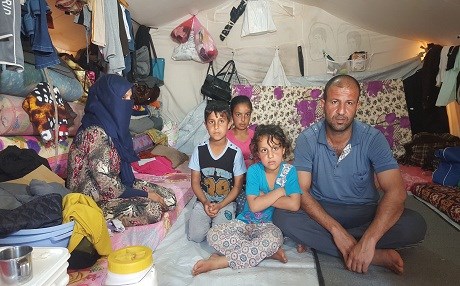
KHANAQIN, Kurdistan Region — Firas Mahmoud and his family have abandoned their home in the town of Muqdadiyah (Sharaban) and fled for their lives twice in less than two years. Once they fled from the Islamic State (ISIS) and now from Shiite militia groups.
“We went back home four month ago for the first time since the liberation of the town from Daesh (ISIS). Our home was a ruin so we rented a house there to live in but we couldn’t,” said Mahmoud, 37, who arrived with a dozen other families a week ago at the Alwan Internally Displaced People (IDP) camp in Khanaqin.
At least nine Sunni mosques and several other public places in Diyala province have been firebombed since January allegedly by Shiite militiamen in reprisal attacks following a series of ISIS assaults on Shiite Muslims in Baghdad.
“We were so scared that we couldn’t get out of the house, but we were hearing the bomb attack and we saw everything on TV,” Mahmoud told Rudaw English.
The deadliest attack was in the town of Muqdadiyah, 110km north of Baghdad, where a suicide bomber killed at least 42 people and wounded 50 others.
Locals blame the Shiite militia, mainly members of Hashd al-Shabi, as responsible for the latest unrest that has shaken the mixed-populated areas of Diyala especially the Sunnis who, said Mahmoud nostalgically, used to coexist peacefully with their Shiite neighbors.
“We don’t know who these militias are. I know a big number of Hashd al-Shabi militias are inside the city but when it comes to attacking people they all wear black and you never understand who they are,” he added. “There are also Iraqi soldiers inside the town but they have done nothing to secure the city.”
Days after the attacks, the militias sent out messages on loudspeakers asking Sunni residents to leave the town within the 24 hours or they would be killed. The road to leave the town however, is now closed by the militiamen, forcing people to remain in the town.
The first series of revenge attacks occurred after ISIS militants attacked a café near Muqdadiyah that was frequented by members of Hashd al-Shabi which led Iraq’s Grand Ayatollah Ali Sistani to urge the militia groups not to attack civilian Sunnis.
Mahmoud said he used to receive text messages from private numbers that threatened to kill him and his family unless he paid them money.
“We risked our lives and finally got out of the house after staying inside days and nights for about one month. I told myself we either manage to escape again or we die,” he recounted his family’s bitter experience after making it alive to the safety of Khanaqin.
“It was so sad to leave home again, especially when I was sure we will never leave again.”
Now Mahmoud and many other escaped Kurds and Sunnis from Diyala plan to live in the camp until they can move to a town or city in the area and begin a new life. They are not sure if they can ever live in Diyala again where Shiite militia groups roam the streets.
Mahmoud’s family receive basic services in the Alwan camp such as, healthcare, water and electricity, “and most importantly security.”
Inside the camp that is home to more than 2,000 Sunni Arabs from Diyala children have brought their school books before fleeing, but a school for them is yet to open.
Mahmoud’s 7-year-old daughter Sara clings to her book and ready to resume her first year of school which was disrupted by her family’s escape. But as much as the classroom she misses her grandparents.
“I miss school and I miss my grandpa,” said Sara. Her grandparents are stranded inside the city, looking for a chance to escape.
Aiden Hassan, head of the IDP camp in Khanaqin, said that once they were hoping to dismantle the camp after ISIS militants were driven from the province two years ago, but now the waves of people have even increased due to the Shiite militia.
“These people are afraid of Hashd al-Shabi and Shiite militias even more than they were afraid of Daesh. They are forced to pay money and forced to leave their houses,” Hassan told Rudaw.
Hassan said the United Nations High Commission for Refugees (UNHCR) was providing the new arrivals with tents as a priority but IDP children will soon start school too.
“This is a strange land,” said Hassan. “As soon as one conflict is over, another one starts. No one knows what the future holds for these people.”
Comments
Rudaw moderates all comments submitted on our website. We welcome comments which are relevant to the article and encourage further discussion about the issues that matter to you. We also welcome constructive criticism about Rudaw.
To be approved for publication, however, your comments must meet our community guidelines.
We will not tolerate the following: profanity, threats, personal attacks, vulgarity, abuse (such as sexism, racism, homophobia or xenophobia), or commercial or personal promotion.
Comments that do not meet our guidelines will be rejected. Comments are not edited – they are either approved or rejected.
Post a comment