


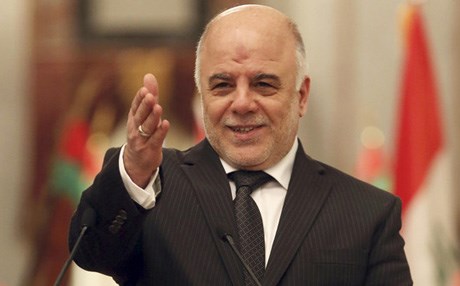
ERBIL, Kurdistan Region - Iraqi Prime Minister Haider al-Abadi has forced at least 300 Iraqi military officers working under the Ministry of Defense to retire, the media office of the prime minister announced Monday.
The decision comes as part of Abadi’s recent attempts to reform the composition of the Iraqi army in an attempt to improve the army’s performance and further strengthen national security. “A restructuring plan is needed for Iraqi forces to enhance their abilities to confront threats facing Iraqis,” the media office said in a Monday statement.
No further details were given about the positions and military ranks of the retired officers.
Abadi's move came hours before he headed to Washington on an official visit reportedly to seek U.S. help to fight the so-called Islamic State.
Since taking office last August, Abadi has retired, reorganized, and repositioned hundreds of military officers and commanders in the Iraqi military. The army under the leadership of former Prime Minister Nouri al-Maliki has been widely criticized for its complete breakdown and retreat from Islamic State forces in Mosul in June 2014.
The loss of Mosul, Iraq’s second largest city, was a total calamity for the Iraqi army, which saw two of its divisions—around 30,000 soldiers—completely crumble, throw off their uniforms and abandon equipment to an ISIS force that different sources estimate to have been composed of only 800-1,500 militants.
The Iraqi army’s collapse at Mosul came after the U.S. had already spent $26 billion in rebuilding, training and equipping the new Iraqi army as of 2012 following the American-led invasion to topple former Iraqi President Saddam Hussein in 2003. The $26 billion figure is according to a 2013 report by the U.S. Special Investigator General for Iraq Reconstruction (SIGIR).
The decision comes as part of Abadi’s recent attempts to reform the composition of the Iraqi army in an attempt to improve the army’s performance and further strengthen national security. “A restructuring plan is needed for Iraqi forces to enhance their abilities to confront threats facing Iraqis,” the media office said in a Monday statement.
No further details were given about the positions and military ranks of the retired officers.
Abadi's move came hours before he headed to Washington on an official visit reportedly to seek U.S. help to fight the so-called Islamic State.
Since taking office last August, Abadi has retired, reorganized, and repositioned hundreds of military officers and commanders in the Iraqi military. The army under the leadership of former Prime Minister Nouri al-Maliki has been widely criticized for its complete breakdown and retreat from Islamic State forces in Mosul in June 2014.
The loss of Mosul, Iraq’s second largest city, was a total calamity for the Iraqi army, which saw two of its divisions—around 30,000 soldiers—completely crumble, throw off their uniforms and abandon equipment to an ISIS force that different sources estimate to have been composed of only 800-1,500 militants.
The Iraqi army’s collapse at Mosul came after the U.S. had already spent $26 billion in rebuilding, training and equipping the new Iraqi army as of 2012 following the American-led invasion to topple former Iraqi President Saddam Hussein in 2003. The $26 billion figure is according to a 2013 report by the U.S. Special Investigator General for Iraq Reconstruction (SIGIR).
Comments
Rudaw moderates all comments submitted on our website. We welcome comments which are relevant to the article and encourage further discussion about the issues that matter to you. We also welcome constructive criticism about Rudaw.
To be approved for publication, however, your comments must meet our community guidelines.
We will not tolerate the following: profanity, threats, personal attacks, vulgarity, abuse (such as sexism, racism, homophobia or xenophobia), or commercial or personal promotion.
Comments that do not meet our guidelines will be rejected. Comments are not edited – they are either approved or rejected.
Post a comment